Xiaojun CuiThis email address is being protected from spambots. You need JavaScript enabled to view it.
School of Business, Zhengzhou College of Finance and Economics, Zhengzhou 450000 China
Received: December 18, 2025 Accepted: February 9, 2026 Publication Date: February 26, 2026
Copyright The Author(s). This is an open access article distributed under the terms of the Creative Commons Attribution License (CC BY 4.0), which permits unrestricted use, distribution, and reproduction in any medium, provided the original author and source are cited.
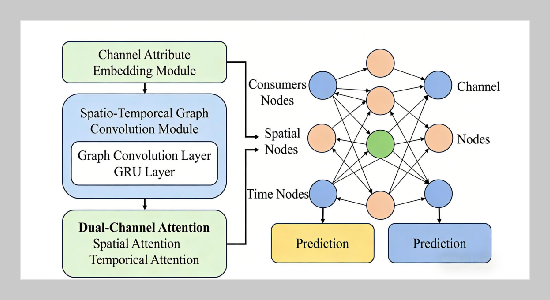
With the integration of online and offline retail channels, consumers’ consumption behavior has shown obvious cross-channel characteristics, and accurately predicting consumer cross-channel consumption paths has become a key issue for retailers to optimize marketing strategies and improve user experience. Existing prediction methods often ignore the spatio-temporal correlation of consumer behavior and the heterogeneity of channel attributes, leading to insufficient prediction accuracy. To solve this problem, this paper proposes a Consumer Cross-Channel Consumption Path Prediction model based on Spatio-Temporal Graph Convolutional Network (ST-GCN-CCPP). First, we construct a spatio-temporal graph structure that integrates consumer nodes, channel nodes and time nodes, in which the spatial correlation is characterized by the geographical distance between offline channels and the interaction frequency between consumers and channels, and the temporal correlation is represented by the time interval of consumer consecutive consumption behaviors. Second, a dual-channel attention mechanism is designed to adaptively adjust the weights of spatial and temporal features, and the channel attribute embedding module is introduced to model the heterogeneity of different channels (such as online e-commerce, offline physical stores, and social commerce). Finally, the graph convolution layer and gated recurrent unit (GRU) are combined to capture the deep spatio-temporal dependencies in the consumption path. Experimental results based on two real datasets (Retail Dataset and E-commerce Dataset) show that the proposed ST-GCN-CCPP model outperforms traditional methods (such as Markov Chain, LSTM) and existing graph neural network models (such as GCN, ST-GCN) in terms of prediction accuracy, precision, recall and F1-score. Specifically, compared with the best baseline model, the F1-score of ST-GCN-CCPP is improved by 8.3% and 6.7% on the two datasets respectively. This study provides a new technical framework for consumer cross-channel consumption path prediction and has important theoretical value and practical significance for retail enterprise marketing decision-making.
[1] K. Chen, S. Zhao, G. Jiang, Y. He, and H. Li, (2025) “The Green Innovation Effect of the Digital Economy" International Review of Economics and Finance 99: DOI: 10.1016/j.iref.2025.103970.
[2] P. Gao, J. Chen, X. Che, F. Liu, Y. Lu, Y. Guan, and J. He, (2025) “Attention-Driven Deep Neural Networks with Cross-Channel Temporal Modeling for Robust Cybersecurity Situational Awareness" IEEE Transactions on Information Forensics and Security 20: DOI: 10.1109/TIFS.2025.3618380.
[3] S. Heitz-Spahn, (2013) “Cross-channel free-riding consumer behavior in a multichannel environment: An investigation of shopping motives, socio demographics and product categories" Journal of retailing and consumer services 20(6): 570–578. DOI: 10.1016/j.jretconser.2013.07.006.
[4] H.-C. Chiu, Y.-C. Hsieh, J. Roan, K.-J. Tseng, and J.-K. Hsieh, (2011) “The challenge for multichannel services: Cross-channel free-riding behavior" Electronic Commerce Research and Applications 10(2): 268–277. DOI: 10.1016/j.elerap.2010.07.002.
[5] S. Shu, J. Wang, and Z. Chen, (2025) “Unraveling the dark threads: exploring the impact of cross-channel cognitive overload on consumers’ behaviors in multichannel re tailing" Internet Research: 1–20. DOI: 10.1108/INTR 06-2024-0933.
[6] Y.-H. Fang and C.-Y. Li, (2025) “Avoiding customer cross-channel behavior in omnichannel retailing: An un certainty reduction theory perspective" Electronic Markets 35(1): 49. DOI: 10.1007/s12525-025-00794-8.
[7] J. Wang, (2025) “The impact of consumers’ cross-channel experiencing behavior on omnichannel integration based on game-theoretic analysis" Humanities and Social Sciences Communications 12(1): 1–14. DOI: 10.1057/ s41599-025-05270-4.
[8] K. Chen, Q. Zhang, and S. Wang, (2025) “Online coupon and offline service efforts in omnichannel retailing with cross-channel effect" Omega: 103423. DOI: 10.1016/j.omega.2025.103423.
[9] X. Wang, H. Dou, D. Dong, and Z. Meng, (2025) “Graph anomaly detection based on hybrid node representation learning" Neural Networks 185: 107169. DOI: 10.1016/j.neunet.2025.107169.
[10] X. Zhang, J. Liu, X. Zhang, and Y. Lu, (2025) “Self supervised graph feature enhancement and scale attention for mechanical signal node-level representation and diagnosis" Advanced Engineering Informatics 65: 103197. DOI: 10.1016/j.aei.2025.103197.
[11] U. Kilic, O. O. Karadag, and G. T. Ozyer, (2025) “AGMS-GCN: Attention-guided multi-scale graph convolutional networks for skeleton-based action recognition" Knowledge-Based Systems 311: 113045. DOI: 10.1016/j.knosys.2025.113045.
[12] Z. Jin, Z. Wu, J. Zhao, D. He, and Y. Zhuang, (2025) “Graph Convolutional Neural Network Algorithms for Bearing Remaining Useful Life Prediction: A Review" Journal of Failure Analysis and Prevention: 1–17. DOI: 10.1007/s11668-025-02194-8.
[13] S. Chatterjee, (2025) “Spectral gap of nonreversible Markov chains" The Annals of Applied Probability 35(4): 2644–2677. DOI: 10.1214/25-AAP2183.
[14] Z. ZhuandB.Xue. “Prediction of Consumers’ Characteristics in Multichannel Selection Based on Hid den Markov Model: Taking Malaysian Consumers as an Example”. In: 2024 International Conference on Advances in Electrical Engineering and Computer Applications (AEECA). IEEE. 2024, 732–737. DOI: 10.1109/AEECA62331.2024.00129.
[15] C. Ling, T. Zhang, and Y. Chen, (2019) “Customer purchase intent prediction under online multi-channel promotion: A feature-combined deep learning framework" IEEE Access 7: 112963–112976. DOI: 10.1109/ACCESS. 2019.2935121.
[16] R. Qi. “Interpretable Slow-Moving Inventory Fore casting: A Hybrid Neural Network Approach with Interactive Visualization”. In: Proceedings of the 2025 International Conference on Generative Artificial Intelligence for Business. 2025, 41–46. DOI: 10.1145/3766918.3766925.
[17] N.C. Vallurupalli and K. Vijayakumar. “Graph Data Science Application in Omni-Channel”. In: 2024 Inter national Conference on Innovative Computing, Intelligent Communication and Smart Electrical Systems (ICSES). IEEE. 2024, 1–6. DOI: 10.1109/ICSES63760.2024. 10910338.
[18] J.Shin, A. S. M.Miah, R.Egawa, K.Hirooka, M.A.M. Hasan, Y. Tomioka, and Y. S. Hwang, (2025) “Fall recognition using a three stream spatiotemporal GCN model with adaptive feature aggregation" Scientific Re ports 15(1): 10635. DOI: 10.1038/s41598-025-95508-7.
We use cookies on this website to personalize content to improve your user experience and analyze our traffic. By using this site you agree to its use of cookies.