Yanping SongThis email address is being protected from spambots. You need JavaScript enabled to view it.
School of Business, Zhengzhou College of Finance and Economics, Zhengzhou 450000 China
Received: December 18, 2025 Accepted: January 26, 2026 Publication Date: February 26, 2026
Copyright The Author(s). This is an open access article distributed under the terms of the Creative Commons Attribution License (CC BY 4.0), which permits unrestricted use, distribution, and reproduction in any medium, provided the original author and source are cited.
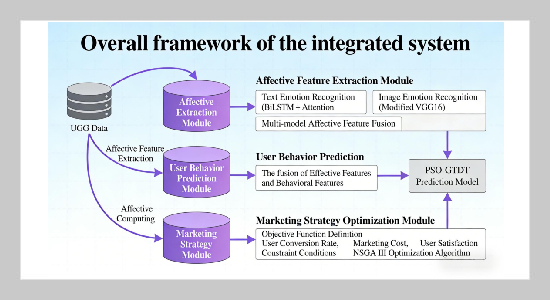
With the rapid development of social media, user-generated content (UGC) has become a valuable source for understanding user preferences and behaviors. However, traditional user behavior analysis methods mainly focus on behavioral data while ignoring the affective information contained in UGC, which limits the accuracy of marketing strategy formulation. To address this issue, this paper proposes an integrated framework of social media user behavior analysis and marketing strategy optimization based on affective computing. First, an affective feature extraction model combining bidirectional long short-term memory (BiLSTM) and attention mechanism is constructed to extract emotional features from text, image, and video UGC. Second, a user behavior prediction model is established by fusing affective features and behavioral features, which adopts a gradient boosting decision tree (GBDT) optimized by particle swarm optimization (PSO) to predict user purchase intention and interaction willingness. Third, a marketing strategy optimization model based on multi-objective optimization is proposed, taking user conversion rate, marketing cost, and user satisfaction as objectives. Experimental results on three real datasets show that the proposed affective feature extraction model achieves an F1-score of 0.892,0.875, and 0.881 for text, image, and video emotion recognition, respectively, which is 5.3%−8.7% higher than traditional models. The user behavior prediction model outperforms comparison models in terms of accuracy ( 0.863 ) and AUC ( 0.897 ). Subjective evaluation by 50 marketing experts shows that the optimized marketing strategy improves user acceptance by 32.6% and marketing ROI by 28.3% compared with traditional strategies. This study provides a new theoretical and technical support for social media marketing decision-making.
Keywords: Affective computing; Social media; User behavior analysis; Marketing strategy optimization; BiLSTM; Multi-objective optimization
[1] A. Abid, S. K. Roy, J. Lees-Marshment, B. L. Dey, S. S. Muhammad, and S. Kumar, (2025) “Political social media marketing: a systematic literature review and agenda for future research" Electronic Commerce Research 25(2): 741–776. DOI: 10.1007/s10660-022 09636-7.
[2] S. Yin, H. Li, A. A. Laghari, L. Teng, T. R. Gadekallu, and A. Almadhor, (2024) “FLSN-MVO: edge computing and privacy protection based on federated learning Siamese network with multi-verse optimization algorithm for industry 5.0" IEEE Open Journal of the Communications Society 6: 3443–3458. DOI: 10.1109/OJCOMS.2024.3520562.
[3] M. Schlicher, Y. Li, S. M. K. Murthy, Q. Sun, and B. W. Schuller, (2025) “Emotionally adaptive support: a narrative review of affective computing for mental health" Frontiers in Digital Health 7: 1657031. DOI: 10.3389/fdgth.2025.1657031.
[4] X. Zhang, T. Zhang, L. Sun, J. Zhao, and Q. Jin, (2025) “Exploring interpretability in deep learning for affective computing: a comprehensive review" ACM Transactions on Multimedia Computing, Communications and Applications 21(7): 1–28. DOI: 10.1145/3723005.
[5] M. M. Thiruthuvana than and B. Krishnan, (2025) “Multitask Efficient Net affective computing for student engagement detection" Multimedia Tools and Applications 84(18): 19039–19063. DOI: 10.1007/s11042-024-19815-3.
[6] J. Chen, J. Guo, Q. Zhang, K. Wu, L. Zhang, V. C. Leung, H. Wang, and Z. Gong, (2025) “Unveiling user interests: A deep user interest exploration network for sequential location recommendation" Information Sciences 689: 121416. DOI: 10.1016/j.ins.2024.121416.
[7] X. Lin, Z. Cheng, L. Yun, Q. Lu, and Y. Luo. “Enhanced recommendation combining collaborative filtering and large language models”. In: Proceedings of the 2025 2nd International Conference on Informatics Education and Computer Technology Applications. 2025, 40–45. DOI: 10.1145/3732801.3732809.
[8] A. Talebi, S. P. Haeri Boroujeni, and A. Razi, (2025) “Integrating random regret minimization-based discrete choice models with mixed integer linear programming for revenue optimization" Iran Journal of Computer Science 8(1): 21–35. DOI: 10.1007/s42044-024-00193-w.
[9] W. Zhang, B. Zheng, J. Chen, and Z. Wang. “Multi Dimensional Quality Assessment for UGC Videos via Modular Multi-Modal Vision-Language Mod els”. In: Proceedings of the Computer Vision and Pattern Recognition Conference. 2025, 1548–1557. DOI: 10.1109/CVPRW67362.2025.00144.
[10] H. Cui, F. Cao, and R. Liu, (2025) “A multi-objective partitioning algorithm for large-scale graph based on NSGA-II" Expert Systems with Applications 263: 125756. DOI: 10.1016/j.eswa.2024.125756.
[11] S. Anakal, P. Lakshmi, N. Fofaria, J. V. N. Ramesh, E. Muniyandy, S. Sanjeera, Y. A. B. El-Ebiary, and R. Patel, (2025) “Optimizing Social Media Marketing Strategies Through Sentiment Analysis and Firefly Algo rithm Techniques" International Journal of Advanced Computer Science & Applications 16(2): DOI: 10. 14569/IJACSA.2025.01602112.
[12] T. Ruan, Q. Liu, and Y. Chang, (2025) “Digital media recommendation system design based on user behavior analysis and emotional feature extraction "PLoS One 20(5): e0322768. DOI: 10.1371/journal.pone.0322768.
[13] M. D. R. Roshan andS. Loganayagi. “Classification of Fraud Websites using Linear regression Algorithm and Recurrent Neural Network Algorithm with Improved Accuracy”. In: 2024 International Conference on Recent Innovation in Smart and Sustainable Tech nology (ICRISST). IEEE. 2024, 1–5. DOI: 10.1109/ICRISST59181.2024.10922003.
[14] P. Alipour, E. E. Gallegos, and S. Sridhar, (2025) “AI driven marketing personalization: Deploying convolutional neural networks to decode consumer behavior" International Journal of Human–Computer Interaction 41(16): 10266–10284. DOI: 10.1080/10447318.2024.2432455.
[15] T. Krabokoukis, (2025) “Bridging neuromarketing and data analytics in tourism: An adaptive digital marketing framework for hotels and destinations" Tourism and Hospitality 6(1): 12. DOI: 10.3390/tourhosp6010012.
We use cookies on this website to personalize content to improve your user experience and analyze our traffic. By using this site you agree to its use of cookies.