Xinli WangThis email address is being protected from spambots. You need JavaScript enabled to view it.
Department of Public Basic, Zhengzhou Medical College, Zhengzhou, 452385 China
Received: January 7, 2026 Accepted: February 13, 2026 Publication Date: February 26, 2026
Copyright The Author(s). This is an open access article distributed under the terms of the Creative Commons Attribution License (CC BY 4.0), which permits unrestricted use, distribution, and reproduction in any medium, provided the original author and source are cited.
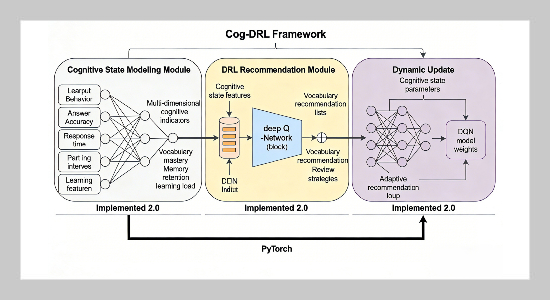
English vocabulary acquisition is a core bottleneck in second language learning, and personalized recommendation systems have become a key tool to optimize learning efficiency. However, existing systems rarely dynamically model learners’ cognitive states (e.g., vocabulary proficiency, memory decay, and learning load) or adapt to real-time changes in learning processes. To address this gap, this study proposes a personalized English vocabulary learning recommendation system based on deep reinforcement learning (DRL), which integrates a dynamic cognitive state modeling framework. First, we construct a multi-dimensional cognitive state evaluation index system, including vocabulary mastery, memory retention, and learning fatigue, and design a quantitative model to characterize cognitive state evolution using forgetting curve theory. Second, we propose a DRL-based recommendation framework (Cog-DRL) that embeds cognitive state features into the state space, designs action strategies oriented to vocabulary difficulty and review frequency, and optimizes the reward function by balancing immediate learning effects and long-term memory consolidation. Finally, extensive experiments are conducted on two datasets (a public vocabulary learning dataset and a self-collected dataset of 520 learners) to compare Cog-DRL with traditional recommendation methods and vanilla DRL models. Experimental results show that the proposed system outperforms baseline models in terms of recommendation accuracy (NDCG@10 improved by 12.3%−21.7% ), vocabulary mastery rate (improved by 15.6% on average), and learning efficiency (time cost reduced by 18.2% ). This study provides a new paradigm for integrating cognitive science into intelligent language learning systems, offering theoretical support and practical solutions for personalized vocabulary education.
Keywords: DeepReinforcement Learning; Personalized Recommendation; Cognitive State Modeling; English Vocabulary Learning; Forgetting Curve; Intelligent Learning System
[1] M. Orosoo, N. Raash, M. Treve, H. F. M. Lahza, N. Alshammry, J. V. N. Ramesh, and M. Rengarajan, (2025) “Transforming English language learning: Advanced speech recognition with MLP-LSTM for personalized education" Alexandria Engineering Journal 111: 21–32. DOI: 10.1016/j.aej.2024.10.065.
[2] M. Morady Moghaddam, F. Esmaeilpour, and F. Ranjbaran, (2025) “Insights into mobile assisted language learning research in Iran: A decade review (2010 2023)" Education and Information Technologies 30(2): 2155–2181. DOI: 10.1007/s10639-024-12879-6.
[3] Z. Zolfaghari, Z. Karimian, N. Zarifsanaiey, and A. Y. Farahmandi, (2025) “A scoping review of gamified ap plications in English language teaching: a comparative discussion with medical education" BMC Medical Edu cation 25(1): 274. DOI: 10.1186/s12909-025-06822-7.
[4] M.YarAhmadiandH.KargarBehbahani,(2025)“The effect of interventionist dynamic assessment on Iranian EFL learners’ vocabulary learning and retention: a socio cultural inquiry" Language Testing in Asia 15(1): 2. DOI: 10.1186/s40468-024-00337-6.
[5] S. Alam, (2025) “Measuring the Effects of Mobile and Social Networking Technology on the Enhancement of English Language Skills: A Comparative Study." International Journal of Interactive Mobile Technologies 19(1): DOI: 10.3991/ijim.v19i01.51427.
[6] S. Sharma, K. Baishya, M. Pandey, and S. S. Rautaray. “Hybrid Product Recommendation System using Popularity Based and Content-Based Filtering”. In: 2023 International Conference on Data Science, Agents & Artificial Intelligence (ICDSAAI). IEEE. 2023, 1–8. DOI: 10.1109/ICDSAAI59313.2023.10452564.
[7] X. Shi, Y. Zhang, A. Pujahari, and S. K. Mishra, (2025) “When latent features meet side information: A preference relation based graph neural network for collaborative filtering" Expert Systems with Applications 260: 125423. DOI: 10.1016/j.eswa.2024.125423.
[8] L.Teng,H.Li,andY.Si,(2025)“NeuralTensor Network And Adaptive Graph Convolution For Sports" Journal of Applied Science and Engineering 29(6): 1483–1491. DOI: 10.6180/jase.202606_29(6).0015.
[9] S. Yin, L. Wang, T. Chen, H. Huang, J. Gao, J. Zhang, M. Liu, P. Li, and C. Xu, (2025) “LKAFormer: A lightweight kolmogorov-arnold transformer model for image semantic segmentation" ACM Transactions on Intelligent Systems and Technology: DOI: 10.1145/ 375925.
[10] X. Wang, J. Liu, C. Nugent, I. Cleland, and Y. Xu, (2023) “Mobile agent path planning under uncertain environment using reinforcement learning and probabilistic model checking" Knowledge-based systems 264: 110355. DOI: 10.1016/j.knosys.2023.110355.
[11] B. Wang, D. Tu, and J. Wang. “Enhancing System Performance in VEC Systems with DRL-Based Actor Critic Algorithms”. In: 2025 IEEE International Symposium on Broadband Multimedia Systems and Broad casting (BMSB). IEEE. 2025, 1–7. DOI: 10.1109/BMSB65076.2025.11165728.
[12] Y. Huang, B. Fu, Y. Lai, and Y. Yao. “Design and Implementation of Memory Assistant Based on Ebbing haus Forgetting Curve”. In: IOP Conference Series: Earth and Environmental Science. 687. 1. IOP Publish ing. 2021, 012187. DOI: 10.1088/1755-1315/687/1/012187.
[13] T. Coughlan, F. Goshtasbpour, T. Mwoma, M. Makoe, F. Aubrey-Smith, and N. Tanglang, (2023) “Decision making in shifts to online teaching: Analysing reflective narratives from staff working in African higher educational institutions" Trends in Higher Education 2(1): 123–139. DOI: 10.3390/higheredu2010008.
[14] X. Zhou, G. Han, G. Zhou, Y. Xue, M. Lv, and A. Chen, (2025) “Hybrid DQN-Based Low-Computational Reinforcement Learning Object Detection With Adaptive Dynamic Reward Function and ROI Align-Based Bounding Box Regression" IEEE Transactions on Image Processing 34: 1712–1725. DOI: 10.1109/TIP.2025.3541564.
[15] N. Darraz, I. Karabila, A. El-Ansari, N. Alami, and M. El Mallahi, (2025) “Enhancing recommendation systems with collaborative filtering and sentiment analysis: dimensionality reduction for improved content-based approaches" Knowledge and Information Systems: 1–35. DOI: 10.1007/s10115-025-02452-z.
[16] W.Huang, (2026) “Personalized recommendation of english learning resources based on collaborative filtering algorithm in english teaching scenarios" Discover Artificial Intelligence 6: DOI: 10.1007/s44163-025-00638-6.
[17] Y.E.Gür,M.To˘gaçar,andB.Solak,(2025)“Integration of CNN models and machine learning methods in credit score classification: 2D image transformation and feature extraction" Computational Economics 65(5): 2991 3035. DOI: 10.1007/s10614-025-10893-5.
[18] P. I. Jaffe, R. A. Poldrack, R. J. Schafer, and P. G. Bis sett, (2023) “Modelling human behaviour in cognitive tasks with latent dynamical systems" Nature Human Behaviour 7(6): 986–1000. DOI: 10.1038/s41562-022-01510-8.
[19] Q. El Maazouzi and A. Retbi, (2025) “Multimodal detection of emotional and cognitive states in e-learning through deep fusion of visual and textual data with NLP" Computers 14(8): 314. DOI: 10.3390/computers14080314.
We use cookies on this website to personalize content to improve your user experience and analyze our traffic. By using this site you agree to its use of cookies.