




Received: April 08, 2024
Accepted: May 07, 2024
Publication Date: April 3, 2026
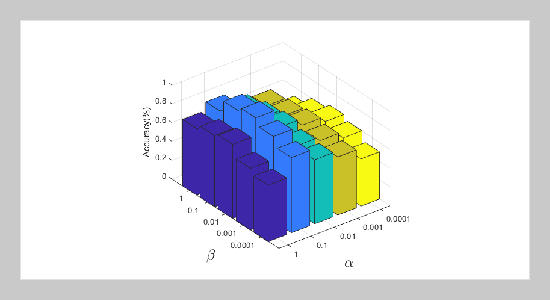
The sensitivity analysis of parameters α and β about Accuracy and Recall in TP-VIB.
Copyright The Author(s). This is an open access article distributed under the terms of the Creative Commons Attribution License (CC BY 4.0), which permits unrestricted use, distribution, and reproduction in any medium, provided the original author and source are cited.
Download Citation: BibTeX | http://dx.doi.org/10.6180/jase.202504_28(4).0003
Turnover prediction of employees has become a key focus for human resource specialists, as it is broadly viewed as a vital measure of an organization’s competitive edge. To this end, a new deep variational information bottleneck network based turnover prediction method is proposed for human resource management (TP-VIB). Specifically, The information bottleneck is utilized to model the turnover prediction task, and then variational inference method is used to obtain lower bound of the IB for optimizing representation learning and pattern mining networks within the deep framework. Furthermore, a entropy regularization term is designed to balance positive and negative class imbalances in employee turnover datasets. Finally, the experiment results demonstrate that TP-VIB sets a new baseline method for employee turnover prediction tasks.
Keywords: Turnover prediction; information bottleneck; deep framework
- [1] R. J. Stone, A. Cox, M. Gavin, and J. Carpini. Human resource management. 2024.
- [2] P. Li, J. Gao, J. Zhang, S. Jin, and Z. Chen, (2022) “Deep Reinforcement Clustering” IEEE Transactions on Multimedia: DOI: 10.1109/TMM.2022.3233249.
- [3] S. Yuan, B. Kroon, and A. Kramer, (2024) “Building prediction models with grouped data: A case study on the prediction of turnover intention” Human Resource Management Journal 34(1): 20–38.
- [4] J. Gao, M. Liu, P. Li, J. Zhang, and Z. Chen, (2023) “Deep Multiview Adaptive Clustering With Semantic Invariance” IEEE Transactions on Neural Networks and Learning Systems: DOI: 10.1109/TNNLS.2023.3265699.
- [5] P. Li, Z. Chen, L. T. Yang, J. Gao, Q. Zhang, and M. J. Deen, (2018) “An incremental deep convolutional computation model for feature learning on industrial big data” IEEE Transactions on Industrial Informatics 15(3): 1341–1349. DOI: 10.1109/TII.2018.2871084.
- [6] C. S. Lim, E. F. Malik, K. W. Khaw, A. Alnoor, X. Chew, Z. L. Chong, and M. Al Akasheh, (2024) “Hybrid GA DeepAutoencoder–KNN Model for Employee Turnover Prediction” Statistics, Optimization & Information Computing 12(1): 75–90. DOI: 10.19139/soic2310-5070-1799.
- [7] J. Park, Y. Feng, and S.-P. Jeong, (2024) “Developing an advanced prediction model for new employee turnover intention utilizing machine learning techniques” Scientific Reports 14(1): 1221. DOI: 10.1038/s41598-023-50593-4.
- [8] J. Park, Y. Feng, and S.-P. Jeong, (2024) “Developing an advanced prediction model for new employee turnover intention utilizing machine learning techniques” Scientific Reports 14(1): 1221. DOI: 10.1038/s41598-023-50593-4.
- [9] Q. Zhu, J. Shang, X. Cai, L. Jiang, F. Liu, and B. Qiang. “CoxRF: Employee turnover prediction based on survival analysis”. In: IEEE SmartWorld, Ubiquitous Intelligence & Computing, Advanced & Trusted Computing, Scalable Computing & Communications, Cloud & Big Data Computing, Internet of People and Smart City Innovation. 2019, 1123–1130.
- [10] Z. Jin, J. Shang, Q. Zhu, C. Ling, W. Xie, and B. Qiang. “RFRSF: Employee turnover prediction based on random forests and survival analysis”. In: Web Information Systems Engineering–WISE 2020: 21st International Conference, Amsterdam, The Netherlands, October 20–24, 2020, Proceedings, Part II 21. 2020, 503–515.
- [11] S. Abdelsalam, P. A. Agius, R. Sacks-Davis, A. Roxburgh, M. Livingston, L. Maher, M. Hickman, and P. Dietze, (2024) “Characteristics of attrition within the SuperMIX cohort of people who inject drugs: A multiple event discrete-time survival analysis”: DOI: 10.21203/rs.3.rs-3922479/v1.
- [12] I. G. Kang, B. Croft, and B. A. Bichelmeyer, (2021) “Predictors of turnover intention in US federal government workforce: Machine learning evidence that perceived comprehensive HR practices predict turnover intention” Public Personnel Management 50(4): 538–558. DOI: 10.1177/0091026020977562.
- [13] V. Nagadevara and V. Srinivasan, (2008) “Early prediction of employee attrition in software companiesapplication of data mining techniques” Research and Practice in Human Resource Management 16: 2020–2032.
- [14] N. El-Rayes, M. Fang, M. Smith, and S. M. Taylor, (2020) “Predicting employee attrition using tree-based models” International Journal of Organizational Analysis 28(6): 1273–1291. DOI: 10.1108/IJOA-10-2019-1903.
- [15] F. Alsubaie and M. Aldoukhi, (2024) “Using machine learning algorithms with improved accuracy to analyze and predict employee attrition” Decision Science Letters 13(1): 1–18. DOI: 10.5267/j.dsl.2023.12.006.
- [16] X. Cai, J. Shang, Z. Jin, F. Liu, B. Qiang, W. Xie, and L. Zhao, (2020) “DBGE: employee turnover prediction based on dynamic bipartite graph embedding” IEEE Access 8: 10390–10402. DOI: 10.1109/ACCESS.2020.2965544.
- [17] J. Park, S. Kwon, and S.-P. Jeong, (2023) “A study on improving turnover intention forecasting by solving imbalanced data problems: focusing on SMOTE and generative adversarial networks” Journal of Big Data 10(1): 36.
- [18] Y. Liu, L. Zhang, L. Nie, Y. Yan, and D. Rosenblum. “Fortune teller: predicting your career path”. In: Proceedings of the AAAI conference on artificial intelligence. 30. 1. 2016.
- [19] F. Guerranti and G. M. Dimitri, (2022) “A comparison of machine learning approaches for predicting employee attrition” Applied Sciences 13(1): 267. DOI: 10.3390/app13010267.
- [20] J. Gao, M. Liu, P. Li, A. A. Laghari, A. R. Javed, N. Victor, and T. R. Gadekallu, (2023) “Deep Incomplete Multi-View Clustering Via Information Bottleneck for Pattern Mining of Data in Extreme-Environment IoT” IEEE Internet of Things Journal: DOI: 10.1109/JIOT.2023.3325272.
- [21] B. Perozzi, R. Al-Rfou, and S. Skiena. “Deepwalk: Online learning of social representations”. In: Proceedings of the 20th ACM SIGKDD international conference on Knowledge discovery and data mining. 2014, 701–710. DOI: 10.1145/2623330.2623732.
- [22] Y. Chang, E. Tanin, X. Cao, and J. Qi. “Spatial Structure-Aware Road Network Embedding via Graph Contrastive Learning.” In: EDBT. 2023, 144–156.