





Yejun He1, Lei Shi2, and Zhongren Chen1
1School of mechanical and electrical engineering, Zhongshan Polytechnics, Zhongshan 528400, Guangdong, China
2Huangpu Wenchong Shipbuilding Co., Ltd.,CSSC, Guangzhou 510000, Guangdong, China
Received: June 26, 2023
Accepted: April 18, 2024
Publication Date: April 3, 2026
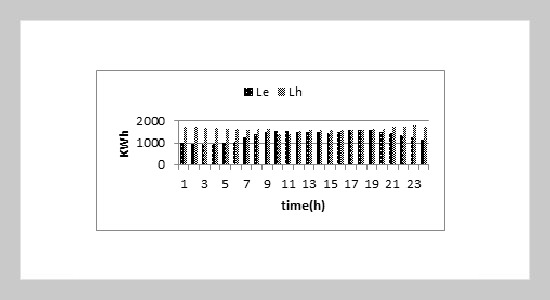
profiles of the thermal/electrical loads in MCMG
Copyright The Author(s). This is an open access article distributed under the terms of the Creative Commons Attribution License (CC BY 4.0), which permits unrestricted use, distribution, and reproduction in any medium, provided the original author and source are cited.
Download Citation: BibTeX | http://dx.doi.org/10.6180/jase.202504_28(4).0017
A microgrid is a smaller-scale power system that helps integrate distributed energy generation and maximize demand-side management utilization. This article analyzes the economic dispatch of a typical multi-carrier microgrid with price-responsive loads in an uncertain environment. Integrating multiple energy infrastructures under the multi-carrier microgrid is shown as an energy hub. This paper proposes a novel price-responsive load that integrates the final price of energy of demanded loads for multiple carriers with energy market price, site generations, and energy purchase. Also, the proposed price-responsive method is analyzed on two different DRP models to verify the model’s effectiveness. The proposed multi-carrier microgrid is investigated considering the uncertainties in thermal and electrical loads, solar generations, and the electricity market. Previous investigations have optimized energy consumption from an infrastructure perspective without considering interactions. However, this study takes into account the interaction between energy system infrastructures in the presence of distributed energy generation and responsive loads. A series of simulations are conducted using GAMS to develop a model for a connected microgrid that incorporates electricity, district heat networks, and natural gas to supply multiple energy demands. Results show that the simultaneous operation of different energy carriers and utilization of price-responsive loads resulted in lower operating costs for smart distribution grids. Finally, the impact of uncertain parameters was assessed in the system, enhancing the optimal solution’s trustworthiness.
Keywords: Economic dispatch; Demand response; Small-scale energy resources, multi-carrier microgrid.
- [1] M. Azimian, V. Amir, R. Habibifar, and H. Golmohamadi, (2021) “Probabilistic optimization of networked multi-carrier microgrids to enhance resilience leveraging demand response programs” Sustainability 13: 5792. DOI: 10.3390/su13115792.
- [2] N. Saito, T. Niimura, K. Koyanagi, and R. Yokoyama. “Trade-off analysis of autonomous microgrid sizing with PV, diesel, and battery storage”. In: IEEE, 2009, 1–6. DOI: 10.1109/PES.2009.5275820.
- [3] A. Joseph and M. Shahidehpour. “Battery storage systems in electric power systems”. In: IEEE, 2006, 8–pp. DOI: 10.1109/pes.2006.1709235.
- [4] H. Lotfi and A. Khodaei. “An efficient preprocessing approach for uncertainty consideration in microgrids”. In: IEEE, 2016, 1–5. DOI: 10.1109/TDC.2016.7520003.
- [5] S. Bourbour. “Development of a Self-Healing strategy for future smart microgrids”. (phdthesis). Murdoch University, 2016.
- [6] T. Krause, G. Andersson, K. Fröhlich, and A. Vaccaro, (2010) “Multiple-energy carriers: modeling of production, delivery, and consumption” Proceedings of the IEEE 99: 15–27. DOI: 10.1109/JPROC.2010.2083610.
- [7] M. Geidl and G. Andersson, (2007) “Optimal power flow of multiple energy carriers” IEEE Transactions on power systems 22: 145–155. DOI: 10.1109/TPWRS.2006.888988.
- [8] C. A. Saldarriaga, R. A. Hincapié, and H. Salazar, (2013) “A holistic approach for planning natural gas and electricity distribution networks” IEEE transactions on
power systems 28: 4052–4063. DOI: 10.1109/TPWRS.2013.2268859. - [9] Q. P. Zheng, S. Rebennack, N. A. Iliadis, and P. M. Pardalos, (2010) “Optimization models in the natural gas industry” Handbook of Power Systems I: 121–148.
- [10] K. Ravi, (2016) “Optimal power flow considering intermittent wind power using particle swarm optimization” International Journal of Renewable Energy Research (IJRER) 6: 504–509.
- [11] S. Sreejith, I. Gandhi, D. Samiappan, and M. Muruganandam, (2016) “Security constraint unit commitment on combined solar thermal generating units using ABC algorithm” International Journal of Renewable Energy Research (IJRER) 6: 1361–1372.
- [12] Q. P. Zheng, J. Wang, and A. L. Liu, (2014) “Stochastic optimization for unit commitment—A review” IEEE Transactions on Power Systems 30: 1913–1924.
- [13] F. Adamek, M. Arnold, and G. Andersson, (2013) “On decisive storage parameters for minimizing energy supply costs in multicarrier energy systems” IEEE Transactions on Sustainable Energy 5: 102–109.
- [14] S. D. Manshadi and M. E. Khodayar, (2015) “Resilient operation of multiple energy carrier microgrids” IEEE Transactions on Smart Grid 6: 2283–2292.
- [15] N. Cai, N. T. T. Nga, and J. Mitra. “Economic dispatch in microgrids using multi-agent system”. In: IEEE, 2012, 1–5.
- [16] M. Motevasel and A. R. Seifi, (2014) “Expert energy management of a micro-grid considering wind energy uncertainty” Energy Conversion and Management
83: 58–72. - [17] N. Nikmehr and S. N. Ravadanegh, (2015) “Optimal power dispatch of multi-microgrids at future smart distribution grids” IEEE transactions on smart grid 6:
1648–1657. - [18] I. A. Sajjad, G. Chicco, and R. Napoli, (2015) “Probabilistic generation of time-coupled aggregate residential demand patterns” IET Generation, Transmission & Distribution 9: 789–797.
- [19] L. Uy, P. Uy, J. Siy, A. S. F. Chiu, and C. Sy, (2018) “Target-oriented robust optimization of a microgrid system investment model” Frontiers in Energy 12: 440–455.
- [20] J. L. R. Duarte and N. Fan, (2019) “Operations of a microgrid with renewable energy integration and line switching” Energy Systems 10: 247–272.
- [21] R. Urooj and S. S. Ahmad, (2017) “Assessment of electricity demand at domestic level in Balochistan, Pakistan” Advances in Energy Research 5: 57.
- [22] B. Heymann, J. F. Bonnans, P. Martinon, F. J. Silva, F. Lanas, and G. Jiménez-Estévez, (2018) “Continuous optimal control approaches to microgrid energy management” Energy Systems 9: 59–77.
- [23] S. S. Reddy, J. Y. Park, and C. M. Jung, (2016) “Optimal operation of microgrid using hybrid differential evolution and harmony search algorithm” Frontiers in Energy 10: 355–362.
- [24] Q. Zhang, B. C. Mclellan, T. Tezuka, and K. N. Ishihara, (2012) “Economic and environmental analysis of power generation expansion in Japan considering Fukushima nuclear accident using a multi-objective optimization model” Energy 44: 986–995.
- [25] D. Zhang, L. Ma, P. Liu, L. Zhang, and Z. Li, (2012) “A multi-period superstructure optimisation model for the optimal planning of China’s power sector considering carbon dioxide mitigation: discussion on China’s carbon mitigation policy based on the model” Energy policy 41: 173–183.
- [26] D. Zhang, P. Liu, L. Ma, Z. Li, and W. Ni, (2012) “A multi-period modelling and optimization approach to the planning of China’s power sector with consideration of carbon dioxide mitigation” Computers & Chemical Engineering 37: 227–247.
- [27] A. Zakariazadeh, S. Jadid, and P. Siano, (2014) “Multiobjective scheduling of electric vehicles in smart distribution system” Energy Conversion and Management 79: 43–53.
- [28] B. Zhao, X. Zhang, J. Chen, C. Wang, and L. Guo, (2013) “Operation optimization of standalone microgrids considering lifetime characteristics of battery energy storage system” IEEE transactions on sustainable energy 4: 934–943.
- [29] I. Koutsopoulos and L. Tassiulas, (2011) “Challenges in demand load control for the smart grid” Ieee Network 25: 16–21.
- [30] C. Chen, S. Duan, T. Cai, B. Liu, and G. Hu, (2011) “Smart energy management system for optimal microgrid economic operation” IET renewable power generation 5: 258–267.
- [31] S. L. Arun and M. P. Selvan, (2019) “Smart residential energy management system for demand response in buildings with energy storage devices” Frontiers in Energy 13: 715–730.
- [32] D. Neves, A. Pina, and C. A. Silva, (2018) “Comparison of different demand response optimization goals on an isolated microgrid” Sustainable Energy Technologies and Assessments 30: 209–215.
- [33] V. K. Prajapati and V. Mahajan, (2022) “Demand response based congestion management of power system with uncertain renewable resources” International Journal of Ambient Energy 43: 103–116.
- [34] M. Jin, W. Feng, P. Liu, C. Marnay, and C. Spanos, (2017) “MOD-DR: Microgrid optimal dispatch with demand response” Applied energy 187: 758–776. DOI:
10.1016/j.apenergy.2016.11.093. - [35] M. H. Albadi and E. F. El-Saadany, (2008) “A summary of demand response in electricity markets” Electric power systems research 78: 1989–1996. DOI: 10.1016/j.epsr.2008.04.002.
- [36] S. Pazouki and M.-R. Haghifam, (2016) “Optimal planning and scheduling of energy hub in presence of wind, storage and demand response under uncertainty” International Journal of Electrical Power & Energy Systems 80: 219–239. DOI: 10.1007/s12667-017-0236-x.
- [37] M. Fisher, J. Apt, and F. Sowell, (2018) “The economics of commercial demand response for spinning reserve” Energy Systems 9: 3–23. DOI: 10.1007/s12667-017-0236-x.
- [38] A. Mirzapour-Kamanaj, A. Talebi, K. Zare, and B. Mohammadi-Ivatloo. Optimal energy management of residential buildings to supply controllable and uncontrollable loads under uncertainty. Springer, 2022, 77–101. DOI: 10.1007/978-3-031-08732-5_5.
- [39] B. M. Azar, A. Mirzapour-Kamanaj, R. Kazemzadeh, B. Mohammadi-Ivatloo, and K. Zare. Optimal coalition operation of interconnected hybrid energy systems containing local energy conversion technologies, renewable energy resources, and energy storage systems. Springer, 2022, 169–198. DOI: 10.1007/978-3-030-87653-1_7.
- [40] M. Agabalaye-Rahvar, A. Mirzapour-Kamanaj, K. Zare, and A. Anvari-Moghaddam. Hybrid IntervalStochastic Optimal Operation Framework of a Multicarrier Microgrid in the Presence of Hybrid Electric and Hydrogen-Based Vehicles Intelligent Parking Lot. Springer, 2023, 209–236. DOI: 10.1007/978-3-031-22186-6_8.
- [41] A. Mansour-Saatloo, M. A. Mirzaei, B. MohammadiIvatloo, and K. Zare, (2020) “A risk-averse hybrid approach for optimal participation of power-to-hydrogen technology-based multi-energy microgrid in multi-energy markets” Sustainable Cities and Society 63: 102421. DOI: 10.1016/j.scs.2020.102421.
- [42] A. Mansour-Saatloo, M. Agabalaye-Rahvar, M. A. Mirzaei, B. Mohammadi-Ivatloo, M. Abapour, and K. Zare, (2020) “Robust scheduling of hydrogen based
smart micro energy hub with integrated demand response” Journal of Cleaner Production 267: 122041. DOI: 10.1016/j.jclepro.2020.122041. - [43] A. Najafi, M. Marzband, B. Mohamadi-Ivatloo, J. Contreras, M. Pourakbari-Kasmaei, M. Lehtonen, and R. Godina, (2019) “Uncertainty-based models for optimal management of energy hubs considering demand response” Energies 12: 1413. DOI: 10.3390/en12081413.
- [44] S. Bahramirad, W. Reder, and A. Khodaei, (2012) “Reliability-constrained optimal sizing of energy storage system in a microgrid” IEEE Transactions on Smart
Grid 3: 2056–2062. - [45] A. Sheikhi, M. Rayati, S. Bahrami, and A. M. Ranjbar, (2015) “Integrated demand side management game in smart energy hubs” IEEE Transactions on Smart Grid 6: 675–683. DOI: 10.1109/TSG.2014.2377020.