





Ming-Yi Liu, An-Pei Wang and Hsing-Wei Tseng
Department of Civil Engineering, Chung Yuan Christian University, Taoyuan, Taiwan 320, R.O.C.
Received: February 22, 2016
Accepted: June 27, 2016
Publication Date: August 02, 2026
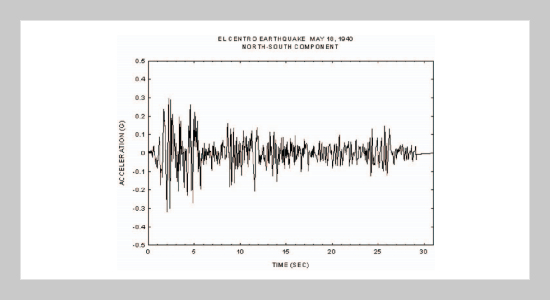
North-south component of the El Centro earthquake accelerogram[1].
Copyright The Author(s). This is an open access article distributed under the terms of the Creative Commons Attribution License (CC BY 4.0), which permits unrestricted use, distribution, and reproduction in any medium, provided the original author and source are cited.
Download Citation: BibTeX | http://dx.doi.org/10.6180/jase.2016.19.4.07
The objective of this paper is to investigate the dynamic characteristics of two adjacent building structures interconnected by viscous dampers under seismic excitations. The computational procedure for an analytical model including the system model formulation, complex modal analysis and seismic time history analysis is presented for this purpose. A numerical example is also provided to illustrate the analytical model. The complex modal analysis is conducted to determine the optimal damping ratio and the optimal damper coefficient of the linear viscous damper for each mode of the system. For the damper coefficient with optimal value, the responses can be categorized into underdamped and critically damped vibrations. The seismic time history analysis is conducted to assess the effectiveness of the linear viscous damper for vibration control. Based on the optimal damping ratio and the optimal damper coefficient of the linear viscous damper for a certain mode of the system, compared to the peak responses, the linear viscous damper can be used to more effectively suppress the root-mean-square responses of the two adjacent buildings.
Keywords: Adjacent Building Structure, Viscous Damper, Complex Modal Analysis, Seismic Time History Analysis
- [1] Chopra, A. K., Dynamics of Structures: Theory and Applications to Earthquake Engineering, Third Edition, Pearson Prentice Hall, Upper Saddle River, NJ, pp. 246–251 (2007).
- [2] Xu, Y. L., He, Q. and Ko, J. M., “Dynamic Response of Damper-Connected Adjacent Buildings under Earthquake Excitation,” Engineering Structures, Vol. 21, No. 2, pp. 135–148 (1999). doi: 10.1016/S0141-0296(97)00154-5
- [3] Zhang, W. S. and Xu, Y. L., “Dynamic Characteristics and Seismic Response of Adjacent Buildings Linked by Discrete Dampers,” Earthquake Engineering and Structural Dynamics, Vol. 28, No. 10, pp. 1163–1185 (1999). doi: 10.1002/(SICI)1096-9845(199910)28:10<1163::AID-EQE860>3.0.CO;2-0
- [4] Xu, Y. L. and Zhang, W. S., “Closed-Form Solution for Seismic Response of Adjacent Buildings with Linear Quadratic Gaussian Controllers,” Earthquake Engineering and Structural Dynamics, Vol. 31, No. 2, pp. 235–259 (2002). doi: 10.1002/eqe.107
- [5] Craig Jr., R. R. and Kurdila, A. J., Fundamentals of Structural Dynamics, Second Edition, John Wiley & Sons, Hoboken, NJ, pp. 307–316 (2006).