




Zhibin Fang1, Shaobin Zhang1, Jiamei Cheng2, and Shaoming Li2
1Department of Sports Work, Hebei Agricultural University, Hebei 071000, Hebei, China
2College of Science and Technology, Hebei Agricultural University, Huanghua 061100, Hebei, China
Received: February 4, 2024
Accepted: April 16, 2024
Publication Date: April 3, 2026
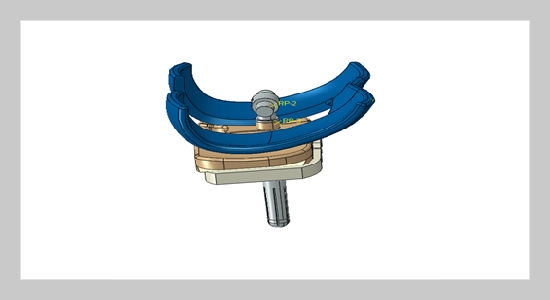
3D model of the femoral part of the knee prosthesis of the case
Copyright The Author(s). This is an open access article distributed under the terms of the Creative Commons Attribution License (CC BY 4.0), which permits unrestricted use, distribution, and reproduction in any medium, provided the original author and source are cited.
Download Citation: BibTeX | http://dx.doi.org/10.6180/jase.202504_28(4).0001
In this study, we investigated the mechanical behavior of a knee replacement prosthesis (TKR) manufactured by the Zimmer company. To facilitate our analysis, we initially utilized a coordinate measuring device, specifically a contact 3D scanner, to prepare a cloud-of-point model of the prosthesis. This scanning process allowed us to accurately capture the geometry and dimensions of the TKR, providing a detailed representation of its physical structure. By utilizing this advanced scanning technology, we ensured that our subsequent simulations and analyses were based on precise and reliable data, enabling a thorough examination of the mechanical performance of the knee replacement prosthesis. ABAQUS software was then used to analyze the threedimensional model and nonlinear static analysis was performed on the model. This simulation examined the mechanical performance of the prosthesis for different weight ranges, and the distribution of stress, strain, and displacement within the prosthesis was analyzed. The results show that the maximum stress created in the investigated prosthesis increases from 16MPa to 64MPa per weight of 55 kg to 75 kg. Although, with a 26% increase in the weight of the individual using a knee prosthesis, the maximum stress created in the prosthesis increases by 76%. This type of prosthesis is suitable for the maximum weight category of 80 kg, as it has a reliability coefficient of 3. In light of these results, it is clear that weight categories must be taken into account when considering a particular prosthesis. Otherwise, the prosthesis may be destroyed due to the application of larger forces during various everyday situations and result in serious knee injuries.
Keywords: knee prosthesis, knee joint, finite element analysis, ABAQUS software, stress distribution
- [1] S. Kumar and S. Bhowmik, (2022) “Potential use of natural fiber-reinforced polymer biocomposites in knee prostheses: A review on fair inclusion in amputees” Iranian Polymer Journal 31: 1297–1319.
- [2] Y. Sun, H. Tang, Y. Tang, J. Zheng, D. Dong, X. Chen, F. Liu, L. Bai, W. Ge, and L. Xin, (2021) “Review of recent progress in robotic knee prosthesis related techniques: Structure, actuation and control” Journal of Bionic Engineering 18: 764–785.
- [3] R. Fluit, E. C. Prinsen, S. Wang, and H. V. D. Kooij, (2019) “A comparison of control strategies in commercial and research knee prostheses” IEEE transactions on biomedical engineering 67: 277–290.
- [4] V. Kanaujia, A. Gupta, D. K. Sharma, S. Verma, and R. K. Yadav, (2020) “Study of effectiveness of lateral wedge insole on medial compartment of osteoarthritis of knee treated with viscosupplementation” Indian Journal of Pain 34: 106–111.
- [5] E. Esfandiari, M. A. Sanjari, A. A. Jamshidi, M. Kamyab, and H. R. Yazdi, (2020) “Gait initiation and lateral wedge insole for individuals with early knee osteoarthritis” Clinical Biomechanics 80: 105163.
- [6] M. Mannisi, A. Dell’Isola, M. S. Andersen, and J. Woodburn, (2019) “Effect of lateral wedged insoles on the knee internal contact forces in medial knee osteoarthritis” Gait & posture 68: 443–448.
- [7] K. A. Marriott and T. B. Birmingham, (2023) “Fundamentals of Osteoarthritis. Rehabilitation: exercise, diet, biomechanics, and physical therapist-delivered interventions” Osteoarthritis and Cartilage:
- [8] L. Shu, N. Abe, S. Li, and N. Sugita, (2022) “Importance of posterior tibial slope in joint kinematics with an anterior cruciate ligament-deficient knee” Bone & Joint Research 11: 739–750.
- [9] A. Grassi, G. D. Fabbro, S. D. Paolo, F. Stefanelli, L. Macchiarola, G. A. Lucidi, and S. Zaffagnini, (2019) “Medial and lateral meniscus have a different role in kinematics of the ACL-deficient knee: a systematic review” Journal of ISAKOS 4: 233–241.
- [10] D. Wang, R. N. K. III, M. J. Amirtharaj, B. M. Hardy, D. H. Nawabi, T. L. Wickiewicz, A. D. Pearle, and C. W. Imhauser, (2019) “Tibiofemoral kinematics during compressive loading of the ACL-intact and ACL-sectioned knee: roles of tibial slope, medial eminence volume, and anterior laxity” JBJS 101: 1085–1092.
- [11] T. De la Mora Ramirez, M. Doñu Ruiz, I. Hilerio Cruz, N. López Perrusquia, and E. García Bustos, (2019) “Topological and Contact Force Analysis of a Knee Tumor Prosthesis” Engineering Design Applications: 291–304.
- [12] N. Conlisk, C. R. Howie, and P. Pankaj, (2016) “An efficient method to capture the impact of total knee replacement on a variety of simulated patient types: A finite element study” Medical Engineering & Physics 38: 959–968.
- [13] A. Navacchia, P. J. Rullkoetter, P. Schütz, R. B. List, C. K. Fitzpatrick, and K. B. Shelburne, (2016) “Subjectspecific modeling of muscle force and knee contact in total knee arthroplasty” Journal of Orthopaedic Research 34: 1576–1587.
- [14] O.-R. Kwon, K.-T. Kang, J. Son, D.-S. Suh, C. Baek, and Y.-G. Koh, (2017) “Importance of joint line preservation in unicompartmental knee arthroplasty: finite element analysis” Journal of Orthopaedic Research 35: 347–352.
- [15] K.-T. Kang, J. Son, O.-R. Kwon, and Y.-G. Koh, (2017) “Malpositioning of prosthesis: patient-specific total knee arthroplasty versus standard off-the-shelf total knee arthroplasty” JAAOS Global Research & Reviews 1: e020.
- [16] C. Belvedere, A. Leardini, F. Catani, S. Pianigiani, and B. Innocenti, (2017) “In vivo kinematics of knee replacement during daily living activities: condylar and postcam contact assessment by three-dimensional fluoroscopy and finite element analyses” Journal of orthopaedic research 35: 1396–1403.
- [17] L. Li, L. Yang, K. Zhang, L. Zhu, X. Wang, and Q. Jiang, (2020) “Three-dimensional finite-element analysis of aggravating medial meniscus tears on knee osteoarthritis” Journal of orthopaedic translation 20: 47–55.
- [18] K. Thienkarochanakul, A. A. Javadi, M. Akrami, J. R. Charnley, and A. Benattayallah, (2020) “Stress distribution of the tibiofemoral joint in a healthy versus osteoarthritis knee model using image-based threedimensional finite element analysis” Journal of Medical and Biological Engineering 40: 409–418.
- [19] M. Nikkhoo, K. Hassani, A. T. Golpaygani, and A. Karimi, (2020) “Biomechanical role of posterior cruciate ligament in total knee arthroplasty: a finite element analysis” Computer Methods and Programs in Biomedicine 183: 105109.
- [20] M. A. Kumbhalkar, U. Nawghare, R. Ghode, Y. Deshmukh, and B. Armarkar, (2013) “Modeling and finite element analysis of knee prosthesis with and without implant” Universal Journal of Computational Mathematics 1: 56–66.
- [21] J. Esmaeili, K. Andalibi, O. Gencel, F. K. Maleki, and V. A. Maleki, (2021) “Pull-out and bond-slip performance of steel fibers with various ends shapes embedded in polymer-modified concrete” Construction and Building Materials 271: 121531.
- [22] E. Altas, F. Khosravi, H. Gokkaya, V. A. Maleki, Y. Akınay, O. Ozdemir, O. Bayraktar, and H. Kandas, (2022) “Finite element simulation and experimental investigation on the effect of temperature on pseudoelastic behavior of perforated Ni–Ti shape memory alloy strips” Smart Materials and Structures 31: 025031.
- [23] M. H. Alizadeh, M. Ajri, and V. A. Maleki, (2023) “Mechanical properties prediction of ductile iron with spherical graphite using multi-scale finite element model” Physica Scripta 98: 125270.
- [24] J. Esmaeili, K. Andalibi, and O. Gencel, (2021) “Mechanical characteristics of experimental multi-scale steel fiber reinforced polymer concrete and optimization by Taguchi methods” Construction and Building Materials 313: 125500.
- [25] J. Esmaeili and K. Andalibi, (2019) “Development of 3D Meso-Scale finite element model to study the mechanical behavior of steel microfiber-reinforced polymer concrete” Computers and Concrete, An International Journal 24: 413–422.