




Guangbo Xiang1, Angang Cao1, Peifang Xin1, and Yilong Hao2
1College of Mechanical Engineering, Zhengzhou University of Science and Technology, Zhengzhou 450064 China
2SAIC Power Technology (Zhengzhou) Co., Ltd, Zhengzhou 450000 China
Received: September 10, 2026
Accepted: September 28, 2026
Publication Date: October 17, 2026
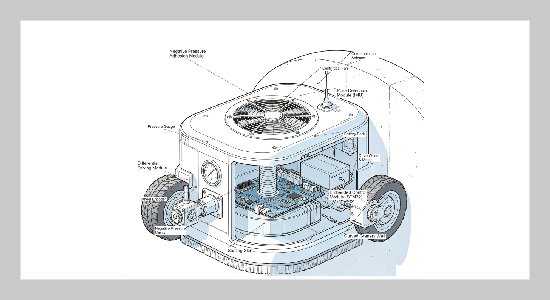
Overall structure of the negative pressure adhesion wall-climbing robot
Copyright The Author(s). This is an open access article distributed under the terms of the Creative Commons Attribution License (CC BY 4.0), which permits unrestricted use, distribution, and reproduction in any medium, provided the original author and source are cited.
Download Citation: BibTeX | http://dx.doi.org/10.6180/jase.202701_36.029
Granary curved wall environments feature variable curvature, surface roughness interference, and time-varying negative pressure adhesion disturbances, which easily cause trajectory deviation, chattering phenomenon, and poor robustness in the trajectory tracking process of traditional wall-climbing robots. To solve the above problems, this paper proposes an adaptive sliding mode control (ASMC) strategy with dynamic disturbance compensation and improved reaching law for the trajectory tracking of negative pressure adhesion wall-climbing robots operating on granary curved walls. Firstly, a kinematic and dynamic model of the robot adapting to curved wall deformation is established, fully considering the coupling characteristics of negative pressure adhesion fluctuation, curved surface curvature variation, and external environmental disturbances. Secondly, an improved exponential reaching law with adaptive boundary layer adjustment is designed to suppress the inherent chattering of traditional sliding mode control (SMC). Meanwhile, a parameter adaptive update law is constructed based on Lyapunov stability theory to dynamically estimate and compensate unknown lumped disturbances including wall friction, adhesion attenuation, and curvature-induced pose deviation, eliminating the dependence on accurate system model parameters. Furthermore, a hierarchical control framework combining trajectory planning layer and dynamic tracking control layer is proposed to realize high-precision and stable tracking of complex curved trajectories of granary walls. Comparative simulation and physical prototype experiments are conducted on typical granary arc wall surfaces with different curvatures and disturbance intensities. The results show that the proposed ASMC strategy reduces the maximum trajectory tracking error by 42.6% and the average error by 38.9% compared with traditional SMC, and effectively suppresses control chattering. The robot maintains stable tracking performance under variable curvature and time-varying disturbance conditions, verifying the superior robustness and adaptability of the proposed method for granary curved wall operation scenarios.
Keywords: Wall-climbing robot; Negative pressure adhesion; Curved wall trajectory tracking; Adaptive sliding mode control; Granary operation; Disturbance compensation
- [1] C. Xie, S. Ren, H. Ouyang, C. Wang, D. Bonilla, and X. Liao, (2026) “A Federated Visual Intelligence Framework for Sustainable Safety Governance in Grain Warehouse Infrastructure” Sustainability 18(17): 8932. DOI: https://doi.org/10.3390/su18178932.
- [2] H. Wang, J. Liu, L. Yang, K. Liu, S. Niu, and Y. Wang, (2026) “Numerical Study of Temperature Fields and Control Methods for Improving the Grain Storage Safety of Semi-Underground Granaries” Materials 19(15): 3357. DOI: https://doi.org/10.3390/ma19153357.
- [3] J. Devi and A. Singhrova, (2026) “Efficient Monitoring Framework for Spoilage Prediction in Wheat Grain Warehouse” IEEE Transactions on AgriFood Electronics. DOI: https://doi.org/10.1109/TAFE.2026.3685969.
- [4] Y. Luo, D. Li, J. Chen, Y. Zhu, Y. Ma, J. Lin, K. Hu, S. Lan, Y. Li, W. Hu, et al., (2026) “AI-driven technologies for pest monitoring, unsound kernel detection, and intelligent aeration in grain storage” International Journal of Agricultural and Biological Engineering 19(1): 1-10. DOI: https://doi.org/10.25165/j.ijabe.20261901.10322.
- [5] Z. Zhiwen, C. Yan, Y. Xilong, Q. Guanpeng, C. Weihua, and D. Shiyu, (2026) “A Case Study on Grain Storage in Underground Granaries with Different Lining Materials” Applied Food Research: 102045. DOI: https://doi.org/10.1016/j.afres.2026.102045.
- [6] X. Li, H. Guo, Y. Lu, S. Wuyun, S. Zhu, Y. Xu, and W. Wu, (2026) “Physics-guided spatiotemporal graph transformer for explainable detection and risk forecasting of mold and condensation in grain storage” Computers and Electronics in Agriculture 245: 111565. DOI: https://doi.org/10.1016/j.compag.2026.111565.
- [7] X. Wang, R. Mohd-Mokhtar, and X. Zhong, (2026) “A Comprehensive Review of Wall-Climbing Robots: Environmental Adaptation, Adhesion Mechanism, and Motion Control” Journal of Field Robotics. DOI: https://doi.org/10.1002/rob.70309.
- [8] Z. Sisi, S. Hongsen, C. Sichen, H. Xing, Z. Chun, T. Gangqiang, W. Jue, and W. Yanjie, (2026) “A Comprehensive Review on Adsorption-Locomotion Codesign of Wall-Climbing Robots for Complex Surface Operations” Journal of Field Robotics. DOI: https://doi.org/10.1002/rob.70293.
- [9] R. Jiao, L. Chen, X. Luhan, L. Hu, H. Zhu, M. Zhang, C. Zhang, M. Li, H. Li, and J. Zhang, (2026) “RWTCbot: A New Wall-Climbing Robot Capable of Wall-to-Wall Transitions at Internal and External Right Angles in All Scenarios” IEEE Robotics and Automation Letters 11(7): 8744-8751. DOI: https://doi.org/10.1109/LRA.2026.3699199.
- [10] Z. Wang, Z. Weng, P. Zhang, W. Jiang, N. Deng, and Z. Wang, (2026) “Pneumatic-Cable-Hybrid-Driven Multi-Mechanism End Effector and Cross-Surface Validation” Biomimetics 11(2): 140. DOI: https://doi.org/10.3390/biomimetics11020140.
- [11] N. Gao, Z. Yang, Q. Teng, S. Liu, and L. Tian, (2026) “Enhancing selective adsorption of magnetite by core-shell magnetic depressants: An experimental and mechanistic study” Minerals Engineering 236: 109943. DOI: https://doi.org/10.1016/j.jenvman.2025.128364.
- [12] P. Zhao, Q. Song, Y. Bi, J. Dong, Z. Fu, Y. Huang, and Y. Zheng, (2026) “Interaction mechanisms of seed suction and cleaning negative pressure of an air-suction seed metering device for maize breeding plots” Biosystems Engineering 262: 104368. DOI: https://doi.org/10.1016/j.biosystemseng.2025.104368.
- [13] D. Zhang, X. Xu, J. Feng, W. Zhou, Z. Ma, and S. Fu, (2026) “Natural Leaf-Inspired Bionic Fabric with Self-Driven Water Sorption/Desorption Capacity for Stable Spectral and Transpiration Simulation” Advanced Fiber Materials: 1-15. DOI: https://doi.org/10.1007/s42765-026-00689-z.
- [14] Y. Li, X. Zhuang, Z. Li, R. Wang, and X. Xiong, (2024) “The mechanical properties of the interface between concrete-epoxy mortar: Splitting tensile vs. direct shear testing” Construction and Building Materials 422: 135809. DOI: https://doi.org/10.1016/j.conbuildmat.2024.135809.
- [15] S.-Y. Guo, X. Zhang, J.-Z. Chen, B. Mou, H.-S. Shang, P. Wang, L. Zhang, and J. Ren, (2020) “Mechanical and interface bonding properties of epoxy resin reinforced Portland cement repairing mortar” Construction and Building Materials 264: 120715. DOI: https://doi.org/10.1016/j.conbuildmat.2020.120715.
- [16] L. Cai, Q. Liu, and R. Guo, (2021) “Study on the shear behavior of RC beams strengthened by CFRP grid with epoxy mortar” Composite Structures 275: 114419. DOI: https://doi.org/10.1016/j.compstruct.2021.114419.
- [17] L. Zhang, H. Ding, J. Shi, Y. Huang, H. Chen, K. Guo, and Q. Li, (2020) “An adaptive backstepping sliding mode controller to improve vehicle maneuverability and stability via torque vectoring control” IEEE Transactions on Vehicular Technology 69(3): 2598-2612. DOI: https://doi.org/10.1109/TVT.2019.2950219.
- [18] J. Fei and H. Ding, (2012) “Adaptive sliding mode control of dynamic system using RBF neural network” Nonlinear Dynamics 70(2): 1563-1573. DOI: https://doi.org/10.1007/s11071-012-0556-2.
- [19] Y. Wang, T. Sun, and J. Yang, (2022) “Super-twisting nonsingular terminal sliding mode-based robust impedance control of robots” Complexity 2022(1): 9263699. DOI: https://doi.org/10.1155/2022/9263699.
- [20] H. Al Jlailaty, A. Celik, M. M. Mansour, and A. M. Eltawil, (2023) “IMU hand calibration for low-cost MEMS inertial sensors” IEEE Transactions on Instrumentation and Measurement 72: 1-16. DOI: https://doi.org/10.1109/TIM.2023.3301860.