




Songru Yang, Ruicheng Zhang, Qianda Luo*, and Yuehua Zhao
College of Electrical Engineering, North China University of Science and Technology, Tangshan 063210, China
Received: July 31, 2026
Accepted: September 14, 2026
Publication Date: October 09, 2026
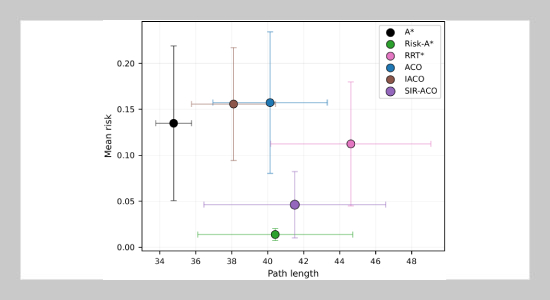
Length–risk trade-off for the cross-algorithm comparison. Points closer to the lower-left region indicate shorter and safer paths
Copyright The Author(s). This is an open access article distributed under the terms of the Creative Commons Attribution License (CC BY 4.0), which permits unrestricted use, distribution, and reproduction in any medium, provided the original author and source are cited.
Download Citation: BibTeX | http://dx.doi.org/10.6180/jase.202701_36.018
Collision-free routing is not necessarily safe for unmanned aerial vehicles operating near spatially distributed hazards, because a geometrically short path may accumulate excessive exposure. This paper studies static fixed-altitude UAV path planning in known environments with non-blocking soft risks. An SIR-inspired risk-field-guided ant colony optimization framework, termed SIR-ACO, is proposed. A deterministic influence propagation surrogate based on susceptible-infected-removed states transforms sparse risk sources into a continuous horizontal risk field; the field is then coupled with ACO through path evaluation, transition guidance, and pheromone regulation. Experiments in three representative environments with 30 independent runs show that SIR-ACO reduces mean risk exposure by 64.2%, 74.1%, and 68.9% relative to basic ACO, and additional 40×40 random-map tests show the same exposure-reduction trend against stochastic ACO baselines. Incremental component analysis identifies SIR-inspired risk-field evaluation as the primary source of exposure reduction, while mass-matched distance-decay and risk-weight-sweep comparisons show that the proposed representation changes the spatial safety-efficiency trade-off beyond merely adding a continuous distance penalty. Comparisons with A*, Risk-A*, and RRT* are included as deterministic and stochastic references. The results support SIR-ACO as a safety-enhanced ACO framework for static global planning, while also showing that it is not a universal replacement for deterministic graph search when a fixed risk cost is directly available.
Keywords: Fixed-altitude UAV; Path planning; Ant colony optimization; Risk field; SIR model; Swarm intelligence
- [1] S. Aggarwal and N. Kumar, (2020) “Path planning techniques for unmanned aerial vehicles: A review, solutions, and challenges” Computer Communications 149: 270-299. DOI: https://doi.org/10.1016/j.comcom.2019.10.014.
- [2] J. Luo, Y. Tian, and Z. Wang, (2024) “Research on unmanned aerial vehicle path planning” Drones 8(2): 51. DOI: https://doi.org/10.3390/drones8020051.
- [3] M. Rahman, N. I. Sarkar, and R. Lutui, (2025) “A Survey on Multi-UAV Path Planning: Classification, Algorithms, Open Research Problems, and Future Directions” Drones 9(4): 263. DOI: https://doi.org/10.3390/drones9040263.
- [4] D. Debnath, F. Vanegas, J. Sandino, A. F. Hawary, and F. Gonzalez, (2024) “A Review of UAV Path-Planning Algorithms and Obstacle Avoidance Methods for Remote Sensing Applications” Remote Sensing 16(21): 4019. DOI: https://doi.org/10.3390/rs16214019.
- [5] D. Alaa, K. Abdelmadjid, and L. Fadhila, (2025) “Intelligent path planning algorithms for UAVs: Classification, complexity analysis, hybrid ablation insights, and future directions” Advances in Mechanical Engineering 17(7): 16878132251355020. DOI: https://doi.org/10.1177/16878132251355020.
- [6] Y. Jiang, X.-X. Xu, M.-Y. Zheng, and Z.-H. Zhan, (2024) “Evolutionary computation for unmanned aerial vehicle path planning: a survey” Artificial Intelligence Review 57(10): 267. DOI: https://doi.org/10.1007/s10462-024-10913-0.
- [7] S. Alshammrei, S. Boubaker, and L. Kolsi, (2022) “Improved Dijkstra algorithm for mobile robot path planning and obstacle avoidance” Computers, Materials & Continua 72(3): 5939-5954. DOI: https://doi.org/10.32604/cmc.2022.028165.
- [8] G. Tang, C. Tang, C. Claramunt, X. Hu, and P. Zhou, (2021) “Geometric A-star algorithm: An improved A-star algorithm for AGV path planning in a port environment” IEEE access 9: 59196-59210. DOI: https://doi.org/10.1109/ACCESS.2021.3070054.
- [9] C. Li, X. Huang, J. Ding, K. Song, and S. Lu, (2022) “Global path planning based on a bidirectional alternating search A* algorithm for mobile robots” Computers & Industrial Engineering 168: 108123. DOI: https://doi.org/10.1016/j.cie.2022.108123.
- [10] R. Guo, X. Quan, and C. Bao, (2025) “Research on Mobile Robot Path Planning Based on an Improved Bidirectional Jump Point Search Algorithm” Electronics 14(8): 1669. DOI: https://doi.org/10.3390/electronics14081669.
- [11] J. Xiang, J. Xie, and J. Chen. “Learning-accelerated A* search for risk-aware path planning”. In: AIAA SCITECH 2024 Forum. 2024, 2895. DOI: https://doi.org/10.2514/6.2024-2895.
- [12] Y. He, T. Hou, and M. Wang, (2024) “A new method for unmanned aerial vehicle path planning in complex environments” Scientific Reports 14(1): 9257. DOI: https://doi.org/10.1038/s41598-024-60051-4.
- [13] L. Xu, M. Xi, R. Gao, Z. Ye, and Z. He, (2025) “Dynamic path planning of UAV with least inflection point based on adaptive neighborhood A* algorithm and multi-strategy fusion” Scientific Reports 15(1): 8563. DOI: https://doi.org/10.1038/s41598-025-92406-w.
- [14] W. Zhang, J. Li, W. Yu, P. Ding, J. Wang, and X. Zhang, (2024) “Algorithm for UAV path planning in high obstacle density environments: RFA-star” Frontiers in Plant Science 15: 1391628. DOI: https://doi.org/10.3389/fpls.2024.1391628.
- [15] J. Qi, H. Yang, and H. Sun, (2021) “MOD-RRT*: A sampling-based algorithm for robot path planning in dynamic environment” IEEE Transactions on Industrial Electronics 68(8): 7244-7251. DOI: https://doi.org/10.1109/TIE.2020.2998740.
- [16] J. Wang, J. Li, Y. Song, Y. Tuo, and C. Liu, (2024) “FC-RRT*: A modified RRT with rapid convergence in complex environments” Journal of Computational Science 77: 102239. DOI: https://doi.org/10.1016/j.jocs.2024.102239.
- [17] J. Wang, Z. Zhao, J. Qu, and X. Chen, (2024) “APPA-3D: an autonomous 3D path planning algorithm for UAVs in unknown complex environments” Scientific Reports 14(1): 1231. DOI: https://doi.org/10.1038/s41598-024-51286-2.
- [18] J. Deng, W. Wang, L. Wang, A. K. Bashir, T. R. Gadekallu, H. Feng, M. Lv, and K. Fang, (2025) “FID-SUS: Federated Intrusion Detection for Securing UAV Swarms in Smart Aerial Computing” IEEE Internet of Things Journal 12(9): 11312-11328. DOI: https://doi.org/10.1109/JIOT.2025.3549508.
- [19] M. Nazarahari, E. Khanmirza, and S. Doostie, (2019) “Multi-objective multi-robot path planning in continuous environment using an enhanced genetic algorithm” Expert Systems with Applications 115: 106-120. DOI: https://doi.org/10.1016/j.eswa.2018.08.008.
- [20] S. Lin, A. Liu, J. Wang, and X. Kong, (2023) “An intelligence-based hybrid PSO-SA for mobile robot path planning in warehouse” Journal of Computational Science 67: 101938. DOI: https://doi.org/10.1016/j.jocs.2022.101938.
- [21] S. Zhang and L. Wang, (2026) “Multi-UAV cooperative path planning based on chaotic grey wolf optimiser” The Aeronautical Journal 130(1345): 741-761. DOI: https://doi.org/10.1017/aer.2025.10101.
- [22] J. Feng, C. Sun, J. Zhang, Y. Du, Z. Liu, and Y. Ding, (2023) “A UAV path planning method in three-dimensional space based on a hybrid gray wolf optimization algorithm” Electronics 13(1): 68. DOI: https://doi.org/10.3390/electronics13010068.
- [23] F. Xu, H. Li, C.-M. Pun, H. Hu, Y. Li, Y. Song, and H. Gao, (2020) “A new global best guided artificial bee colony algorithm with application in robot path planning” Applied Soft Computing 88: 106037. DOI: https://doi.org/10.1016/j.asoc.2019.106037.
- [24] Y. Zhao, H. Feng, T. Wang, T. R. Gadekallu, K. Fang, and W. Wang. “Communication-Efficient Federated Learning for Post-Flood Risk Assessment Using UAV Swarms”. In: Proceedings of the ACM Web Conference 2026. Association for Computing Machinery, 2026, 8984-8994. DOI: https://doi.org/10.1145/3774904.3792983.
- [25] M. Dorigo, V. Maniezzo, and A. Colorni, (1996) “Ant system: optimization by a colony of cooperating agents” IEEE transactions on systems, man, and cybernetics, part b (cybernetics) 26(1): 29-41. DOI: https://doi.org/10.1109/3477.484436.
- [26] L. Wu, X. Huang, J. Cui, C. Liu, and W. Xiao, (2023) “Modified adaptive ant colony optimization algorithm and its application for solving path planning of mobile robot” Expert Systems with Applications 215: 119410. DOI: https://doi.org/10.1016/j.eswa.2022.119410.
- [27] S. Zhu, W. Zhu, X. Zhang, and T. Cao, (2020) “Path planning of lunar robot based on dynamic adaptive ant colony algorithm and obstacle avoidance” International Journal of Advanced Robotic Systems 17(3): 1729881419898979. DOI: https://doi.org/10.1177/1729881419898979.
- [28] G. Yi, Z. Feng, T. Mei, P. Li, W. Jin, and S. Chen, (2019) “Multi-AGVs path planning based on improved ant colony algorithm” The Journal of Supercomputing 75(9): 5898-5913. DOI: https://doi.org/10.1007/s11227-019-02884-9.
- [29] Y. Yu and S. Lee, (2023) “Efficient multi-UAV path planning for collaborative area search operations” Applied Sciences 13(15): 8728. DOI: https://doi.org/10.3390/app13158728.
- [30] F. H. Ajeil, I. K. Ibraheem, A. T. Azar, and A. J. Humaidi, (2020) “Grid-based mobile robot path planning using aging-based ant colony optimization algorithm in static and dynamic environments” Sensors 20(7): 1880. DOI: https://doi.org/10.3390/s20071880.
- [31] C. Liu, L. Wu, W. Xiao, G. Li, D. Xu, J. Guo, and W. Li, (2023) “An improved heuristic mechanism ant colony optimization algorithm for solving path planning” Knowledge-Based Systems 271: 110540. DOI: https://doi.org/10.1016/j.knosys.2023.110540.
- [32] Q. Li, Q. Li, and B. Cui, (2024) “Improved ant colony optimization algorithm based on islands type for mobile robot path planning” International Journal of Advanced Robotic Systems 21(5): 17298806241278170. DOI: https://doi.org/10.1177/17298806241278170.
- [33] Y. Lu and C. Da, (2025) “Global and local path planning of robots combining ACO and dynamic window algorithm” Scientific Reports 15(1): 9452. DOI: https://doi.org/10.1038/s41598-025-93571-8.
- [34] J. Ma, Q. Liu, Z. Yang, and B. Wang, (2025) “Improved Trimming Ant Colony Optimization Algorithm for Mobile Robot Path Planning” Algorithms 18(5): 240. DOI: https://doi.org/10.3390/a18050240.
- [35] Y. Wang, J. Liu, Y. Qian, and W. Yi, (2025) “Path Planning for Multi-UAV in a Complex Environment Based on Reinforcement-Learning-Driven Continuous Ant Colony Optimization” Drones 9(9): 638. DOI: https://doi.org/10.3390/drones9090638.
- [36] W. O. Kermack and A. G. McKendrick, (1927) “A contribution to the mathematical theory of epidemics” Proceedings of the Royal Society of London. Series A, Containing Papers of a Mathematical and Physical Character 115(772): 700-721. DOI: https://doi.org/10.1098/rspa.1927.0118.
- [37] M. Dorigo and L. M. Gambardella, (1997) “Ant colony system: A cooperative learning approach to the traveling salesman problem” IEEE Transactions on Evolutionary Computation 1(1): 53-66. DOI: https://doi.org/10.1109/4235.585892.
- [38] T. Stützle and H. H. Hoos, (2000) “MAX-MIN ant system” Future Generation Computer Systems 16(8): 889-914. DOI: https://doi.org/10.1016/S0167-739X(00)00043-1.