




School of Water Transport and Land Transpotation Engineering, Wuhan Technical College of Communications, Wuhan, Hubei Province, 430065, China
Received: May 09, 2026
Accepted: August 01, 2026
Publication Date: September 11, 2026
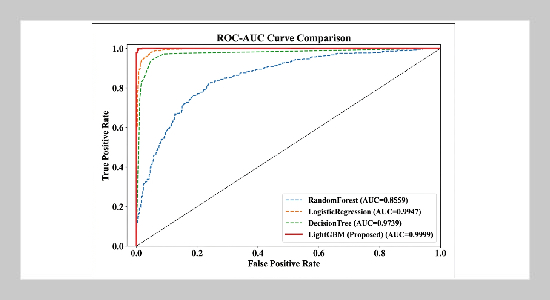
ROC-AUC Curve Comparison for Classifier Discrimination.
Copyright The Author(s). This is an open access article distributed under the terms of the Creative Commons Attribution License (CC BY 4.0), which permits unrestricted use, distribution, and reproduction in any medium, provided the original author and source are cited.
Download Citation: BibTeX | http://dx.doi.org/10.6180/jase.202612_35.028
Accurate road pavement condition monitoring plays an important role in safe driving and pavement maintenance; while traditional methods depend only on images or tables independently, which can reduce accuracy and decision-making capability. In this paper, a joint approach based on image-based distress detection and tabular data mining is proposed to promote the pavement maintenance prediction and ranking. By utilizing the YOLOv11 object detection model to detect various road distresses including potholes, cracks, manholes and so on, a high detection performance is achieved with a mean Average Precision (mAP)@0.5, precision, recall, F1-score and Intersection over Union (IoU) at 0.9681, 0.9520, 0.9147, 0.9330 and 0.9681 respectively. The detection-derived features: Pothole Count (PC), Crack Density (CD), and Severity Metrics (SM), are then fused with tabular data: Pavement Condition Index (PCI), Annual Average Daily Traffic (AADT), International Roughness Index (IRI) and rainfall to predict maintenance demands, using the Light Gradient Boosting Machine (LightGBM) model, the results achieved a high performance with accuracy, precision, recall, F1-score, and Receiver Operating Characteristic – Area Under the Curve (ROC-AUC) at 0.9914, 0.9962, 0.9867, 0.9914 and 0.9999 respectively. In the repair ranking module, road segments are prioritized according to prediction probability, damage severity and traffic conditions. Finally, the experiment has verified that multimodal feature fusion model could achieve higher accuracy and stronger robustness compared with tradition Random Forest (RF), Extreme Gradient Boost (XGBoost) and hybrid method.
Keywords: Pavement Maintenance; You Only Look Once version 11; Light Gradient Boosting Machine; Feature Fusion; Predictive Analytics; Repair Prioritization; Distress Identification.
- [1] A. Kadyraliev et al., (2022) “Investments in Transport Infrastructure as a Factor of Stimulation of Economic Development” Transportation Research Procedia 63: 1359-1369. DOI: 10.1016/j.trpro.2022.06.146.
- [2] A. Almeida and L. Picado-Santos, (2022) “Asphalt Road Pavements to Address Climate Change Challenges-An Overview” Applied Sciences 12(24): DOI: 10.3390/app122412515.
- [3] A. A. Angelo, K. Sasai, and K. Kaito, (2023) “Safety Integrated Network Level Pavement Maintenance Decision Support Framework as a Practical Solution in Developing Countries: The Case of Addis Ababa, Ethiopia” Sustainability 15(11): DOI: 10.3390/su15118884.
- [4] A. Azam, A. H. Alshehri, M. Alharthai, M. M. El-Banna, A. M. Yosri, and A. A. A. Beshr, (2023) “Applications of Terrestrial Laser Scanner in Detecting Pavement Surface Defects” Processes 11(5): DOI: 10.3390/pr11051370.
- [5] R. Bayat, S. Talatahari, A. H. Gandomi, M. Habibi, and B. Aminnejad, (2023) “Artificial Neural Networks for Flexible Pavement” Information 14(2): DOI: 10.3390/info14020062.
- [6] W. Wang et al., (2025) “YOLO-RD: A Road Damage Detection Method for Effective Pavement Maintenance” Sensors 25(5): DOI: 10.3390/s25051442.
- [7] M. S. Shuvo, (2022) “Machine Learning-Based Pavement Condition Prediction Models for Sustainable Transportation Systems” AJIS 3(1): 31-64. DOI: 10.63125/1jsmkg92.
- [8] L. Lu, M. Yin, Y. Xie, Y. Pan, M. Wang, and I. Brilakis, (2025) “Development of a Trustworthy AI-Supported Digital Twin Framework for Road Operation and Maintenance” Smart Construction: DOI: 10.55092/sc20250001.
- [9] A. T. Adetokunbo and Z. Q. Sikhakhane-Nwokediegwu, (2022) “Conceptual Framework for Performance-Based Design of Pavement Structures Under Variable Loading Conditions” SHISRRJ 5(5): 436-456. DOI: 10.32628/SHISRRJ225892.
- [10] G. J. Kashesh et al., (2025) “Data-Driven Optimization of Sustainable Asphalt Overlays Using Machine Learning and Life-Cycle Cost Evaluation” CivilEng 7(1): DOI: 10.3390/civileng7010001.
- [11] Road Damage Dataset: Potholes, Cracks and Manholes. 2026. URL: https://www.kaggle.com/datasets/lorenzoarcioni/road-damage-dataset-potholes-cracks-and-manholes (visited on 04/21/2026).
- [12] Pavement Dataset. 2026. URL: https://www.kaggle.com/datasets/gifreysulay/pavement-dataset (visited on 04/21/2026).
- [13] N. S. Ahmed, (2024) “Machine Learning Models for Pavement Structural Condition Prediction: A Comparative Study of Random Forest (RF) and eXtreme Gradient Boosting (XGBoost)” Open Journal of Civil Engineering 14(4): 570-586. DOI: 10.4236/ojce.2024.144031.
- [14] N. S. Ahmed, N. Huynh, S. Gassman, R. Mullen, C. Pierce, and Y. Chen, (2022) “Predicting Pavement Structural Condition Using Machine Learning Methods” Sustainability 14(14): DOI: 10.3390/su14148627.
- [15] J. Zhang, R. Wang, Y. Lu, and J. Huang, (2024) “Prediction of Compressive Strength of Geopolymer Concrete Landscape Design: Application of the Novel Hybrid RF-GWO-XGBoost Algorithm” Buildings 14(3): DOI: 10.3390/buildings14030591.