




Received: July 22, 2026
Accepted: August 16, 2026
Publication Date: September 06, 2026
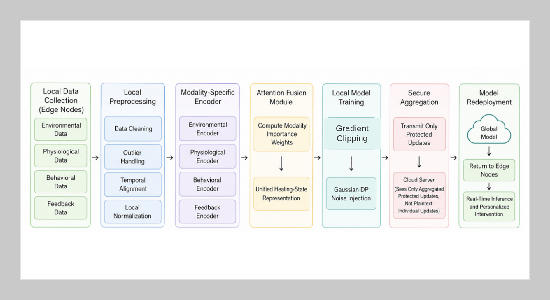
Privacy-preserving federated multimodal fusion process
Copyright The Author(s). This is an open access article distributed under the terms of the Creative Commons Attribution License (CC BY 4.0), which permits unrestricted use, distribution, and reproduction in any medium, provided the original author and source are cited.
Download Citation: BibTeX | http://dx.doi.org/10.6180/jase.202612_35.024
Smart healing spaces rely on continuous environmental, physiological, behavioral, and feedback data to keep therapeutic facilities operating reliably and support timely maintenance decisions. Existing approaches suffer from weak multimodal fusion, poor edge coordination, and heavy communication overhead from centralized raw-data upload. This study proposes a privacy-preserving federated multimodal fusion framework for scalable, low-latency smart healing space monitoring and decision support, with facility operation and maintenance as a prospective extension: edge nodes preprocess environmental, physiological, behavioral, and feedback data, extract modality-specific latent representations, and fuse them via mask-aware temporal attention into a unified status representation for healing-state recognition and, prospectively, equipment assessment and maintenance scheduling; local updates are clipped, DP-perturbed, and securely aggregated into a reliability-weighted global model. Results show 93.2% accuracy and 92.9% F1 in healing-state recognition (5.1/4.5 points above prior methods), 88.2% F1 under severe non-IID conditions, 38.9% lower communication overhead versus FedAvg, and membership-inference attack success reduced from 71.8% to 38.7%. These results validate healing-state recognition and the communication-latency-privacy trade-offs; facility-maintenance tasks such as sensor-fault diagnosis are an architectural extension, not separately benchmarked here.
Keywords: smart healing space, facility operation and maintenance, distributed multimodal data fusion, federated learning, privacy protection, and edge-cloud collaboration.
- [1] Q. Li, Z. Wen, Z. Wu, S. Hu, N. Wang, Y. Li, X. Liu, and B. He, (2023) “A Survey on Federated Learning Systems: Vision, Hype and Reality for Data Privacy and Protection” IEEE Transactions on Knowledge and Data Engineering 35(4): 3347-3366. DOI: https://doi.org/10.1109/TKDE.2021.3124599.
- [2] D. C. Nguyen, M. Ding, P. N. Pathirana, A. Seneviratne, J. Li, and H. V. Poor, (2021) “Federated Learning for Internet of Things: A Comprehensive Survey” IEEE Communications Surveys & Tutorials 23(3): 1622-1658. DOI: https://doi.org/10.1109/COMST.2021.3075439.
- [3] D. C. Nguyen, Q.-V. Pham, P. N. Pathirana, M. Ding, A. Seneviratne, Z. Lin, O. A. Dobre, and W.-J. Hwang, (2022) “Federated Learning for Smart Healthcare: A Survey” ACM Computing Surveys 55(3): 60:1-60:37. DOI: https://doi.org/10.1145/3501296.
- [4] V. Mothukuri, R. M. Parizi, S. Pouriyeh, Y. Huang, A. Dehghantanha, and G. Srivastava, (2021) “A Survey on Security and Privacy of Federated Learning” Future Generation Computer Systems 115: 619-640. DOI: https://doi.org/10.1016/j.future.2020.10.007.
- [5] G. Muhammad, F. Alshehri, F. Karray, A. El Saddik, M. Alsulaiman, and T. H. Falk, (2021) “A Comprehensive Survey on Multimodal Medical Signals Fusion for Smart Healthcare Systems” Information Fusion 76: 355-375. DOI: https://doi.org/10.1016/j.inffus.2021.06.007.
- [6] A. Kline, H. Wang, Y. Li, S. Dennis, M. Hutch, Z. Xu, F. Wang, F. Cheng, and Y. Luo, (2022) “Multimodal Machine Learning in Precision Health: A Scoping Review” npj Digital Medicine 5: 171. DOI: https://doi.org/10.1038/s41746-022-00712-8.
- [7] J. R. Teoh, J. Dong, X. Zuo, K. W. Lai, K. Hasikin, and X. Wu, (2024) “Advancing Healthcare Through Multimodal Data Fusion: A Comprehensive Review of Techniques and Applications” Peer Computer Science 10: e2298. DOI: https://doi.org/10.7717/peerj-cs.2298.
- [8] S. Pati, S. Kumar, A. Varma, B. Edwards, C. Lu, L. Qu, J. J. Wang, A. Lakshminarayanan, S.-H. Wang, M. J. Sheller, K. Chang, P. Singh, D. L. Rubin, J. Kalpathy-Cramer, and S. Bakas, (2024) “Privacy Preservation for Federated Learning in Health Care” Patterns 5(7): 100974. DOI: https://doi.org/10.1016/j.patter.2024.100974.
- [9] I. Dayan, H. R. Roth, A. Zhong, A. Harouni, A. Kaur, A. Gentili, A. Z. Abidin, A. Liu, A. B. Costa, B. J. Wood, C.-C. Tsai, C.-H. Wang, C.-N. Hsu, C.-K. Lee, P. Ruan, D. Xu, D. Wu, E. Huang, F. C. Kitamura, G. Lacey, G. Shachar, G. Yang, H. Roth, H. Li, H. Li, J. Li, J. G. Lee, J. S. Lee, J. S. Kim, J. W. Kim, J. Y. Kim, K. W. Kim, K. Y. Lee, L. Chen, M. G. Linguraru, M. R. Havaei, M. R. Ghavami, S. H. Kim, S. J. Kim, S. M. Kim, S. W. Kim, T. H. Kim, W. J. Kim, W. K. Moon, X. Li, X. Wang, Y. Chen, Y. J. Kim, Y. J. Lee, Y. J. Park, Y. K. Kim, Y. K. Kwon, Y. S. Lee, Y. S. Park, Z. Liu, Z. Xu, Z. Zhang, Z. Wang, Z. Wang, and Q. Li, (2021) “Federated Learning for Predicting Clinical Outcomes in Patients with COVID-19” Nature Medicine 27(10): 1735-1743. DOI: https://doi.org/10.1038/s41591-021-01506-3.
- [10] V. S. Lalapura, J. Amudha, and H. S. Satheesh, (2022) “Recurrent Neural Networks for Edge Intelligence: A Survey” ACM Computing Surveys 54(4): 91:1-91:38. DOI: https://doi.org/10.1145/3448974.
- [11] R. S. Antunes, C. A. da Costa, A. Küderle, I. A. Yari, and B. M. Eskofier, (2022) “Federated Learning for Healthcare: Systematic Review and Architecture Proposal” ACM Transactions on Intelligent Systems and Technology 13(4): 54:1-54:23. DOI: https://doi.org/10.1145/3501813.
- [12] J. Liu, J. Huang, Y. Zhou, X. Li, S. Ji, H. Xiong, and D. Dou, (2022) “From Distributed Machine Learning to Federated Learning: A Survey” Knowledge and Information Systems 64(4): 885-917. DOI: https://doi.org/10.1007/s10115-022-01664-x.
- [13] Y. Lin, Y. Gao, M. Gong, S. Zhang, Y. Zhang, and Z. Li, (2023) “Federated Learning on Multimodal Data: A Comprehensive Survey” Machine Intelligence Research 20(4): 539-553. DOI: https://doi.org/10.1007/s11633-022-1398-0.
- [14] J. Wen, Z. Zhang, Y. Lan, Z. Cui, J. Cai, and W. Zhang, (2023) “A Survey on Federated Learning: Challenges and Applications” International Journal of Machine Learning and Cybernetics 14(2): 513-535. DOI: https://doi.org/10.1007/s13042-022-01647-y.
- [15] J. Yang, K. Tian, H. Zhao, Z. Feng, S. Bourouis, S. Dhahbi, A. A. Khan, M. Berrima, and L. Y. Por, (2025) “Wastewater Treatment Monitoring: Fault Detection in Sensors Using Transductive Learning and Improved Reinforcement Learning” Expert Systems with Applications 264: 125805. DOI: https://doi.org/10.1016/j.eswa.2024.125805.
- [16] J. Yang, D. Hu, M. A. Khan, L. Cascone, M. W. Bhatt, L. Y. Por, H. Yao, and Q. Yang, (2026) “FSSL-TANet: A Federated Semi-Supervised Temporal Attention Network for Personalized Early Detection of Age-Related Macular Degeneration in Consumer Electronics” IEEE Transactions on Consumer Electronics: 3703836. DOI: https://doi.org/10.1109/TCE.2026.3703836.
- [17] J. Yang, V. Govindarajan, S. Arif, X. Xu, M. Kallel, Z. A. Shaikh, Z. Liu, C. Yuan, and L. Y. Por, (2026) “NeuroCare-SCC: An AI-Enhanced Integrated Sensing-Communication-Computing-Control Framework for Cognitive Health Monitoring” IEEE Transactions on Consumer Electronics: 3667208. DOI: https://doi.org/10.1109/TCE.2026.3667208.
- [18] Y. Zhang, X. Li, S. Wang, M. Li, F. Teng, Y. Gao, Z. Wang, H. Yang, L. Y. Por, and Q. Yang, (2026) “CardioGPT-VIT: Explainable Deep Learning Models with Multimodal Data for Coronary Artery Disease and Heart Failure on Edge Consumer Devices” IEEE Transactions on Consumer Electronics: 3667507. DOI: https://doi.org/10.1109/TCE.2026.3667507.
- [19] J. Yang, V. Govindarajan, S. Arif, X. Xu, M. Kallel, Z. A. Shaikh, Z. Liu, C. Yuan, and L. Y. Por, (2026) “SwarmSense-DNN: A Trustworthy and Decentralized Neural Framework for Proactive Anomaly Defense in Consumer IoT” IEEE Transactions on Consumer Electronics 72(1): 1997-2006. DOI: https://doi.org/10.1109/TCE.2025.3634160.
- [20] X. Xu, J. Yang, C. Yuan, Z. Liu, Z. A. Shaikh, M. Kallel, S. Arif, V. Govindarajan, and L. Y. Por, (2025) “Activity Recognition Empowered Autonomic Systems with Generative Artificial Intelligence” ACM Transactions on Autonomous and Adaptive Systems: DOI: https://doi.org/10.1145/3787222.