





Ecological Municipal Institute, CAUPD Beijing Planning and Design consultants LTD, Haidian 100044, Beijing, China
Received: July 21, 2026
Accepted: August 08, 2026
Publication Date: August 26, 2026
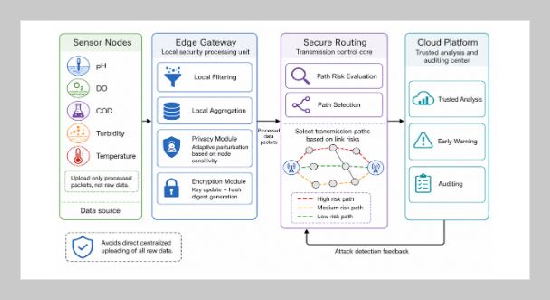
SPST-WSN Overall Architecture
Copyright The Author(s). This is an open access article distributed under the terms of the Creative Commons Attribution License (CC BY 4.0), which permits unrestricted use, distribution, and reproduction in any medium, provided the original author and source are cited.
Download Citation: BibTeX | http://dx.doi.org/10.6180/jase.202612_35.010
Urban water environment monitoring relies on large-scale distributed sensor networks continuously collecting multi-source water quality data – pH, dissolved oxygen, turbidity, COD, ammonia nitrogen, and temperature. High-density node access, edge-gateway forwarding, and centralized cloud analysis expose these systems to data leakage, node spoofing, eavesdropping, replay, tampering, and inference of sensitive patterns, and a single encrypted channel cannot satisfy privacy, security, and scalability together. This study proposes SPST-WSN, a scalable privacy-preserving secure transmission framework integrating adaptive differential privacy, lightweight encryption, dynamic session-key updates, timestamp/nonce verification, MAC-based integrity verification, and link-risk-aware routing across sensor nodes, edge gateways, secure routing, and a cloud platform. In simulations, as node scale grows from 100 to 1500, latency reaches about 168 ms-43.8% lower than blockchain-based methods. with throughput above 760 packets/s. Under 30% attack intensity, delivery rate remains 92.4%, privacy leakage risk falls to 0.18 at budget 0.5, and detection rates for tampering, replay, and spoofing reach 96.8%, 95.9%, and 94.7%. SPST-WSN improves privacy, security, anomaly detection, and scalability while preserving utility for urban rivers, outfalls, lakes, and pipe networks.
Keywords: Urban water environment monitoring, distributed sensor network, privacy protection, secure transmission, edge computing, differential privacy, scalable information system
- [1] A. K. Agarwal, C. Mounaïm-Rousselle, P. Brequigny, A. Dhar, C. Hespel, C. Patel, D. K. Srivastava, G. Duraisamy, L. Le Moyne, N. Sharma, N. Labhasetwar, P. Singh, P. Das, P. K. Panigrahi, P. C. Shukla, P. Sakthivel, S. Mohan, S. Panigrahy, S. Sen, and H. Valera, (2025) “Future of internal combustion engines using sustainable, scalable, and storable E-fuels and biofuels for decarbonizing transport and enabling advanced combustion technologies” Progress in Energy and Combustion Science 110: 101236. DOI: https://doi.org/10.1016/j.pecs.2025.101236.
- [2] A. O. Ali, O. Abdelrehim, M. M. Saafan, M. R. Elmarghany, and A. M. Hamed, (2025) “Comprehensive review of battery management systems for electric vehicles: Thermal management, charging strategies, and emerging technologies” Journal of Power Sources 658: 238269. DOI: https://doi.org/10.1016/j.jpowsour.2025.238269.
- [3] P. Shrivastava, P. A. Naidu, S. Sharma, B. K. Panigrahi, and A. Garg, (2023) “Review on technological advancement of lithium-ion battery states estimation methods for electric vehicle applications” Journal of Energy Storage 64: 107159. DOI: https://doi.org/10.1016/j.est.2023.107159.
- [4] C. Huang, Q. Shi, W. Ding, E. Q. Wu, and P. Mei, (2025) “A Multirate-Fused State-of-Charge Estimation Scheme of Lithium-Ion Batteries for Electric Vehicles With Energy Harvesting Sensors” IEEE Transactions on Instrumentation and Measurement 74: 1-11. DOI: https://doi.org/10.1109/TIM.2025.3547129.
- [5] R. Guo and W. Shen, (2023) “Lithium-Ion Battery State of Charge and State of Power Estimation Based on a Partial-Adaptive Fractional-Order Model in Electric Vehicles” IEEE Transactions on Industrial Electronics 70(10): 10123-10133. DOI: https://doi.org/10.1109/TIE.2022.3220881.
- [6] Q. Wang, C. Sun, and Y. Gu, (2023) “Research on SOC estimation method of hybrid electric vehicles battery based on the grey wolf optimized particle filter” Computers and Electrical Engineering 110: 108907. DOI: https://doi.org/10.1016/j.compeleceng.2023.108907.
- [7] X. Lü, S. Li, X. He, C. Xie, S. He, Y. Xu, J. Fang, M. Zhang, and X. Yang, (2022) “Hybrid electric vehicles: A review of energy management strategies based on model predictive control” Journal of Energy Storage 56: 106112. DOI: https://doi.org/10.1016/j.est.2022.106112.
- [8] J. J. Jui, M. A. Ahmad, M. I. Molla, and M. I. M. Rashid, (2024) “Optimal energy management strategies for hybrid electric vehicles: A recent survey of machine learning approaches” Journal of Engineering Research 12(3): 454-467. DOI: https://doi.org/10.1016/j.jer.2024.01.016.
- [9] A. S. Mohammed, S. M. Atnaw, A. O. Salau, and J. N. Eneh, (2023) “Review of optimal sizing and power management strategies for fuel cell/battery/super capacitor hybrid electric vehicles” Energy Reports 9: 2213-2228. DOI: https://doi.org/10.1016/j.egyr.2023.01.042.
- [10] I. Jarraya, F. Masmoudi, M. H. Chabchoub, and H. Trabelsi, (2019) “An online state of charge estimation for Lithium-ion and supercapacitor in hybrid electric drive vehicle” Journal of Energy Storage 26: 100946. DOI: https://doi.org/10.1016/j.est.2019.100946.
- [11] X. Zhao, L. Wang, Y. Zhou, B. Pan, R. Wang, L. Wang, and X. Yan, (2022) “Energy management strategies for fuel cell hybrid electric vehicles: Classification, comparison, and outlook” Energy Conversion and Management 270: 116179. DOI: https://doi.org/10.1016/j.enconman.2022.116179.
- [12] C. P. Sahwal, S. Sengupta, and T. Q. Dinh, (2024) “Advanced Equivalent Consumption Minimization Strategy for Fuel Cell Hybrid Electric Vehicles” Journal of Cleaner Production 437: 140366. DOI: https://doi.org/10.1016/j.jclepro.2023.140366.
- [13] V. Duong, T. Thâm, W. Choi, and D.-W. Kim, (2016) “State Estimation Technique for VRLA Batteries for Automotive Applications” Journal of Power Electronics 16: 238-248. DOI: https://doi.org/10.6113/JPE.2016.16.1.238.
- [14] M. Debbou and F. Colet. “Inductive wireless power transfer for electric vehicle dynamic charging”. In: 2016 IEEE PELS Workshop on Emerging Technologies: Wireless Power Transfer (WoW). 2016, 118-122. DOI: https://doi.org/10.1109/WoW.2016.7772077.
- [15] S. Kim, K. Kim, J. Ha, S. Kwon, and Y. Seo, (2016) “A Study about Impact of Battery SOC on Fuel Economy of Conventional Diesel Vehicle” Transactions of the Korean Society of Automotive Engineers 24: 480-486. DOI: https://doi.org/10.7467/KSAE.2016.24.4.480.
- [16] A. A. Mahajan and N. P. Mungle, (2025) “Fuzzy Logic Based Power Distribution Strategy for Hybrid Fuel Cell Vehicle” Metallurgical and Materials Engineering 31(3): 358-367. DOI: https://doi.org/10.63278/1385.
- [17] M. Averbukh, B. Rivin, and J. Vinogradov. “On-Board Battery Condition Diagnostics Based on Mathematical Modeling of an Engine Starting System”. In: SAE World Congress & Exhibition. SAE International, 2007. DOI: https://doi.org/10.4271/2007-01-1476.
- [18] C. Bharatiraja and G. Ramanathan. “A Hybridization of Photovoltaic and Battery Sources with Dual Input-Dual Output Converter for EV Charger”. In: Smart Grid Stability and Control. Ed. by R. Krishan, D. R. Pullaguram, and S. R. Salkuti. Singapore: Springer Nature Singapore, 2025, 263-281. DOI: https://doi.org/10.1007/978-981-97-8634-3_18.
- [19] C. Armenta-Déu, (2024) “Battery Management for Improved Performance in Hybrid Electric Vehicles” Vehicles 6(2): 949-966. DOI: https://doi.org/10.3390/vehicles6020045.
- [20] R. R. Kumar, C. Bharatiraja, K. Udhayakumar, S. Devakirubakaran, K. S. Sekar, and L. Mihet-Popa, (2023) “Advances in Batteries, Battery Modeling, Battery Management System, Battery Thermal Management, SOC, SOH, and Charge/Discharge Characteristics in EV Applications” IEEE Access 11: 105761-105809. DOI: https://doi.org/10.1109/ACCESS.2023.3318121.
- [21] G. Vuylsteke, H. Wu, W. Moore, and D. Washington. “Impact of Battery Aging on the State of Charge-Open Circuit Voltage Relationship and Its Effects on Battery Capacity Estimation”. In: WCX SAE World Congress Experience. SAE International, 2025. DOI: https://doi.org/10.4271/2025-01-8558.
- [22] K. W. E. Cheng, B. P. Divakar, H. Wu, K. Ding, and H. F. Ho, (2011) “Battery-Management System (BMS) and SOC Development for Electrical Vehicles” IEEE Transactions on Vehicular Technology 60: 76-88. DOI: https://doi.org/10.1109/TVT.2010.2089647.
- [23] M. Wang and T. Huang. “An Integrated Electric Energy Management System to Improve Fuel Economy”. In: Proceedings of the FISITA 2012 World Automotive Congress. Berlin, Heidelberg: Springer Berlin Heidelberg, 2013, 115-122. DOI: https://doi.org/10.1007/978-3-642-33829-8_12.
- [24] J. Wishart, M. Shirk, T. Gray, and N. Fengler. “Quantifying the Effects of Idle-Stop Systems on Fuel Economy in Light-Duty Passenger Vehicles”. In: SAE 2012 World Congress & Exhibition. SAE International, 2012. DOI: https://doi.org/10.4271/2012-01-0719.
- [25] I. Cho and J. Lee, (2020) “Characteristics of Battery SOC According to Drive Output and Battery Capacity of Parallel Hybrid Electric Vehicle” Applied Sciences 10(8): DOI: https://doi.org/10.3390/app10082833.
- [26] P. Ruetschi, (2004) “Aging mechanisms and service life of lead-acid batteries” Journal of Power Sources 127(1): 33-44. DOI: https://doi.org/10.1016/j.jpowsour.2003.09.028.
- [27] S. Singirikonda and Y. P. Obulesu. “Advanced SOC and SOH Estimation Methods for EV Batteries-A Review”. In: Advances in Automation, Signal Processing, Instrumentation, and Control. Ed. by V. L. N. Komanapalli, N. Sivakumaran, and S. Hampannavar. Singapore: Springer Nature Singapore, 2021, 1963-1977.
- [28] Y. Wang, J. Tian, Z. Sun, L. Wang, R. Xu, M. Li, and Z. Chen, (2020) “A comprehensive review of battery modeling and state estimation approaches for advanced battery management systems” Renewable and Sustainable Energy Reviews 131: 110015. DOI: https://doi.org/10.1016/j.rser.2020.110015.
- [29] J. S. Kim, J. W. Kim, J. H. Jeong, S. C. Jeong, and J. W. Lee, (2016) “Effects of Initial SOC of 270-Volt Battery on Operating Performance of Gasoline Engine and Electric motor in a Parallel Hybrid Vehicle under IM240 Driving Cycle Mode” Advances in Automobile Engineering 2016: 1-9. DOI: https://doi.org/10.4172/2167-7670.51-008.
- [30] United Nations. Global technical regulation on worldwide harmonized light vehicles test procedure. Tech. rep. ECE/TRANS/180/Add.15. Global Technical Regulation No. 15 (GTR 15) on Worldwide harmonized Light vehicles Test Procedures (WLTP), established in the Global Registry on 15 November 2017. United Nations, 2017.