




Mingzhe Hou, Zhenzi Wang, and Zhenhao Ye
China southern power grid shenzhen power supply Co., Ltd, Shenzhen 518000, China
Received: June 01, 2026
Accepted: July 26, 2026
Publication Date: August 26, 2026
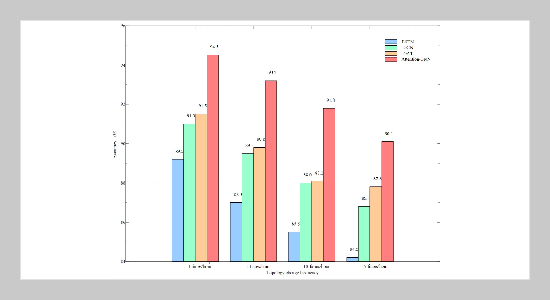
Comparison of model accuracy under different topology change frequencies
Copyright The Author(s). This is an open access article distributed under the terms of the Creative Commons Attribution License (CC BY 4.0), which permits unrestricted use, distribution, and reproduction in any medium, provided the original author and source are cited.
Download Citation: BibTeX | http://dx.doi.org/10.6180/jase.202611_34.066
To address the challenges of lagging situational awareness and insufficient risk assessment accuracy brought about by the high proportion of renewable energy grid integration and the increasingly complex grid topology, this paper proposes a power system situational awareness and risk assessment method integrating graph neural networks (GNNs), multimodal perception, and human-machine collaboration. First, a multimodal perception data system is constructed, which integrates multi-source information such as measurement data, text data, and image data. Heterogeneous data fusion is achieved through data preprocessing and feature alignment. Then, an attention-based graph neural network model (Attention-GNN) is designed. Utilizing the graph structure to adapt to the grid topology characteristics, it mines the deep correlation between multimodal features and grid situational awareness, so that can enable dynamic updates of situational awareness. Next, a human-machine collaborative risk assessment framework is established. The machine model outputs an initial risk level, which is then corrected and optimized by incorporating domain expert experience, constructing a dual-drive assessment mode of “data-driven + knowledge-guided”. Finally, experimental verification is conducted based on a real power grid dataset and a simulation platform. Experimental results show that the method proposed in this paper achieves a situational awareness accuracy of 93.2% and a single-step inference time of 28.4 ms, which can meet the real-time requirements (approximately 35 FPS) for video inspections conducted by drones or fixed cameras. The accuracy of human-machine collaborative risk assessment reaches 95.6%, with an accuracy of 92.3% in extreme scenarios. Even with a 40% renewable energy penetration rate, the accuracy remains at 89.5%. In a six-month pilot project in a provincial power grid, the risk identification coverage increased from 53% to 97%, with an average early warning time of 3.2 minutes, which can prevent approximately five potential power outages and reduce direct economic losses by approximately 8 million yuan. This research provides effective technical support for the safe and stable operation of power systems.
Keywords: graph neural network, multimodal perception, human-machine collaboration, situational awareness, risk assessment
- [1] M. I. Abdelwanis and M. I. Elmezain, (2024) “A comprehensive review of hybrid AC/DC networks: insights into system planning, energy management, control, and protection” Neural Computing and Applications 36(29): 17961-17977. DOI: https://doi.org/10.1007/s00521-024-10264-5.
- [2] D. Huang, P. Wu, X. Wang, and D. Wang. “Analysis of security and stability characteristics in new power system”. In: 2024 IEEE 8th Conference on Energy Internet and Energy System Integration (E12). IEEE. 2024, 3639-3646. DOI: https://doi.org/10.1109/E1264398.2024.10991342.
- [3] D. Madurasinghe and G. K. Venayagamoorthy, (2024) “Distributed dynamic security assessment for modern power system operational situational awareness” IEEE Access 12: 147991-148010. DOI: https://doi.org/10.1109/ACCESS.2024.3475011.
- [4] M. Ren, N. Chen, and H. Qiu, (2023) “Human-machine collaborative decision-making: An evolutionary roadmap based on cognitive intelligence” International Journal of Social Robotics 15(7): 1101-1114. DOI: https://doi.org/10.1007/s12369-023-01020.
- [5] K. Chen, J. Zhu, L. Han, S. Li, and P. Gao. “A Novel Network Security Situation Awareness Model for Advanced Persistent Threat”. In: 2022 7th IEEE International Conference on Data Science in Cyberspace (DSC). IEEE. 2022, 9-16. DOI: https://doi.org/10.1109/DSC55868.2022.00009.
- [6] A. Sahu and K. Davis, (2023) “Inferring adversarial behaviour in cyber-physical power systems using a Bayesian attack graph approach” IET Cyber-Physical Systems: Theory & Applications 8(2): 91-108. DOI: https://doi.org/10.1049/cps2.12047.
- [7] S. Das and B. K. Panigrahi, (2022) “A PMU-based data-driven approach for enhancing situational awareness in building a resilient power systems” IEEE Transactions on Industrial Informatics 18(7): 4773-4784. DOI: https://doi.org/10.1109/TII.2022.3147794.
- [8] S. Wei, D. Wenjuan, and C. Xia, (2024) “Power quality disturbances categorization using identity feature vector and extreme learning machine” Intelligent Systems with Applications 24: 200446. DOI: https://doi.org/10.1016/j.iswa.2024.200446.
- [9] Z. Ye, Y. J. Kumar, G. O. Sing, F. Song, and J. Wang, (2022) “A comprehensive survey of graph neural networks for knowledge graphs” Ieee Access 10: 75729-75741. DOI: https://doi.org/10.1109/ACCESS.2022.3191784.
- [10] B. Khemani, S. Patil, K. Kotecha, and S. Tanwar, (2024) “A review of graph neural networks: concepts, architectures, techniques, challenges, datasets, applications, and future directions” Journal of Big Data 11(1): 18. DOI: https://doi.org/10.1186/s40537-023-00876-4.
- [11] B. Zheng, L. Ming, K. Zeng, M. Zhou, X. Zhang, T. Ye, B. Yang, X. Zhou, and C. S. Jensen, (2024) “Adversarial graph neural network for multivariate time series anomaly detection” IEEE Transactions on Knowledge and Data Engineering 36(12): 7612-7626. DOI: https://doi.org/10.1109/TKDE.2024.3419891.
- [12] U. Pandey, A. Pathak, A. Kumar, and S. Mondal, (2023) “Applications of artificial intelligence in power system operation, control and planning: a review” Clean Energy 7(6): 1199-1218. DOI: https://doi.org/10.1093/ce/zkad061.
- [13] S. Liu, Y. Teng, and Z. Chen, (2025) “Optimization framework for transient overvoltage for new energy clusters in power grids supported by integrated energy” Journal of Renewable and Sustainable Energy 17(5): DOI: https://doi.org/10.1063/5.0248715.
- [14] R. Bhattacharya, N. K. Nagwani, and S. Tripathi, (2023) “A community detection model using node embedding approach and graph convolutional network with clustering technique” Decision Analytics Journal 9: 100362. DOI: https://doi.org/10.1016/j.dajour.2023.100362.
- [15] E. Mohammadi, M. Alizadeh, M. Asgarimoghaddam, X. Wang, and M. G. Simões, (2022) “A review on application of artificial intelligence techniques in microgrids”: DOI: https://doi.org/10.1109/JESTIE.2022.3198504.
- [16] N. Arvinth, (2025) “Fault Detection in Smart Grids Using Deep Learning-Based Phasor Measurement Unit Data Analysis” Journal of Reconfigurable Hardware Architectures and Embedded Systems 2(2): 1-7. DOI: https://doi.org/10.17051/JRHAES/02.02.01.
- [17] B. Azimian, R. S. Biswas, S. Moshtagh, A. Pal, L. Tong, and G. Dasarathy, (2022) “State and topology estimation for unobservable distribution systems using deep neural networks” IEEE transactions on instrumentation and measurement 71: 1-14. DOI: https://doi.org/10.1109/TIM.2022.3167722.
- [18] Z. Cheng, H. Chen, T. Mao, B. Zhou, W. Zhao, T. Wang, and Y. Xu, (2025) “Data-driven topology identification and line parameter estimation for distribution network: A two-stage approach” Journal of Renewable and Sustainable Energy 17(3): DOI: https://doi.org/10.1063/5.0267179.
- [19] Y. Zhang, L. Guo, Y. Liu, Z. Wang, X. Li, and C. Wang, (2026) “Physical informed data-driven topology estimation of radial distribution networks based on partial measurement” CSEE Journal of Power and Energy Systems: DOI: https://doi.org/10.17775/CSEEJPES.2024.09220.
- [20] S. Liu, Y. Teng, and Z. Chen, (2025) “Optimization framework for transient overvoltage for new energy clusters in power grids supported by integrated energy” Journal of Renewable and Sustainable Energy 17(5): DOI: https://doi.org/10.1063/5.0248715.