





Received: November 25, 2025
Accepted: March 30, 2026
Publication Date: May 27, 2026
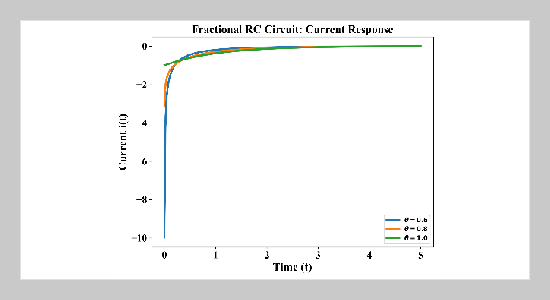
The current response i(t) for the same fractional orders
Copyright The Author(s). This is an open access article distributed under the terms of the Creative Commons Attribution License (CC BY 4.0), which permits unrestricted use, distribution, and reproduction in any medium, provided the original author and source are cited.
Download Citation: BibTeX | http://dx.doi.org/10.6180/jase.202609_32.054
Conformable fractional calculus simplifies research and application due to its similarity with classical calculus in theory and operations. Therefore, it has gained significant attention from researchers and has accumulated rich theoretical achievements. The article establishes a comprehensive eigenvalue-based analytical system for constant coefficient flexible fractional differential systems by extending previous research work. The proposed method provides a systematic approach to eigenvalue classification, which results in four distinct eigenvalue categories and produces actual solutions for every category. The process of transforming complex eigenvalues into real solutions employs Euler’s formula, whereas the method for handling repeated roots uses a systematic approach of variable substitution. The framework establishes a complete theoretical foundation that describes high-dimensional conformable systems and demonstrates its validity through practical examples.
Keywords: Conformable Differential Systems, Constant Coefficients, Eigenvalue.
- [1] F. Gürcan, G. Kaya, and ¸S. Kartal, (2020) “Dynamical analysis of a discrete conformable fractional order bacteria population model in a microcosm” Physica A: Statistical Mechanics and its Applications 547: 123864. DOI: 10.1016/j.physa.2019.123864.
- [2] E. Balçı, İ. Öztürk, and S. Kartal, (2019) “Dynamical behaviour of fractional order tumor model with Caputo and conformable fractional derivative” Chaos, Solitons & Fractals 123: 43–51. DOI: 10.1016/j.chaos.2019.03.032.
- [3] E. Balçı, Ş. Kartal, and İ. Öztürk, (2021) “Comparison of dynamical behavior between fractional order delayed and discrete conformable fractional order tumor-immune system” Mathematical Modelling of Natural Phenomena 16(3): DOI: 10.1051/mmnp/2020055.
- [4] S. Kartal and F. Gürcan, (2019) “Discretization of conformable fractional differential equations by a piecewise constant approximation” International Journal of Computer Mathematics 96(9): 1849–1860. DOI: 10.1080/00207160.2018.1536782.
- [5] F. Gürcan, G. Kaya, and S. Kartal, (2019) “Conformable fractional order Lotka–Volterra predator–prey model: Discretization, stability and bifurcation” Journal of Computational and Nonlinear Dynamics 14(11): 111007. DOI: 10.1115/1.4044313.
- [6] R. Khalil, M. A. Horani, A. Yousef, and M. Sababheh, (2014) “A new definition of fractional derivative” Journal of Computational and Applied Mathematics 264: 65–70. DOI: 10.1016/j.cam.2014.01.002.
- [7] N. R. Kareem, F. S. Fadhel, and S. Al-Nassir, (2025) “Solution of Linear Fuzzy Stochastic Ordinary Differential Equations Using Homotopy Perturbation Method” Journal of Applied Science and Engineering 28(4): 717–730. DOI: 10.6180/jase.202504_28(4).0006.
- [8] H. M. Rezk, W. Albalawi, H. A. El-Hamid, A. I. Saied, O. Bazighifan, M. S. Mohamed, and M. Zakarya, (2022) “Hardy-Leindler-Type Inequalities via Conformable Delta Fractional Calculus” Journal of Function Spaces 2022(1): 2399182. DOI: 10.1155/2022/2399182.
- [9] T. Alfishawi, (2015) “On conformable fractional calculus” Journal of Computational and Applied Mathematics 279: 57–66. DOI: 10.1016/j.cam.2014.10.016.
- [10] O. Özkan and A. Kurt, (2019) “Exact solutions of fractional partial differential equation systems with conformable derivative” Filomat 33(5): 1313–1322. DOI: 10.2298/FIL1905313O.
- [11] R. Saleh, M. Kassem, and S. M. Mabrouk, (2019) “Exact solutions of nonlinear fractional order partial differential equations via singular manifold method” Chinese Journal of Physics 61: 290–300. DOI: 10.1016/j.cjph.2019.09.005.
- [12] H. Thabet and S. Kendre, (2023) “Conformable mathematical modeling of the COVID-19 transmission dynamics: A more general study” Mathematical Methods in the Applied Sciences 46(17): 18126–18149. DOI: 10.1002/mma.9549.
- [13] O. Osman, A. Korkmaz, H. Rezazadeh, M. Mirzazadeh, and Q. Zhou, (2018) “The unified method for conformable time fractional Schrödinger equation with perturbation terms” Chinese Journal of Physics 56(5): 2500–2506. DOI: 10.1016/j.cjph.2018.06.009.
- [14] Y. Xiangnan, X. Hao, M. Zhiping, et al., (2025) “A data-driven framework for discovering fractional differential equations in complex systems” Nonlinear Dynamics 113: 24557–24577. DOI: 10.1007/s11071-025-11373-z.
- [15] J. Xu, Y. Cui, and W. Rui, (2025) “Innate Character of Conformable Fractional Derivative and Its Effects on Solutions of Differential Equations” Mathematical Methods in the Applied Sciences 48(9): 9414–9429. DOI: 10.1002/mma.10807.
- [16] Y. Ding, (2025) “Existence and stability analysis of solutions for periodic conformable differential systems with non-instantaneous impulses” Aims Mathematics 10(2): 4040–4066. DOI: 10.3934/math.2025188.
- [17] A. Chatziafratis and S. Kamvissis, (2025) “Infinity of solutions to initial-boundary value problems for linear constant-coefficient evolution PDEs on semi-infinite intervals” Bulletin of the London Mathematical Society 57(12): 4111–4121. DOI: 10.1112/blms.70179.