




Fathony Nada Saputro1, Wijang Wisnu Raharjo2 , and Bambang Kusharjanta2
1Master’s Student in Mechanical Engineering, Sebelas Maret University, Jl.Ir.Sutami 36A, Surakarta 57126, Indonesia
2Mechanical Engineering Department, Sebelas Maret University, Jl.Ir.Sutami 36A, Surakarta 57126, Indonesia
Received: November 6, 2025
Accepted: March 24, 2026
Publication Date: May 13, 2026
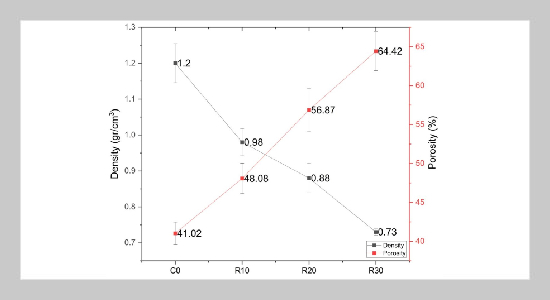
Density of LWB with rubber powder variation
Copyright The Author(s). This is an open access article distributed under the terms of the Creative Commons Attribution License (CC BY 4.0), which permits unrestricted use, distribution, and reproduction in any medium, provided the original author and source are cited.
Download Citation: BibTeX | http://dx.doi.org/10.6180/jase.202609_32.031
The construction sector contributes significantly to environmental degradation due to the extensive use of conventional building materials. Lightweight bricks offer a potential alternative; however, achieving both reduced weight and adequate mechanical performance remains a challenge. The substitution of sand with waste derived materials provides a sustainable pathway. In this work, fly ash and rubber powder, both industrial by-products, were utilized as fine aggregate replacements in the production of lightweight bricks, combined with geogrid reinforcement to enhance their structural performance. Rubber powder was incorporated at 10%,20%, and 30% by weight, while geogrid layers were applied in one to three layers. The physical and mechanical properties were evaluated through density, water absorption, macroscopic structure observation, compressive strength, and flexural strength tests. Increasing the rubber powder content effectively reduced the brick density, reaching a minimum of 0.68 g/cm3 at a 30% replacement level. However, an increase in rubber content led to greater porosity and water absorption, resulting in a reduction in both compressive and
flexural strength. Optimum mechanical performance was observed at 10% rubber powder, with compressive and flexural strengths of 2.41 MPa and 1.64 MPa , respectively. The introduction of geogrid reinforcement significantly improved the strength, with three layers achieving compressive and flexural strengths of 6.01 MPa and 3.48 MPa, respectively. The results indicate that combining fly ash, rubber waste, and geogrid reinforcement can effectively produce lightweight, sustainable bricks with enhanced structural performance.
Keywords: mechanical properties; lightweight bricks; fly ash; rubber powder; geogrid
- [1] M. M. Barros, M. F. L. de Oliveira, R. C. da Conceição Ribeiro, D. C. Bastos, and M. G. de Oliveira, (2020) “Ecological bricks from dimension stone waste and polyester resin” Construction and Building Materials 232: 117252. DOI: 10.1016/j.conbuildmat.2019.117252.
- [2] J. K. Shrestha, (2021) “Assessment of energy demand and greenhouse gas emissions in low rise building systems: Case study of five building systems built after the Gorkha Earthquake in Nepal” Journal of Building Engineering 34: 101831. DOI: 10.1016/j.jobe.2020.101831.
- [3] S. N. Jonnala, D. Gogoi, S. Devi, M. Kumar, and C. Kumar, (2024) “A comprehensive study of building materials and bricks for residential construction” Construction and Building Materials 425: 135931. DOI: 10.1016/j.conbuildmat.2024.135931.
- [4] A. B. Raheem and F. S. Klak, (2024) “Shear Strength of Conventional and Lightweight Concrete I-Beams with Fibrous Webs” Engineering, Technology and Applied Science Research 14: 16486–16491. DOI: 10.48084/etasr.8155.
- [5] M. Oleksik, D. Dobrotă, C. S. Dimulescu, O. Dumitraşcu, and R. Petraşcu, (2024) “Advanced use of waste rubber and fly ash to ensure an efficient circular economy” Ain Shams Engineering Journal 15(1): 102264. DOI: 10.1016/j.asej.2023.102264.
- [6] Z. Hussain, N. Al-Zaqril, A. Boshaala, T. Ayaz, and A. Z. Khan, (2023) “Treatment of coal fly ash and its environmentally friendly use in the rubber and plastic industries” Arabian Journal of Geosciences 16: 374. DOI: 10.1007/s12517-023-11467-1.
- [7] G. Scheffknecht, L. Al-Makhadmeh, U. Schnell, and J. Maier, (2011) “Oxy-fuel coal combustion—A review of the current state-of-the-art” International Journal of Greenhouse Gas Control 5: S16–S35. DOI: 10.1016/j.ijggc.2011.05.020.
- [8] U. Anggarini, C. Kosada, and N. C. Sukmana, (2017) “Penerapan Metode Taguchi pada Perancangan Eksperimen Beton Geopolimer Berbasis Abu Layang” CHEM-ICA: Jurnal Teknik Kimia 4: 9. DOI: 10.26555/chemica.v4i1.6776.
- [9] M. Bekhiti, H. Trouzine, and A. Asroun, (2014) “Properties of Waste Tire Rubber Powder” Engineering, Technology & Applied Science Research 4: 669–672. DOI: 10.48084/etasr.439.
- [10] S. Rahardjo and Sutanto, “Annual Report 2021 PT Gajah Tunggal Tbk”.
- [11] H. T. N. Avior Ocean Louis Ishaac Noya Desak Ari Gita Wahyuni, (2023) “Kajian Ekstensifikasi Barang Kena Cukai Pada Ban Karet” Jurnal Perspektif Bea dan Cukai 7: 189–212. DOI: 10.31092/jpbc.v7i2.2108.
- [12] M. Badawi, A. G. Ahmed, T. A. Eldamaty, and M. M. Helal, (2023) “The Effect of Polypropylene Fibers on the Fracture Characteristics of Lightweight Aggregate Crumb Rubber Concrete Composites” Engineering, Technology and Applied Science Research 13: 10638–10645. DOI: 10.48084/etasr.5821.
- [13] O. S. P. Pratama. “Pengaruh ketebalan pasir sebagai pembungkus geogrid terhadap stabilitas lereng lempung”. 2020.
- [14] Z. Huang, L. Sui, F. Wang, S. Du, Y. Zhou, and J. Ye, (2020) “Dynamic compressive behavior of a novel ultra-lightweight cement composite incorporated with rubber powder” Composite Structures 244: 112300. DOI: 10.1016/j.compstruct.2020.112300.
- [15] K. R. Kumar, T. J. Vijay, A. Bahrami, and G. Ravindran, (2023) “Structural Behavior of Concrete Beams Reinforced with Biaxial Geogrid” Buildings 13: 1124. DOI: 10.3390/buildings13051124.
- [16] J. Lv, T. Zhou, Q. Du, and H. Wu, (2015) “Effects of rubber particles on mechanical properties of lightweight aggregate concrete” Construction and Building Materials 19: 145–149. DOI: 10.1016/j.conbuildmat.2015.05.038.
- [17] N. Intaboot and P. Kanbua, (2022) “Investigation of concrete blocks mixed with recycled crumb rubber: A case study in Thailand” Engineering and Applied Science Research 49: 413–424. DOI: 10.14456/easr.2022.42.
- [18] A. Wongsa, V. Sata, B. Nematollahi, J. Sanjayan, and P. Chindaprasirt, (2018) “Mechanical and thermal properties of lightweight geopolymer mortar incorporating crumb rubber” Journal of Cleaner Production 195: 1069–1080. DOI: 10.1016/j.jclepro.2018.06.003.
- [19] I. S. Raj and K. Somasundaram, (2023) “An optimized mix for the manufacture of sustainable aerated concrete blocks using waste rubber powder” Clean Technologies and Environmental Policy 25: 1273–1289. DOI: 10.1007/s10098-022-02442-7.
- [20] E. Eltayeb, X. Ma, Y. Zhuge, O. Youssf, and J. E. Mills, (2020) “Influence of rubber particles on the properties of foam concrete” Journal of Building Engineering 30: 101217. DOI: 10.1016/j.jobe.2020.101217.
- [21] R. Si, S. Guo, and Q. Dai, (2017) “Durability performance of rubberized mortar and concrete with NaOH-Solution treated rubber particles” Construction and Building Materials 153: 496–505. DOI: 10.1016/j.conbuildmat.2017.07.085.
- [22] D. N. Giedrius Girskas, (2017) “Crushed rubber waste impact of concrete basic properties” Construction and Building Materials 140: 36–42. DOI: 10.1016/j.conbuildmat.2017.02.107.
- [23] M. L. iu, G. D. Zhang, Y. F. Ding, L. Wei, Y. Wang, and X. Z. Zhang, (2016) “Research on Properties of the Concrete with Waste Rubber Powder” Materials Science Forum 825: 1443–1449. DOI: 10.4028/www.scientific.net/MSF.825.1443.
- [24] K. Strukar, T. K. Šipoš, I. Miličević, and R. Bušić, (2019) “Potential use of rubber as aggregate in structural reinforced concrete element—A review” Engineering Structures 188: 452–468. DOI: 10.1016/j.engstruct.2019.03.031.
- [25] I. H. Xiaochao Tang and M. N. Jlilati, (2018) “Behavior of Geogrid-Reinforced Portland Cement Concrete under Static Flexural Loading” Infrastructures 3: 41. DOI: 10.3390/infrastructures3040041.
- [26] M. A. Yousif, K. S. Mahmoud, Z. A. Hacheem, and M. M. Rasheed, (2021) “Effect of geogrid on the structural behavior of reinforced concrete beams” Journal of Physics: Conference Series 1895: 012048. DOI: 10.1088/1742-6596/1895/1/012048.
- [27] A. S. A.-A. Al-Hedad and M. N. S. Hadi, (2021) “Effect of geogrid reinforcement on the strains at compressive zone of concrete pavements” Structural Concrete 22: 109–119. DOI: 10.1002/suco.202000075.
- [28] P. B. S and Kiran, (2020) “Compressive Strength Comparison of Control Specimen with Glass Fibre Reinforced Concrete and Geogrid Fibre Rereinforced Concrete” International Journal of Engineering Technologies and Management Research 5: 120–127. DOI: 10.29121/ijetmr.v5.i6.2018.252.
- [29] Z. Huang, L. Sui, F. Wang, S. Du, Y. Zhou, and J. Ye, (2020) “Dynamic compressive behavior of a novel ultra-lightweight cement composite incorporated with rubber powder” Composite Structures 244: 112300. DOI: 10.1016/j.compstruct.2020.112300.
- [30] F. Liu, G. Chen, L. Li, and Y. Guo, (2012) “Study of impact performance of rubber reinforced concrete” Construction and Building Materials 36: 604–616. DOI: 10.1016/j.conbuildmat.2012.06.014.
- [31] D. Sinkhonde, R. O. Onchiri, W. O. Oyawa, and J. N. Mwero, (2023) “Properties of concrete mixes containing tire rubber and brick powder exposed to sulfuric acid and cured in water: A comparative study” Heliyon 9: e17514. DOI: 10.1016/j.heliyon.2023.e17514.
- [32] K. RajeshKumar, P. Awoyera, G. Shyamala, V. Kumar, N. Gurumoorthy, S. Kayikci, L. B. Romero, and A. K. Prakash, (2022) “Structural performance of biaxial geogrid reinforced concrete slab” International Journal of Civil Engineering 20(3): 349–359. DOI: 10.1007/s40999-021-00668-y.
- [33] M. N. Hadi and A. S. Al-Hedad, (2020) “Flexural fatigue behaviour of geogrid reinforced concrete pavements” Construction and Building Materials 249: 118762. DOI: 10.1016/j.conbuildmat.2020.118762.
- [34] S. S. F. A. Zakaria Muda Che and J. hong Ng, (2012) “Flexural Behavior Of Lightweight Oil Palm Shells Concrete Slab Reinforced With Geogrid” International Journal of Scientific & Engineering Research 3: 7.
- [35] X. Meng, Y. Chi, Q. Jiang, R. Liu, K. Wu, and S. Li, (2019) “Experimental investigation on the flexural behavior of pervious concrete beams reinforced with geogrids” Construction and Building Materials 215: 275–284. DOI: 10.1016/j.conbuildmat.2019.04.217.
- [36] N. S. Correia and G. M. Dalfre, (2021) “Experimental investigation on the flexural and post-cracking behaviour of geogrid-reinforced concrete overlays” LAUTECH Journal of Civil and Environmental Studies 6: 2714–3988. DOI: 10.36108/laujoces/1202.60.0110.