




Kieu Do Trung Kien1,2, and Huynh Ngoc Minh1,2
1Faculty of Materials Technology, Ho Chi Minh City University of Technology (HCMUT), 268 Ly Thuong Kiet Street, Dien Hong Ward, Ho Chi Minh City, Vietnam
2Vietnam National University Ho Chi Minh City, Linh Trung Ward, Ho Chi Minh City, Vietnam
Received: February 15, 2026
Accepted: April 14, 2026
Publication Date: May 11, 2026
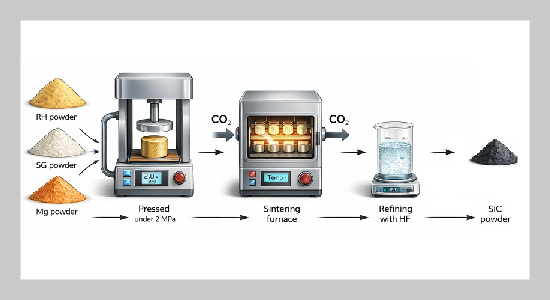
Schematic of the experimental procedure for synthesizing and purifying SiC
Copyright The Author(s). This is an open access article distributed under the terms of the Creative Commons Attribution License (CC BY 4.0), which permits unrestricted use, distribution, and reproduction in any medium, provided the original author and source are cited.
Download Citation: BibTeX | http://dx.doi.org/10.6180/jase.202609_32.029
Silicon carbide is an advanced ceramic material widely used in structural and electronic applications due to its high thermal stability, mechanical strength, and wide bandgap properties. In this study, SiC was synthesized from rice husk through a magnesium-assisted carbothermal reduction process to reduce the reaction temperature compared with conventional methods. The SiO2 content in the precursor mixture was adjusted by incorporating synthesized silica gel, while magnesium powder was introduced as a reducing additive. The influence of calcination temperature (500-1300◦C) on phase evolution, SiC formation, and microstructural development was systematically investigated. The results indicate that calcination temperature plays a crucial role in controlling SiC formation. A significant increase in the SiC yield was observed when the calcination temperature
increased from 900◦C ( 8.25wt.% ) to 1100◦C (18.94 wt.%), identifying 1100◦C as the optimal condition within the studied range. X-ray diffraction analysis confirmed the presence of intermediate and secondary phases, including MgO, Mg2Si, Mg2SiO4, and residual SiO2 during the reaction process. Post-synthesis acid treatment effectively removed these Mg-containing compounds and unreacted silica. Consequently, the purity of the SiC product synthesized at 1100◦C improved substantially from 18.94wt.% to 94.02wt.%, as further confirmed by corresponding XRD, SEM, and EDX analyses. These findings demonstrate that magnesium-assisted synthesis enables SiC formation at considerably lower temperatures than the traditional carbothermal process, offering a promising approach for energy-efficient and sustainable production of SiC from agricultural waste.
Keywords: silicon carbide, rice husk, magnesium, carbothermal reduction, calcination temperature
- [1] S. Ding, Y. P. Zeng, and D. Jiang, (2006) “Thermal shock resistance of in situ reaction bonded porous silicon carbide ceramics” Materials Science and Engineering: A 425(1-2): 326–329. DOI: 10.1016/j.msea.2006.03.075.
- [2] G. Iannaccone, C. Sbrana, I. Morelli, and S. Strangio, (2021) “Power electronics based on wide-bandgap semiconductors: Opportunities and challenges” IEEE Access 9: 139446–139456. DOI: 10.1109/ACCESS.2021.3118897.
- [3] X. Wang, X. Gao, Z. Zhang, L. Cheng, H. Ma, and W. Yang, (2021) “Advances in modifications and high-temperature applications of silicon carbide ceramic matrix composites in aerospace: A focused review” Journal of the European Ceramic Society 41(9): 4671–4688. DOI: 10.1016/j.jeurceramsoc.2021.03.051.
- [4] F. L. Via, D. Alquier, F. Giannazzo, T. Kimoto, P. Neudeck, H. Ou, A. Roncaglia, S. E. Saddow, and S. Tudisco, (2023) “Emerging SiC applications beyond power electronic devices” Micromachines 14(6): 1200. DOI: 10.3390/mi14061200.
- [5] T. Chun, S. Kim, J. Chung, and H. Lee, (2025) “Numerical study on temperature and thermal stress behaviors in silicon carbide heating elements within high-temperature annealing furnaces” Applied Thermal Engineering 260: 125047. DOI: 10.1016/j.applthermaleng.2024.125047.
- [6] S. Jayakumari and M. Tangstad, (2020) “Transformation of β-SiC from charcoal, coal, and petroleum coke to α-SiC at higher temperatures” Metallurgical and Materials Transactions B 51(6): 2673–2688. DOI: 10.1007/s11663-020-01970-1.
- [7] F. Narciso-Romero, F. Rodríguez-Reinoso, and M. Díez, (1999) “Influence of the carbon material on the synthesis of silicon carbide” Carbon 37(11): 1771–1778. DOI: 10.1016/S0008-6223(99)00045-7.
- [8] V. Sevast’yanov, E. P. Simonenko, A. N. Gordeev, N. P. Simonenko, A. F. Kolesnikov, E. K. Papynov, O. O. Shichalin, V. A. Avramenko, and N. T. Kuznetsov, (2013) “Production of ultrahigh temperature composite materials HfB2-SiC and the study of their behavior under the action of a dissociated air flow” Russian Journal of Inorganic Chemistry 58(11): 1269–1276. DOI: 10.1134/S003602361311017X.
- [9] C. Zheng, X. Li, J. Yu, Z. Huang, M. Li, X. Hu, and Y. Li, (2024) “Biomass-derived lightweight SiC aerogels for superior thermal insulation” Nanoscale 16(9): 4600–4608. DOI: 10.1039/D3NR06076D.
- [10] K. D. Trung Kien and H. Ngoc Minh, (2025) “The impact of copper additive content on the synthesis of SiC from rice husks” Materials Research Express 12(2): 025502. DOI: 10.1088/2053-1591/adb12d.
- [11] Y. L. Chiew and K. Y. Cheong, (2011) “A review on the synthesis of SiC from plant-based biomass” Materials Science and Engineering: B 176(13): 951–964. DOI: 10.1016/j.mseb.2011.05.037.
- [12] T. K. Kieu Do, C. T. Nguyen, and N. M. Huynh, (2024) “Effect of temperature on the ability to synthesize SiC from rice husks” Materials Research Express 11(5): 055510. DOI: 10.1088/2053-1591/ad4981.
- [13] I. Hamidu, B. Afotey, B. Kwakye-Awuah, and D. A. Anang, (2025) “Synthesis of silica and silicon from rice husk feedstock: A review” Heliyon 11(4): e42491. DOI: 10.1016/j.heliyon.2025.e42491.
- [14] K. D. T. Kien, H. O. Dieu, K. N. H. Thien, and M. H. Ngoc, (2023) “Effect of rice husk morphology on the ability to synthesize silicon carbide by pyrolysis method” Vietnam Journal of Science and Technology 63(5): 916–923. DOI: 10.15625/2525-2518/18511.
- [15] T. Van Khai, H. N. Minh, N. V. U. Nhi, and K. D. T. Kien, (2021) “Effect of composition on the ability to form SiC/SiO2-C composite from rice husk and silica gel” Journal of Ceramic Processing Research 22(2): 246–251. DOI: 10.36410/jcpr.2021.22.2.246.
- [16] G. Tuci, Y. Liu, A. Rossin, X. Guo, C. Pham, G. Giambastiani, and P. H. Cuong, (2021) “Porous silicon carbide (SiC): a chance for improving catalysts or just another active phase carrier” Chemical Reviews 121(17): 10559–10665. DOI: 10.1021/acs.chemrev.1c00269.
- [17] N. Xu, T. Wu, and H. Lv, (2025) “Electrochemical conversion of rice husk in molten salts to photocatalyst for CO2 photoreduction” Functional Materials Letters 18(02): 2550006. DOI: 10.1142/S1793604725500067.
- [18] Q. Cong, X. Zhu, Z. Ban, J. Li, Z. Cai, and L. Pei, (2025) “Silicon Carbide-based Materials from Rice Husk” Current Nanoscience 21(4): 585–595. DOI: 10.2174/0115734137316974240620095136.
- [19] J. Li, X. Ren, Y. Zhang, and H. Hou, (2021) “The role of Mg2Si additive in sintering silicon carbide” Materials Characterization 171: 110809. DOI: 10.1016/j.matchar.2020.110809.
- [20] A. Fuad, U. Kultsum, and A. Taufiq, (2019) “Low-temperature synthesis of α-SiC (6H SiC) nanoparticles with magnesium catalyst” Materials Today: Proceedings 17(4): 1451–1457. DOI: 10.1016/j.matpr.2019.06.167.
- [21] Y. Wang, X. Hou, W. Xu, and M. Tian, (2015) “Effects of reaction temperature on the synthesis of high purity silicon carbide powder” Materials Research Innovations 19(sup5): S5-1338–S5-1343. DOI: 10.1179/1432891714Z.0000000001306.
- [22] K. D. T. Kien and N. V. U. Nhi, (2025) “Effect of Mg/Cu additives on the ability to synthesize SiC from rice husk” Journal of Applied Science and Engineering 28(8): 1717–1726. DOI: 10.6180/jase.202508_28(8).0009.
- [23] V. H. Le, C. N. H. Thuc, and H. H. Thuc, (2013) “Synthesis of silica nanoparticles from Vietnamese rice husk by sol-gel method” Nanoscale Research Letters 8(1): 58. DOI: 10.1186/1556-276X-8-58.
- [24] M. Pereira, D. S. D. S. Figueira, B. R. Girolamo, and F. Vernilli, (2020) “Synthesis of silicon carbide from rice husk” Cerâmica 66(379): 256–261. DOI: 10.1590/036669132020663792892.
- [25] Y. Wang, Z. Gu, Y. Xin, N. Yuan, and J. Ding, (2018) “Facile formation of superhydrophobic nickel coating on magnesium alloy with improved corrosion resistance” Colloids and Surfaces A: Physicochemical and Engineering Aspects 538: 500–505. DOI: 10.1016/j.colsurfa.2017.11.055.
- [26] L. Zhang, W. Zhu, H. Zhang, S. Bi, and Q. Zhang, (2014) “Hydrothermal-thermal conversion synthesis of hierarchical porous MgO microrods as efficient adsorbents for lead (II) and chromium (VI) removal” RSC Advances 4(58): 30542–30550. DOI: 10.1039/C4RA03971H.
- [27] M. Hojamberdiev, A. Eminov, and Y. Xu, (2011) “Utilization of muscovite granite waste in the manufacture of ceramic tiles” Ceramics International 37(3): 871–876. DOI: 10.1016/j.ceramint.2010.10.032.
- [28] J. Liang, X. Li, Z. Hou, C. Guo, Y. Zhu, and Y. Qian, (2015) “Nanoporous silicon prepared through air-oxidation demagnesiation of Mg2Si and properties of its lithium ion batteries” Chemical Communications 51(33): 7230–7233. DOI: 10.1039/C5CC01659B.
- [29] M. D. Alba, M. A. Castro, M. Naranjo, and E. Pavón, (2006) “Hydrothermal reactivity of Na-n-micas (n=2,3,4)” Chemistry of Materials 18(12): 2867–2872. DOI: 10.1021/cm0514802.
- [30] D. Wu, P. Wu, Z. Xia, X. Hong, B. Qian, and P. K. Chu, (2025) “SiC-induced modification of MnCo2O4 nanoneedles fabricated on Ni foam for binder-free electrodes in high-performance asymmetrical supercapacitors” Materials Letters 379: 137665. DOI: 10.1016/j.matlet.2024.137665.
- [31] Y. Jiao, J. Zhu, X. Li, F. Wang, X. Zhao, C. Shi, W. Abdul, and B. Lu, (2020) “In-situ synthesis, microstructure and mechanism of SiC/Al-Mg-Si composites: Effects of Mg addition” Ceramics International 46(11): 17675–17683. DOI: 10.1016/j.ceramint.2020.04.070.
- [32] K. Kien and N. Nhi, (2025) “The influence of the magnesium additive concentration on the synthesis of silicon carbide from rice husks” Ceramics Silikáty 69(1): 63–74. DOI: 10.13168/cs.2024.0066.