




Qingyang Ren1,2, Yanding Wang1,2, Songqiang Xiao1,2, Yanping Jia1,2, Senlin Gao1,2, and Yong Zeng1,2
1State Key Laboratory of Mountain Bridge and Tunnel Engineering, Chongqing Jiaotong University, Chongqing 400074, China
2School of Civil Engineering, Chongqing Jiaotong University, Chongqing 400074, China
Received: October 9, 2025
Accepted: April 19, 2026
Publication Date: May 4, 2026
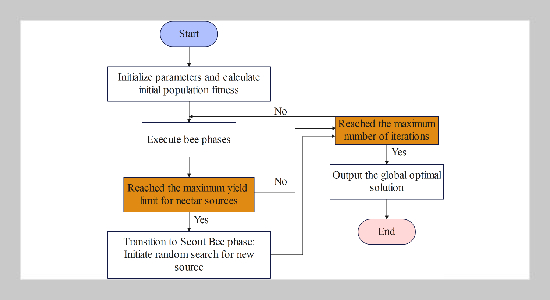
ABC algorithm flowchart.
Copyright The Author(s). This is an open access article distributed under the terms of the Creative Commons Attribution License (CC BY 4.0), which permits unrestricted use, distribution, and reproduction in any medium, provided the original author and source are cited.
Download Citation: BibTeX | http://dx.doi.org/10.6180/jase.202609_32.028
Cantilever anti-sliding piles are critical for slope stability, yet their subsurface health assessment remains challenged due to the invisibility of internal damage. This study proposes an on-destructive inversion framework that integrates computer vision with computational mechanics to quantify internal crack propagation depth based on surface morphological features. To address the limitations of the standard Artificial Bee Colony (ABC) algorithm, specifically its slow convergence and susceptibility to local optima—an Improved ABC (I-ABC) algorithm is developed. This enhancement incorporates a neighborhood-based optimal guidance mechanism and an adaptive selection probability strategy to strike an optimal balance between global exploration and local exploitation. The proposed framework first employs an optimized YOLOv8 model, with hyper-parameters tuned via the I-ABC algorithm, to extract surface crack parameters. These parameters are subsequently mapped to internal depths using a normalized objective function derived from an Extended Finite Element Method (XFEM) forward modeling database. Experimental validation, utilizing a hybrid dataset comprising physical pile tests and numerical simulations, demonstrates that the proposed method achieves a crack depth inversion accuracy of 96%. Furthermore, statistical comparisons reveal that the I-ABC algorithm significantly outperforms Particle Swarm Optimization (PSO), Differential Evolution (DE), and Grey Wolf Optimizer (GWO) in terms of robustness and convergence speed. Ultimately, this framework provides a reliable and automated tool for the
structural health monitoring of geotechnical infrastructure
Keywords: Cantilever anti-sliding pile; Artificial Bee Colony Algorithm; Adaptive parameters; Crack propagation depth; Extended Finite Element Method
- [1] Z. Zhu and B. Lin, (2024) “Calculations on Pile Spacing of Cantilever Anti-Slide Piles and Its Three-Dimensional Numerical Simulations” Chinese Journal of Industrial Construction 54(10): 183–190. DOI: 10.13204/j.gyjzg22100503.
- [2] Q. Ren, Y. Wang, and J. Shi, (2024) “Advances in Target Detection Algorithms for Convolutional Neural Networks” Science Technology and Engineering 24(32): 13665–13677. DOI: 10.12404/j.issn.1671-1815.2402976.
- [3] J. H. Holland, (1992) “Genetic Algorithms” Scientific American 267(1): 66–73.
- [4] J. Kennedy and R. Eberhart. “Particle swarm optimization”. In: Proceedings of ICNN’95 – International Conference on Neural Networks. 4. 1995, 1942–1948 vol.4. DOI: 10.1109/ICNN.1995.488968.
- [5] D. Marco, B. Mauro, and S. Thomas, (2006) “Ant colony optimization” IEEE Computational Intelligence Magazine 1(4): 28–39. DOI: 10.1109/MCI.2006.329691.
- [6] S. Mirjalili, S. M. Mirjalili, and A. Lewis, (2014) “Grey Wolf Optimizer” Advances in Engineering Software 69: 46–61. DOI: 10.1016/j.advengsoft.2013.12.007.
- [7] D. Karaboga and B. Basturk, (2007) “A powerful and efficient algorithm for numerical function optimization: artificial bee colony (ABC) algorithm” Journal of Global Optimization 39(3): 459–471. DOI: 10.1007/s10898-007-9149-x.
- [8] X. Deng, C. Du, L. Jin, and X. Wang, (2019) “Recognition of structural defects with improved artificial bee colony algorithm” Chinese Journal of Hefei University of Technology (Natural Science) 42(06): 856–864. DOI: 10.3969/j.issn.1003-5060.2019.06.0123.
- [9] Z. Xiang, L. Liu, and Z. Zhu, (2024) “Research on Propagation Behaviors of Fatigue Cracks of Arc-Cutouts in Diaphragms Based on XFEM” Chinese Journal of Bridge Construction 54(03): 46–53. DOI: 10.20051/j.issn.1003-4722.2024.03.007.
- [10] B. Akay, D. Karaboga, B. Gorkemli, and E. Kaya, (2021) “A survey on the Artificial Bee Colony algorithm variants for binary, integer and mixed integer programming problems” Applied Soft Computing 106: 107351. DOI: 10.1016/j.asoc.2021.107351.
- [11] D. Bajer and B. Zorić, (2019) “An effective refined artificial bee colony algorithm for numerical optimisation” Information Sciences 504: 221–275. DOI: 10.1016/j.ins.2019.07.022.
- [12] G. Zhu and S. Kwong, (2010) “Gbest-guided artificial bee colony algorithm for numerical optimization” Applied Mathematics and Computation 217(7): 3166–3173. DOI: 10.1016/j.amc.2010.08.049.
- [13] W.-f. Gao and S.-y. Liu, (2012) “A modified artificial bee colony algorithm” Computers & Operations Research 39(3): 687–697. DOI: 10.1016/j.cor.2011.06.007.
- [14] D. Kong, T. Chan, W. Dai, Q. Wang, and H. Sun, (2019) “An improved artificial bee colony algorithm based on the ranking selection and the elite guidance” Chinese Journal of Control and Decision 34(04): 781–786. DOI: 10.13195/j.kzyjc.2017.1334.
- [15] D. Guo. “Research and Application of Hidden Trouble Detection Model of Transmission Line Based on Improved YOLOX”. (mathesis). Liaoning Technical University,CHINA, 2023. DOI: 10.27210/d.cnki.glnju.2023.000583.
- [16] T. Belytschko and T. Black, (1999) “Elastic crack growth in finite elements with minimal remeshing” International Journal for Numerical Methods in Engineering 45(5): 601–620. DOI: 10.1002/(SICI)1097-0207(19990620)45:5<601::AID-NME598>3.0.CO;2-S.
- [17] J. Yu, X. X. Feng Li, P. Zhu, X. Wu, and P. Lu, (2021) “Intelligent Identification of Bridge Structural Cracks Based on Unmanned Aerial Vehicle and Mask R-CNN” Chinese Journal of Highway and Transport 34(12): 80–90. DOI: 10.19721/j.cnki.1001-7372.2021.12.007.
- [18] Z. Fang, J. Xia, and C. Liu, (2016) “Crack shape detection on the structural surface based on image analysis technology” Chinese Journal of Railway Science and Engineering 13(12): 2447–2454. DOI: 10.19713/j.cnki.43-1423/u.2016.12.019.
- [19] S. Hao, W. Haim, and B. Raimondo, (2013) “Nondestructive identification of multiple flaws using XFEM and a topologically adapting artificial bee colony algorithm” International Journal for Numerical Methods in Engineering 95(10): 871–900. DOI: 10.1002/nme.4529.
- [20] J. Song. “Research of identification method for bridge local damage based on deep learning and optimal inversion analysis”. (phdthesis). Tianjin University,CHINA, 2020. DOI: 10.27356/d.cnki.gtjdu.2020.002921.
- [21] H. Jin. “Study on the Service Performance and Durability Limit Life of Cantilever Anti-sliding Pile under Simulated Acid Rain Erosion Environment”. (phdthesis). Chongqing Jiaotong University,CHINA, 2024. DOI: 10.27671/d.cnki.gcjtc.2024.000015.
- [22] GB/T38509-2020. Code for the Design of Landslide Stabilization. 2020.
- [23] G. 50152-2012. Standard for test method of concrete structures. 2012.