



Huu-Thai Pham1, Dinh-Nhon Truong1, Van-Phong Vu1, Minh-Tam Nguyen1, Ngoc-Hoai-An Nguyen2, and Hoai-An Trinh1
1Faculty of Electrical and Electronics Engineering, Ho Chi Minh City University of Technology and Engineering, Vietnam 01 Vo Van Ngan Street, Thu Duc Ward, Ho Chi Minh City, Vietnam
2Faculty of Industrial Engineering, Ben Tre Technology Post-Secondary School, Vietnam 899 National Road 57C, Son Dong Ward, Vinh Long Province, Vietnam
Received: December 26, 2025
Accepted: March 30, 2026
Publication Date: April 25, 2026
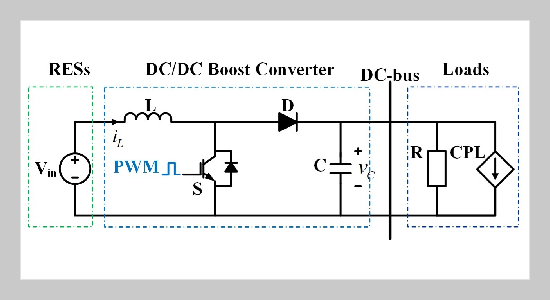
The Simplified DC Distribution System.
Copyright The Author(s). This is an open access article distributed under the terms of the Creative Commons Attribution License (CC BY 4.0), which permits unrestricted use, distribution, and reproduction in any medium, provided the original author and source are cited.
Download Citation: BibTeX | http://dx.doi.org/10.6180/jase.202609_32.017
In DC microgrids, Constant Power Load (CPL) is one of the causes to generate negative incremental resistance, which significantly reduces the stability margin and may lead to DC-bus voltage fluctuations. Therefore, the issue of handling the DC-bus voltage under the CPL is of considerable interest. In this paper, a Linear Extended State Observer-based Backstepping Sliding Mode Control (LESO-BSMC) strategy is proposed to enhance the robustness of output voltage for a boost converter under CPL and system uncertainties. A two-channel Linear Extended State Observer (LESO) is designed to estimate real-time disturbances caused by load variations, input-voltage fluctuations, and parameter mismatches, allowing for accurate compensation without relying on a detailed nonlinear model. The Backstepping Sliding Mode Control (BSMC) law is constructed based on the Lyapunov stability criteria to guarantee global stability, fast dynamic response, and reduced control chattering. Comprehensive simulations were conducted to confirm the effectiveness of the proposed algorithm for maintaining DC-bus voltage at 24 V under four scenarios. The obtained results demonstrate that the proposed LESO-BSMC strategy achieves high tracking performance, efficiency in disturbance rejection and robustness, faster dynamic recovery, and minimizes DC-bus voltage ripple in comparison to other strategies of PI-SMC and Adaptive BSMC (ABSMC), while significantly reducing switching activity as quantified by control-effort indices.
Keywords: Constant Power Load, DC Microgrid, DC-Bus Voltage, Linear Extended State Observer, Sliding Mode Control.
- [1] M. Uddin, H. Mo, D. Dong, S. Elsawah, J. Zhu, and J. M. Guerrero, (2023) “Microgrids: A review, outstanding issues and future trends” Energy Strategy Reviews 49: DOI: 10.1016/j.esr.2023.101127.
- [2] C. N. Papadimitriou, E. I. Zountouridou, and N. D. Hatziargyriou, (2015) “Review of hierarchical control in DC microgrids” Electric Power Systems Research 122: 159–167. DOI: 10.1016/j.epsr.2015.01.006.
- [3] R. Kumar and C. N. Bhende, (2023) “A virtual adaptive RC damper control method to suppress voltage oscillation in DC microgrid” International Journal of Electrical Power & Energy Systems 146: DOI: 10.1016/j.ijepes.2022.108795.
- [4] E. Hossain, R. Perez, A. Nasiri, and S. Padmanaban, (2018) “A Comprehensive Review on Constant Power Loads Compensation Techniques” IEEE Access 6: 33285–33305. DOI: 10.1109/access.2018.2849065.
- [5] S. Ansari, J. Zhang, and R. E. Singh, (2022) “A review of stabilization methods for DCMG with CPL, the role of bandwidth limits and droop control” Protection and Control of Modern Power Systems 7(1): DOI: 10.1186/s41601-021-00222-x.
- [6] S. Liu, P. Su, and L. Zhang, (2018) “A Virtual Negative Inductor Stabilizing Strategy for DC Microgrid With Constant Power Loads” IEEE Access 6: 59728–59741. DOI: 10.1109/access.2018.2874201.
- [7] Z. Zhang, G. Song, J. Zhou, X. Zhang, B. Yang, C. Liu, and J. M. Guerrero, (2022) “An adaptive backstepping control to ensure the stability and robustness for boost power converter in DC microgrids” Energy Reports 8: 1110–1124. DOI: 10.1016/j.egyr.2022.02.024.
- [8] H. Sira-Ramirez and M. Ilic-Spong, (1989) “Exact linearization in switched-mode DC-to-DC power converters” International Journal of Control 50(2): 511–524. DOI: 10.1080/00207178908953380.
- [9] L. Wang, T. Miao, X. Liu, and S. Liu, (2020) “Sliding Mode Control of Bi-directional DC/DC Converter in DC Microgrid Based on Exact Feedback Linearization” Wseas Transactions on Circuits and Systems 19: 206–211. DOI: 10.37394/23201.2020.19.23.
- [10] K. E. Lucas, D. J. Pagano, D. A. Plaza, D. A. Vaca–Benavides, and S. J. Ríos, (2020) “Robust Feedback Linearization Control for DAB Converter feeding a CPL” IFAC-PapersOnLine 53(2): 13402–13409. DOI: 10.1016/j.ifacol.2020.12.178.
- [11] M. Csizmadia, M. Kuczmann, and T. Orosz, (2022) “A Novel Control Scheme Based on Exact Feedback Linearization Achieving Robust Constant Voltage for Boost Converter” Electronics 12(1): DOI: 10.3390/electronics12010057.
- [12] J. D. Cham, F. L. D. Koffi, A. T. Boum, and A. Harrison, (2024) “Robust adaptive sliding mode control of a bidirectional DC-DC converter feeding a resistive and CPL based on PSO” International Journal of Power Electronics and Drive Systems (IJPEDS) 15(4): DOI: 10.11591/ijpeds.v15.i4.pp2397-2408.
- [13] S. Zheng, M. Qi, Y. Shu, Y. Wang, and J. Lang, (2022) “Non-singular terminal sliding mode control strategy for DC/DC Boost converter system using a finite-time convergent observer” IET Power Electronics 15(16): 1868–1876. DOI: 10.1049/pel.2.12354.
- [14] S. Singh, D. Fulwani, and V. Kumar, (2015) “Robust sliding-mode control of dc/dc boost converter feeding a constant power load” IET Power Electronics 8(7): 1230–1237. DOI: 10.1049/iet-pel.2014.0534.
- [15] G. Mustafa, F. Ahmad, R. Zhang, E. U. Haq, and M. Hussain, (2023) “Adaptive sliding mode control of buck converter feeding resistive and constant power load in DC microgrid” Energy Reports 9: 1026–1035. DOI: 10.1016/j.egyr.2022.11.131.
- [16] S. Oucheriah and L. Guo, (2013) “PWM-Based Adaptive Sliding-Mode Control for Boost DC–DC Converters” IEEE Transactions on Industrial Electronics 60(8): 3291–3294. DOI: 10.1109/tie.2012.2203769.
- [17] Z. Alam, T. K. Roy, S. K. Ghosh, and M. A. Mahmud, (2023) “A hybrid non-linear voltage controller design for DC–DC buck converters” The Journal of Engineering 2023(10): DOI: 10.1049/tje2.12318.
- [18] J. Linares-Flores, J. A. Juarez-Abad, A. Hernandez-Mendez, O. Castro-Heredia, J. F. Guerrero-Castellanos, R. Heredia-Barba, and G. Curiel-Olivares, (2022) “Sliding Mode Control Based on Linear Extended State Observer for DC-to-DC Buck-Boost Power Converter System With Mismatched Disturbances” IEEE Transactions on Industry Applications 58(1): 940–950. DOI: 10.1109/tia.2021.3130017.
- [19] R. F. Muktiadji, M. A. M. Ramli, H. R. E. H. Bouchekara, A. H. Milyani, M. Rawa, M. M. A. Seedahmed, and F. N. Budiman, (2022) “Control of Boost Converter Using Observer-Based Backstepping Sliding Mode Control for DC Microgrid” Frontiers in Energy Research 10: DOI: 10.3389/fenrg.2022.828978.
- [20] D. J. Almakhles, (2020) “Robust Backstepping Sliding Mode Control for a Quadrotor Trajectory Tracking Application” IEEE Access 8: 5515–5525. DOI: 10.1109/access.2019.2962722.
- [21] T. K. Roy, S. K. Ghosh, and S. Saha, (2023) “Robust backstepping global integral terminal sliding mode controller to enhance dynamic stability of hybrid AC/DC microgrids” Protection and Control of Modern Power Systems 8(1): DOI: 10.1186/s41601-023-00281-2.
- [22] J. Wu and Y. Lu, (2019) “Adaptive Backstepping Sliding Mode Control for Boost Converter With Constant Power Load” IEEE Access 7: 50797–50807. DOI: 10.1109/access.2019.2910936.
- [23] Z. Karami, Q. Shafiee, S. Sahoo, M. Yaribeygi, H. Bevrani, and T. Dragicevic, (2021) “Hybrid Model Predictive Control of DC-DC Boost Converters With Constant Power Load” IEEE Transactions on Energy Conversion 36(2): 1347–1356. DOI: 10.1109/tec.2020.3047754.
- [24] M. A. Hassan, C.-L. Su, J. Pou, G. Sulligoi, D. Almakhles, D. Bosich, and J. M. Guerrero, (2022) “DC Shipboard Microgrids With Constant Power Loads: A Review of Advanced Nonlinear Control Strategies and Stabilization Techniques” IEEE Transactions on Smart Grid 13(5): 3422–3438. DOI: 10.1109/tsg.2022.3168267.
- [25] S. Vazquez, J. Rodriguez, M. Rivera, L. G. Franquelo, and M. Norambuena, (2017) “Model Predictive Control for Power Converters and Drives: Advances and Trends” IEEE Transactions on Industrial Electronics 64(2): 935–947. DOI: 10.1109/tie.2016.2625238.
- [26] S. Oucheriah and A. Azad, (2024) “Robust Nonlinear Current Sensorless Control of the Boost Converter with Constant Power Load” Circuits and Systems 15(03): 29–43. DOI: 10.4236/cs.2024.153003.
- [27] J.-H. Xu, B.-X. Zhang, H.-Z. Yan, Q. Ding, K.-Q. Zhu, Y.-R. Yang, T.-M. Huang, S. Li, Z.-M. Wan, and X.-D. Wang, (2024) “Sliding mode – Extended state observer control strategy to improve energy transfer of PEMFC connected DC-DC boost converter system” Sustainable Energy Technologies and Assessments 63: DOI: 10.1016/j.seta.2024.103654.
- [28] M. Yang and P. Liu, (2023) “Research on Sliding Mode Control of Dual Active Bridge Converter Based on Linear Extended State Observer in Distributed Electric Propulsion System” Electronics 12(16): DOI: 10.3390/electronics12163522.
- [29] A. Viswambharan, R. Errouissi, M. Debouza, and H. Shareef, (2023) “Experimental Verification of Disturbance Observer-Based Backstepping Control for DC-DC Boost Converter” IEEE Transactions on Circuits and Systems I: Regular Papers 70(12): 5520–5533. DOI: 10.1109/tcsi.2023.3318970.
- [30] Z. Tian, R. Ren, and D. Tian. A Extended State Observer Based Backstepping Control for Improving Stability of DC-DC Boost Converters with Constant Power Loads. Conference Paper. 2024. DOI: 10.1109/ei264398.2024.10991407.
- [31] Q. Xu, C. Zhang, C. Wen, and P. Wang, (2019) “A Novel Composite Nonlinear Controller for Stabilization of Constant Power Load in DC Microgrid” IEEE Transactions on Smart Grid 10(1): 752–761. DOI: 10.1109/tsg.2017.2751755.
- [32] M. Alipour, J. Zarei, R. Razavi-Far, M. Saif, N. Mijatovic, and T. Dragicevic, (2023) “Observer-Based Backstepping Sliding Mode Control Design for Microgrids Feeding a Constant Power Load” IEEE Transactions on Industrial Electronics 70(1): 465–473. DOI: 10.1109/tie.2022.3152028.
- [33] J.-Q. Han. “Nonlinear design methods for control systems”. In: IFAC Proceedings Volumes. 32. 1999, 1531–1536. DOI: 10.1016/s1474-6670(17)56259-x.
- [34] J. Han, (2009) “From PID to Active Disturbance Rejection Control” IEEE Transactions on Industrial Electronics 56(3): 900–906. DOI: 10.1109/tie.2008.2011621.
- [35] Z. Gao. “Scaling and bandwidth-parameterization based controller tuning”. In: the 2003 American Control Conference. IEEE, 2003, 4989–4996. DOI: 10.1109/ACC.2003.1242516.
- [36] Z. S. Zhiqiang and G. “Active disturbance rejection control for nonminimum phase systems”. In: the 29th Chinese Control Conference. IEEE, 2010, 6066–6070. URL: https://ieeexplore.ieee.org/document/5572904.
- [37] J. Espín, F. Castrillon, H. Leiva, and O. Camacho, (2022) “A modified Smith predictor based – Sliding mode control approach for integrating processes with dead time” Alexandria Engineering Journal 61(12): 10119–10137. DOI: 10.1016/j.aej.2022.03.045.
- [38] M. C. Maya-Rodriguez, I. Carvajal-Mariscal, R. López-Muñoz, M. A. Lopez-Pacheco, and R. Tolentino-Eslava, (2023) “Temperature Control of a Chemical Reactor Based on Neuro-Fuzzy Tuned with a Metaheuristic Technique to Improve Biodiesel Production” Energies 16(17): DOI: 10.3390/en16176187.
- [39] C. Obando, R. Rojas, F. Ulloa, and O. Camacho, (2023) “Dual-Mode Based Sliding Mode Control Approach for Nonlinear Chemical Processes” ACS Omega 8(10): 9511–9525. DOI: 10.1021/acsomega.2c08201. URL: https://www.ncbi.nlm.nih.gov/pubmed/36936305.