


Sularman Sularman, Wijang Wisnu Raharjo, and Heru Sukanto
Mechanical Engineering Department, Universitas Sebelas Maret, Surakarta 57126, Indonesia
Received: November 10, 2025
Accepted: March 15, 2026
Publication Date: April 25, 2026
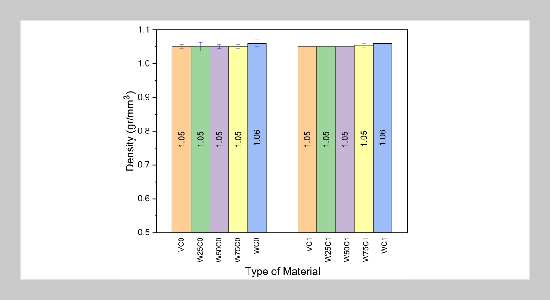
Density of ABS variants under control (C0) and 1-month natural weathering (C1) conditions (mean ± SD, n = 5 ). Error bars represent standard deviation.
Copyright The Author(s). This is an open access article distributed under the terms of the Creative Commons Attribution License (CC BY 4.0), which permits unrestricted use, distribution, and reproduction in any medium, provided the original author and source are cited.
Download Citation: BibTeX | http://dx.doi.org/10.6180/jase.202609_32.014
Acrylonitrile butadiene styrene (ABS) is widely used in various industries, generating significant post-industrial waste. Mechanical recycling and outdoor exposure are both known to degrade ABS; however, their combined effects under natural conditions remain insufficiently understood. This study investigates the influence of reprocessed ABS (rABS) content ( 0−100% ) and short-term natural weathering (one month) on the physical and mechanical behaviour of injection-moulded ABS. A total of 160 specimens, representing five material compositions and two exposure conditions (control and weathered), were characterised through density measurement, tensile, flexural, and impact testing, complemented by macro photography. The density remained relatively stable 1.05 −1.06 g/cm3 across all conditions, with a slight increase observed at higher rABS contents. Under control conditions, tensile strength ranged from 41.2 to 44.9 MPa and flexural strength from 66.3 to 73.4 MPa , values approximately 8−12% lower than the manufacturer’s nominal datasheet values, indicating acceptable agreement with commercial-grade ABS. Following short-term natural weathering, tensile strength decreased by up to 23.6%, while strain at break was reduced by approximately 86−89%, confirming severe embrittlement. Flexural strength exhibited the most pronounced degradation, with reductions of approximately 88.9 −92.3%, highlighting the high sensitivity of bending resistance to early-stage environmental exposure. In contrast, impact strength showed comparatively moderate variations (within −17.3% to +1.7% ), suggesting that dynamic fracture resistance is less sensitive than quasi-static bending during short-term outdoor exposure. These findings demonstrate that recycled ABS blends, particularly at higher recycled fractions, are more susceptible to embrittlement under natural weathering conditions.
Keywords: Recycled ABS; Natural Weathering; Mechanical Properties; Flexural Strength; Impact Toughness; Embrittlement
- [1] M. A. A. AlMaadeed, D. Ponnamma, and A. A. El-Samak. “Chapter 1 – Polymers to improve the world and lifestyle: physical, mechanical, and chemical needs”. In: Polymer Science and Innovative Applications. Ed. by M. A. A. AlMaadeed, D. Ponnamma, and M. A. Carignano. Elsevier, 2020, 1–19. DOI: 10.1016/B978-0-12-816808-0.00001-9.
- [2] D. Li and S. Wang. “Acrylonitrile–Butadiene–Styrene (ABS) Polymers”. In: Kirk-Othmer Encyclopedia of Chemical Technology. John Wiley & Sons, Ltd, 2021, 1–27. DOI: 10.1002/0471238961.01021911211209.a01.pub3.
- [3] M. Bharne and S. Bhosle, (2014) “Mechanical and Thermal Properties of Fly Ash Filled ABS” International Journal of Engineering Research and Technology 3: 750–756.
- [4] N. Evode, S. A. Qamar, M. Bilal, D. Barceló, and H. M. N. Iqbal, (2021) “Plastic waste and its management strategies for environmental sustainability” Case Studies in Chemical and Environmental Engineering 4: 100142. DOI: 10.1016/j.cscee.2021.100142.
- [5] M. A. Nikousaleh, R.-U. Giesen, H.-P. Heim, and M. Hartung, (2023) “MC-Injection Molding with Liquid Silicone Rubber (LSR) and Acrylonitrile Butadiene Styrene (ABS) for Medical Technology” Polymers 15: 3972. DOI: 10.3390/polym15193972.
- [6] G. Shanthi, J. Beula Isabel, R. Thankachan, and M. Premalatha, (2024) “Sustainable strategies towards better utilization of synthetic polymers” Biopolymers 115(4): e23581. DOI: 10.1002/bip.23581.
- [7] F. Di Maio and P. C. Rem, (2015) “A robust indicator for promoting circular economy through recycling” Journal of Environmental Protection 6(10): 1095–1104. DOI: 10.4236/jep.2015.610096.
- [8] A. Lamtai, S. Elkoun, M. Robert, F. Mighri, and C. Diez, (2023) “Mechanical Recycling of Thermoplastics: A Review of Key Issues” Waste 1(4): 860–883. DOI: 10.3390/waste1040050.
- [9] A. K. Cress, J. Huynh, E. H. Anderson, R. O’Neill, Y. Schneider, and Ö. Keleş, (2021) “Effect of recycling on the mechanical behavior and structure of additively manufactured acrylonitrile butadiene styrene (ABS)” Journal of Cleaner Production 279: 123689. DOI: 10.1016/j.jclepro.2020.123689.
- [10] X. Bai, D. H. Isaac, and K. Smith, (2007) “Reprocessing acrylonitrile–butadiene–styrene plastics: Structure–property relationships” Polymer Engineering and Science 47(2): 120–130. DOI: 10.1002/pen.20681.
- [11] V. Mishra, S. Negi, and S. Kar, (2023) “FDM-based additive manufacturing of recycled thermoplastics and associated composites” Journal of Material Cycles and Waste Management 25(2): 758–784. DOI: 10.1007/s10163-022-01588-2.
- [12] L. Hýlová and M. Maňas. “Impact behaviour of acrylonitrile-butadiene-styrene after temperature and humidity load”. In: MATEC Web of Conferences. 125. 2017, 02048. DOI: 10.1051/matecconf/201712502048.
- [13] P. Kakanuru and K. Pochiraju, (2020) “Moisture Ingress and Degradation of Additively Manufactured PLA, ABS and PLA/SiC Composite Parts” Additive Manufacturing 36: 101529. DOI: 10.1016/j.addma.2020.101529.
- [14] V. Ramesh, S. Mohanty, M. Biswal, and S. K. Nayak, (2015) “Effect of Reprocessing and Accelerated Weathering on Impact-Modified Recycled Blend” Journal of Materials Engineering and Performance 24(12): 5046–5053. DOI: 10.1007/s11665-015-1743-3.
- [15] G. A. Munshi and V. M. Kulkarni, (2025) “A comprehensive study on restoring properties in expired/aged ABS materials: advanced techniques, additive integration and challenges for sustainable industrial reuse and manufacturing” Journal of Materials Science: Materials in Engineering 20(1): 48. DOI: 10.1186/s40712-025-00260-5.
- [16] J. Finnerty, S. Rowe, T. Howard, S. Connolly, C. Doran, D. M. Devine, N. M. Gately, V. Chyzna, A. Portela, G. S. N. Bezerra, P. McDonald, and D. M. Colbert, (2023) “Effect of Mechanical Recycling on the Mechanical Properties of PLA-Based Natural Fiber-Reinforced Composites” Journal of Composites Science 7(4): 141. DOI: 10.3390/jcs7040141.
- [17] P.-W. Huang and H.-S. Peng, (2021) “Number of Times Recycled and Its Effect on the Recyclability, Fluidity and Tensile Properties of Polypropylene Injection Molded Parts” Sustainability 13(19): 11085. DOI: 10.3390/su131911085.
- [18] V. Mishra, C. K. Ror, S. Negi, S. Kar, and L. N. Borah, (2023) “Development of sustainable 3D printing filaments using recycled/virgin ABS blends: Processing and characterization” Polymer Engineering and Science 63(7): 1890–1899. DOI: 10.1002/pen.26330.
- [19] N. Vidakis, M. Petousis, A. Maniadi, E. Koudoumas, A. Vairis, and J. Kechagias, (2020) “Sustainable Additive Manufacturing: Mechanical Response of Acrylonitrile-Butadiene-Styrene over Multiple Recycling Processes” Sustainability 12(9): 3568. DOI: 10.3390/su12093568.
- [20] O. T. Türkan and E. Çetin, (2023) “Evaluating combination of solvent-based recycling and mechanical recycling of ABS materials for mitigating plastic pollution and promoting environmental consciousness” Orclever Proceedings of Research and Development 3(1): 672–693. DOI: 10.56038/oprd.v3i1.410.
- [21] J. Sedlak, Z. Joska, J. Jansky, J. Zouhar, S. Kolomy, M. Slany, A. Svasta, and J. Jirousek, (2023) “Analysis of the Mechanical Properties of 3D-Printed Plastic Samples Subjected to Selected Degradation Effects” Materials 16(8): 3268. DOI: 10.3390/ma16083268.
- [22] A. Milovanovic, M. Milosevic, I. Trajkovic, A. Sedmak, N. Razavi, and F. Berto, (2022) “Crack path direction in plane-strain fracture toughness assessment tests of quasi-brittle PLA polymer and ductile PLA-X composite” Procedia Structural Integrity 42: 1376–1381. DOI: 10.1016/j.prostr.2022.12.175.