




Mingru Lei1, Haiyong Peng1, Yuchen Jiang1, Yi Cui2, and Yun Guo1
1School of Mechanical and Automotive Engineering, Shanghai University of Engineering Science, Shanghai 201600, China
2School of Mechanical Engineering, Shanghai Jiao Tong University, Shanghai 201100, China
Received: October 9, 2025
Accepted: February 7, 2026
Publication Date: April 12, 2026
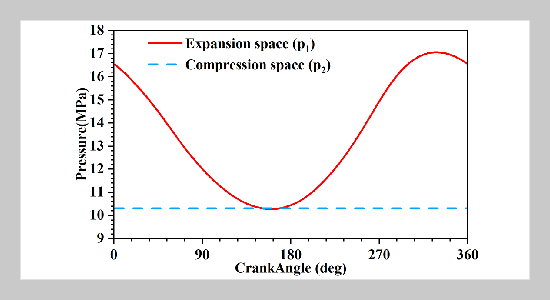
Variation of expansion chamber and compression chamber pressures with crank angle
Copyright The Author(s). This is an open access article distributed under the terms of the Creative Commons Attribution License (CC BY 4.0), which permits unrestricted use, distribution, and reproduction in any medium, provided the original author and source are cited.
Download Citation: BibTeX | http://dx.doi.org/10.6180/jase.202609_32.004
The reliability and durability of piston rings in double-acting Stirling engines are critical to overall engine performance. This study investigates the dynamic tribological behavior of the piston ring-cylinder liner contacts during operation. By establishing a coupled dynamic-tribological-leakage simulation model, the friction, sealing, and wear performance of the ring pack under rated and variable-speed operating conditions are systematically analyzed. Under the rated condition of 1800r/min, the instantaneous maximum friction forces of the top ring and the second ring are 392.3 N and 163.7 N, respectively, while the corresponding cycle-averaged friction forces are 147.9 N and 94.8 N. The instantaneous peak frictional power losses are 1360 W and 590 W, and the cycle-averaged frictional power losses are 470.2 W and 309.3 W, respectively. The peak total contact pressures reach 18.9 MPa for the top ring and 13.55 MPa for the second ring, and the maximum radial wear depths after 100 h of operation are 0.121 mm and 0.115 mm, respectively. When the rotational speed increases from 900r/min to 3600 r/min, the blow-by of the ring pack decreases by 68.8%, whereas the total frictional power loss and the wear rate increase by 229% and 122%, respectively. These results quantitatively reveal an inherent and previously unresolved trade-off between sealing performance and wear life for filled PTFE composite piston rings in double-acting Stirling engines. The proposed framework provides physically based design metrics for ring material selection, ring geometry optimization, and operating-condition assessment, and supports reliable sealing performance and service-life prediction for Stirling engine applications.
Keywords: dynamic simulation; oil-free lubrication seal; sealing performance; Blow-by
- [1] D. G. Thombare and S. K. Verma, (2008) “Technological development in the Stirling cycle engines” Renewable and Sustainable Energy Reviews 12(1): 1–38. DOI: 10.1016/j.rser.2006.07.001.
- [2] J. Zou. Stirling Engine. 1st ed. Changsha: Hunan University Press, 1985, Chapter 3.
- [3] H. Hachem, R. Gheith, F. Aloui, and S. Ben Nasrallah, (2018) “Technological challenges and optimization efforts of the Stirling machine: A review” Energy Conversion and Management 171: 1365–1387. DOI: 10.1016/j.enconman.2018.06.042.
- [4] S. Zare and A. Tavakolpour-Saleh, (2019) “Free piston Stirling engines: A review” International Journal of Energy Research 44(7): 5039–5070. DOI: 10.1002/er.4533.
- [5] M. H. Briggs. “Improving power density of free-piston stirling engines”. In: 14th International Energy Conversion Engineering Conference. 2016, 5016. DOI: 10.2514/6.2016-5016.
- [6] G. Walker. Stirling engines. Oxford: Oxford University Press, 1980, Chapter 3.
- [7] B. Brushan and D. F. Wilcock, (1982) “Wear behavior of polymeric compositions in dry reciprocating sliding” Wear 75(1): 41–70. DOI: 10.1016/0043-1648(82)90139-9.
- [8] Y. Diao and A. Wei, (2004) “Friction and Wear Analysis of Self-lubrication Piston Ring” Lubrication Engineering 29(05): 103–106.
- [9] J. Ye, D. Burris, and T. Xie, (2016) “A Review of Transfer Films and Their Role in Ultra-Low-Wear Sliding of Polymers” Lubricants 4(1): DOI: 10.3390/lubricants4010004.
- [10] T. W. Scharf and S. V. Prasad, (2013) “Solid lubricants: a review” Journal of Materials Science 48(2): 511–531. DOI: 10.1007/s10853-012-7038-2.
- [11] H. Guo, J. Zhao, and X. Sun, (1990) “A Study on the Wear Mechanism of Filled Oilless Sliding Materials” Journal of Beijing University of Aeronautics and Astronautics (04): 32–39. DOI: 10.13700/j.bh.1001-5965.1990.04.006.
- [12] J. Wang, X. Huang, W. Wang, H. Han, H. Duan, S. Yu, and M. Zhu, (2022) “Tribological behavior and film-forming mechanism of a polytetrafluoroethylene/polyester fabric composite” Industrial Lubrication and Tribology 74(1): 65–72. DOI: 10.1108/ILT-07-2021-0246.
- [13] R. Huang, S. Ma, M. Zhang, J. Yang, D. Wang, L. Zhang, and J. Xu, (2019) “Wear Evolution of the Glass Fiber-Reinforced PTFE under Dry Sliding and Elevated Temperature” Materials (Basel) 12(7): 1082. DOI: 10.3390/ma12071082.
- [14] H. C. Meng and K. C. Ludema, (1995) “Wear models and predictive equations: their form and content” Wear 181-183: 443–457. DOI: 10.1016/0043-1648(95)90158-2.
- [15] S. K. Rhee, (1970) “Wear equation for polymers sliding against metal surfaces” Wear 16(6): 431–445. DOI: 10.1016/0043-1648(70)90170-5.
- [16] S. Xu, H. Li, and Z. Su, (2019) “Fitting of Wear Formula of Filled PTFE Based on Finite Element Analysis Method” Lubrication Engineering 44(09): 142–146.
- [17] V. Singh and A. Kumar, (2024) “A Systematic and Comprehensive Review on 2-D and 3-D Numerical Modelling of Stirling Engine” Archives of Computational Methods in Engineering 31(6): 3255–3266. DOI: 10.1007/s11831-024-10080-z.
- [18] G. Gu, D. Jin, and T. Yan, (2000) “Study on the Stirling Engine Dynamic Characteristics” Transactions of CSICE (03): 305–307. DOI: 10.16236/j.cnki.nrjxb.2000.03.018.
- [19] H.-S. Yang, C.-H. Cheng, and S.-T. Huang, (2018) “A complete model for dynamic simulation of a 1-kW class beta-type Stirling engine with rhombic-drive mechanism” Energy 161: 892–906. DOI: 10.1016/j.energy.2018.07.159.
- [20] C.-H. Cheng and Y.-J. Yu, (2012) “Combining dynamic and thermodynamic models for dynamic simulation of a beta-type Stirling engine with rhombic-drive mechanism” Renewable Energy 37(1): 161–173. DOI: 10.1016/j.renene.2011.06.013.
- [21] Y. Q. Lian, Q. C. Xu, and D. K. Ren, (2012) “Life Prediction of the Oil-Free Piston Rings in the Air-Powered Swashplate Engine” Advanced Materials Research 538-541: 3008–3011. DOI: 10.4028/www.scientific.net/AMR.538-541.3008.
- [22] S. Hou, L. Zhang, and X. Zhang. “Friction analysis for piston ring of seal device in the stirling engine”. In: 2nd International Conference on Electronic & Mechanical Engineering and Information Technology. Atlantis Press. 2012, 987–991. DOI: 10.2991/emeit.2012.214.
- [23] D. Y. Yang, H. Xie, and J. Gong, (2013) “The Analysis of the Influencing Factors about Friction and Wear Characteristics of the Piston Ring in Stirling Engine” Advanced Materials Research 690-693: 2003–2007. DOI: 10.4028/www.scientific.net/AMR.690-693.2003.
- [24] D. Xin, J. Feng, Y. Xu, and X. Peng, (2010) “Investigation of Pressure Distribution and Frictional Heat on Self-Lubricated Piston Rings in Reciprocating Compressors” Compressor Technology 48(06): 8–12. DOI: 10.16051/j.cnki.ysjs.2010.06.010.
- [25] J. Zen, Y. Peng, X. Dai, and R. Xiao, (2015) “Numerical Calculation of Flow esistance Characteristics of Double-acting Stirling Engine Piston Sealing” Lubrication Engineering 40(06): 95–99.
- [26] J. F. Archard, (1953) “Contact and Rubbing of Flat Surfaces” Journal of Applied Physics 24(8): 981–988. DOI: 10.1063/1.1721448.
- [27] M. Hanief and M. S. Charoo, (2021) “Archard’s wear law revisited to measure accurate wear coefficient considering actual sliding velocity” Materials Today: Proceedings 47: 5598–5600. DOI: 10.1016/j.matpr.2021.03.475.
- [28] M. Varenberg, (2022) “Adjusting for Running-in: Extension of the Archard Wear Equation” Tribology Letters 70(2): DOI: 10.1007/s11249-022-01602-6.
- [29] Y. Ding, P. Li, C. Xing, X. Kang, Y. Lv, X. Du, X. Gao, and Y. Li, (2025) “Lifespan prediction of the piston ring set of oil-free reciprocating compressors coupled with pressure distribution variation” Engineering Failure Analysis 171: 109317. DOI: 10.1016/j.engfailanal.2025.109317.
- [30] N. Békési, K. Váradi, and D. Felhős, (2011) “Wear Simulation of a Reciprocating Seal” Journal of Tribology 133(3): DOI: 10.1115/1.4004301.
- [31] W. Cao, Z. Chang, A. Zhou, X. Dou, G. Gao, and J. Gong, (2022) “Investigation into the Influence of Parallel Offset Wear on Stirling Engine Piston Rod Oil-Free Lubrication Seal” Machines 10(5): 350. DOI: 10.3390/machines10050350.
- [32] F. Razavirad, N. Kristensen, J. de Claville Christiansen, and M. M. B. Bak, (2025) “A computational study on wear behavior in piston ring-cylinder liner assemblies” Proceedings of the Institution of Mechanical Engineers, Part J: Journal of Engineering Tribology 240(1): 119–138. DOI: 10.1177/13506501251337966.
- [33] M. Ahmed Ali, H. Xianjun, R. Turkson, and M. Ezzat, (2015) “An analytical study of tribological parameters between piston ring and cylinder liner in internal combustion engines” Proceedings of the Institution of Mechanical Engineers, Part K: Journal of Multi-body Dynamics 230(4): 329–349. DOI: 10.1177/1464419315605922.
- [34] K. Mahmoud, O. Knaus, T. Parikyan, and M. Patete. “Three dimensional ring dynamics modeling approach for analyzing lubrication, friction and wear of piston ring-pack”. In: Internal Combustion Engine Division Fall Technical Conference. 58325. American Society of Mechanical Engineers. 2017, V002T06A013. DOI: 10.1115/ICEF2017-3586.
- [35] K. G. Mahmoud, O. Knaus, T. Parikyan, G. Offner, and S. Sklepic, (2018) “An integrated model for the performance of piston ring pack in internal combustion engines” Proceedings of the Institution of Mechanical Engineers, Part K: Journal of Multi-body Dynamics 232(3): 371–384. DOI: 10.1177/1464419317736676.
- [36] Y. Zhu, (2008) “Design and calculation on work clearance and relative interference amount of non-backpressure piston rings” Journal of Hebei University of Science Technology 29(1): 53–56.
- [37] Y. Zhu, (2006) “Research on design of integral non-backpressure piston rings in compressors” Lubrication Engineering 31(12): 106–107.
- [38] N. P. Suh, (1973) “The delamination theory of wear” Wear 25(1): 111–124. DOI: 10.1016/0043-1648(73)90125-7.
- [39] C. Delprete, E. Selmani, and A. Bisha, (2019) “Gas escape to crankcase: impact of system parameters on sealing behavior of a piston cylinder ring pack” International Journal of Energy and Environmental Engineering 10(2): 207–220. DOI: 10.1007/s40095-019-0296-x.
- [40] H. X. Xu, W. Song, W. B. Ying, X. N. Cheng, and X. H. Yuan, (2007) “Mechanical properties of PTFE composites rein forced by glass fiber and graphite” Journal of Jiangsu University(Natural Science Edition) 37(05): 401–404.
- [41] B. Menacer, S. Narayan, V. Tuninetti, T. Khatir, A. Oñate, L. Osorio, S. Abubakar, J. Samuel, I. Grujic, N. Stojanovic, and M. U. Kaisan, (2024) “Impact of Influence of Piston Design Parameters on the Hydrodynamic Characteristics of Internal Combustion Engines—A Numerical Study” Lubricants 12(12): 427. DOI: 10.3390/lubricants12120427.
- [42] B. Bhushan, (1984) “Analysis of the Real Area of Contact Between a Polymeric Magnetic Medium and a Rigid Surface” Journal of Tribology 106(1): 26–34. DOI: 10.1115/1.3260862.
- [43] H. Li, R. Yang, and Z. Su, (2023) “Effect of different rigid reinforcing fillers on properties of PTFE” China Plastics 37(08): 13–19. DOI: 10.19491/j.issn.1001-9278.2023.08.003.
- [44] Q. Yao, Y. Wen, J. Yu, and R. Zhang, (2012) “Research on Structure Design of Elastic Composite Cylindrical Roller Bearing” China Mechanical Engineering 23(24): 2899–2902.
- [45] S. Zhang, H. Song, S. Sandfeld, X. Liu, and Y. G. Wei, (2019) “Discrete Greenwood–Williamson Modeling of Rough Surface Contact Accounting for Three-Dimensional Sinusoidal Asperities and Asperity Interaction” Journal of Tribology 141(12): DOI: 10.1115/1.4044635.
- [46] J. A. Greenwood and J. H. Tripp, (1967) “The Elastic Contact of Rough Spheres” Journal of Applied Mechanics 34(1): 153–159. DOI: 10.1115/1.3607616.
- [47] D. Xin, J. Feng, L. Ding, D. Yang, and X. Peng, (2012) “Experimental investigation of pressure distribution between the piston rings and its formation in reciprocating compressors” Proceedings of the Institution of Mechanical Engineers, Part C: Journal of Mechanical Engineering Science 226(11): 2701–2712. DOI: 10.1177/0954406212438151.