



School of Henan Institute of International Business and Economics; Zhengzhou Henan, 450002, China
Received: June 15, 2025
Accepted: September 21, 2025
Publication Date: March 8, 2026
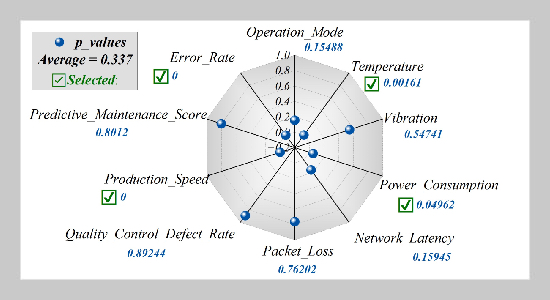
Feature selection for the input variables.
Copyright The Author(s). This is an open access article distributed under the terms of the Creative Commons Attribution License (CC BY 4.0), which permits unrestricted use, distribution, and reproduction in any medium, provided the original author and source are cited.
Download Citation: RIS | BibTeX | http://dx.doi.org/10.6180/jase.202607_30.029
This paper presents a feature-based paradigm for intelligent manufacturing, highlighting the operational influence of critical variables temperature, operating mode, power consumption, network latency, production speed, and error rate on system efficiency. Four hybrid models were created by integrating Stacking Classification (SC) and Gaussian Process Classification (GPC) with Artificial Rabbit Optimization (ARO) and Coronavirus Herd Immunity Optimizer (CHIO) to elucidate intricate feature connections and improve prediction accuracy. The models—STCO, STAO, GPCO, and GPAO were evaluated using metrics such as Accuracy, F1-score, and Matthews Correlation Coefficient. STAO attained the greatest test accuracy (0.981) and MCC (0.972), thereby validating its exceptional performance. Feature importance analysis indicated that production speed and error rate are the most significant variables. SHAP and FAST studies provided additional insights, indicating that interaction effects among characteristics predominantly influence model behavior. The findings indicate that hybrid intelligent models utilizing feature-level input priority provide enhanced predicted accuracy and increased explainability, rendering them appropriate for real-time industrial application.
Keywords: Intelligent Manufacturing; Feature Importance Analysis; Production Efficiency Prediction; Feature-Based Modeling; Bio-inspired Optimization
- [1] C. Li, Y. Chen, and Y. Shang, (2022) “A review of industrial big data for decision making in intelligent manufacturing” Engineering science and technology, an international journal 29: 101021. DOI: 10.1016/j.jestch.2021.06.001.
- [2] A. Barari, M. de Sales Guerra Tsuzuki, Y. Cohen, and M. Macchi, (2021) “Intelligent manufacturing systems towards industry 4.0 era” Journal of Intelligent Manufacturing 32: 1793–1796. DOI: 10.1007/s10845-021-01769-0.
- [3] Y. Shen and X. Zhang, (2023) “Intelligent manufacturing, green technological innovation and environmental pollution” Journal of Innovation & Knowledge 8: 100384. DOI: 10.1016/j.jik.2023.100384.
- [4] G. Nain, K. K. Pattanaik, and G. K. Sharma, (2022) “Towards edge computing in intelligent manufacturing: Past, present and future” Journal of Manufacturing Systems 62: 588–611. DOI: 10.1016/j.jmsy.2022.01.010.
- [5] L. Zhou, Z. Jiang, N. Geng, Y. Niu, F. Cui, K. Liu, and N. Qi, (2022) “Production and operations management for intelligent manufacturing: A systematic literature review” International Journal of Production Research 60: 808–846. DOI: 10.1080/00207543.2021.2017055.
- [6] Y. Fu, Y. Hou, Z. Wang, X. Wu, K. Gao, and L. Wang, (2021) “Distributed scheduling problems in intelligent manufacturing systems” Tsinghua Science and Technology 26: 625–645. DOI: 10.26599/TST.2021.9010009.
- [7] M. Attaran, S. Attaran, and B. G. Celik, (2023) “The impact of digital twins on the evolution of intelligent manufacturing and Industry 4.0″ Advances in Computational Intelligence 3: 11. DOI: 10.1007/s43674-023-00058-y.
- [8] K. Feng, J. C. Ji, Q. Ni, Y. Li, W. Mao, and L. Liu, (2023) “A novel vibration-based prognostic scheme for gear health management in surface wear progression of the intelligent manufacturing system” Wear 522: 204697. DOI: 10.1016/j.wear.2023.204697.
- [9] S. Yin, N. Zhang, K. Ullah, and S. Gao, (2022) “Enhancing digital innovation for the sustainable transformation of manufacturing industry: a pressure-state-response system framework to perceptions of digital green innovation and its performance for green and intelligent manufacturing” Systems 10: 72. DOI: 10.3390/systems10030072.
- [10] B. Wang, F. Tao, X. Fang, C. Liu, Y. Liu, and T. Freiheit, (2021) “Smart manufacturing and intelligent manufacturing: A comparative review” Engineering 7: 738–757. DOI: 10.1016/j.eng.2020.07.017.
- [11] B. He and K.-J. Bai, (2021) “Digital twin-based sustainable intelligent manufacturing: a review” Advances in Manufacturing 9: 1–21. DOI: 10.1007/s40436-020-00302-5.
- [12] H. B. Mahajan, A. Badarla, and A. A. Junnarkar, (2021) “CL-IoT: cross-layer Internet of Things protocol for intelligent manufacturing of smart farming” Journal of Ambient Intelligence and Humanized Computing 12: 7777–7791. DOI: 10.1007/s12652-020-02502-0.
- [13] S. Wu and J. Zhang, (2021) “Research on a compound dual innovation capability model of intelligent manufacturing enterprises” Sustainability 13: 12521. DOI: 10.3390/su132212521.
- [14] V. Bortnikova, V. Yevsieiev, I. Botsman, I. Nevliudov, K. Kolesnyk, and N. Jaworski, (2021) “Queries classification using machine learning for implementation in intelligent manufacturing” Publishing House of Bialystok University of Technology: DOI: 10.24427/978-83-66391-87-1.
- [15] Q. Huang. “Intelligent manufacturing”. In: Springer, 2022, 111–127. DOI: 10.1007/978-981-19-2527-6.
- [16] H.-Y. Zhang, Q.-X. Chen, J. M. Smith, N. Mao, Y. Liao, and S.-H. Xi, (2021) “Queueing network models for intelligent manufacturing units with dual-resource constraints” Computers & Operations Research 129: 105213. DOI: 10.1016/j.cor.2021.105213.
- [17] I. K. Nti, A. F. Adekoya, B. A. Weyori, and O. NyarkoBoateng, (2022) “Applications of artificial intelligence in engineering and manufacturing: a systematic review” Journal of Intelligent Manufacturing 33: 1581–1601. DOI: 10.1007/s10845-021-01771-6.
- [18] H. Fan, X. Liu, J. Y. H. Fuh, W. F. Lu, and B. Li, (2025) “Embodied intelligence in manufacturing: leveraging large language models for autonomous industrial robotics” Journal of Intelligent Manufacturing 36: 1141–1157. DOI: 10.1007/s10845-023-02294-y.
- [19] H. Yang, L. Li, and Y. Liu, (2022) “The effect of manufacturing intelligence on green innovation performance in China” Technological Forecasting and Social Change 178: 121569. DOI: 10.1016/j.techfore.2022.121569.
- [20] S. W. Kim, J. H. Kong, S. W. Lee, and S. Lee, (2022) “Recent advances of artificial intelligence in manufacturing industrial sectors: A review” International Journal of Precision Engineering and Manufacturing 23: 111–129. DOI: 10.1007/s12541-021-00600-3.
- [21] B. S. A. Alhayani and H. Llhan, (2021) “RETRACTED ARTICLE: Visual sensor intelligent module based image transmission in industrial manufacturing for monitoring and manipulation problems” Journal of Intelligent Manufacturing 32: 597–610. DOI: 10.1007/s10845-020-01590-1.
- [22] M. Noor-A-Rahim, F. Firyaguna, J. John, M. O. Khyam, D. Pesch, E. Armstrong, H. Claussen, and H. V. Poor, (2022) “Toward industry 5.0: Intelligent reflecting surface in smart manufacturing” IEEE Communications Magazine 60: 72–78. DOI: 10.1109/MCOM.001.2200016.
- [23] L. Wang, Z. Pan, and J. Wang, (2021) “A review of reinforcement learning based intelligent optimization for manufacturing scheduling” Complex System Modeling and Simulation 1: 257–270. DOI: 10.23919/CSMS.2021.0027.
- [24] H. Yan, X. Du, L. Xu, S. Xu, Y. Zhang, and P. Gong, (2022) “Toward intelligent clothes manufacturing: a systematic method for static and dynamic task allocation by genetic optimization” Neural Computing and Applications 34: 7881–7897. DOI: 10.1007/s00521-022-06890-6.
- [25] X. Zhou, X. Xu, W. Liang, Z. Zeng, S. Shimizu, L. T. Yang, and Q. Jin, (2021) “Intelligent small object detection for digital twin in smart manufacturing with industrial cyber-physical systems” IEEE Transactions on Industrial Informatics 18: 1377–1386. DOI: 10.1109/TII.2021.3061419.
- [26] A. Shojaeinasab, T. Charter, M. Jalayer, M. Khadivi, O. Ogunfowora, N. Raiyani, M. Yaghoubi, and H. Najjaran, (2022) “Intelligent manufacturing execution systems: A systematic review” Journal of Manufacturing Systems 62: 503–522. DOI: 10.1016/j.jmsy.2022.01.004.
- [27] J. Wang, C. Xu, J. Zhang, and R. Zhong, (2022) “Big data analytics for intelligent manufacturing systems: A review” Journal of Manufacturing Systems 62: 738–752. DOI: 10.1016/j.jmsy.2021.03.005.
- [28] T. Yang, X. Yi, S. Lu, K. H. Johansson, and T. Chai, (2021) “Intelligent manufacturing for the process industry driven by industrial artificial intelligence” Engineering 7: 1224–1230. DOI: 10.1016/j.eng.2021.04.023.
- [29] H. Wang, Z. Ma, W. Qi, N. Zhang, and H. Zhuang. “A Research Review of the Stacking Classification Model”. In: 2024 6th International Conference on Machine Learning, Big Data and Business Intelligence (MLBDBI). IEEE, 2024, 61–65. DOI: 10.1109/MLBDBI63974.2024.10823722.
- [30] Q. Bi, H. Zhang, and K. Qin, (2021) “Multi-scale stacking attention pooling for remote sensing scene classification” Neurocomputing 436: 147–161. DOI: 10.1016/j.neucom.2021.01.038.
- [31] G. Zhao, E. Dougherty, B.-J. Yoon, F. Alexander, and X. Qian, (2021) “Efficient active learning for Gaussian process classification by error reduction” Advances in Neural Information Processing Systems 34: 9734–9746.
- [32] T. Lan, Z. Zhang, J. Sun, W. Zhao, M. Zhang, W. Jia, M. Liu, and X. Guo, (2022) “Regional prediction and prevention analysis of rockburst hazard based on the Gaussian process for binary classification” Frontiers in Earth Science 10: 959232. DOI: 10.3389/feart.2022.959232.
- [33] M. A. Awadallah, M. S. Braik, M. A. Al-Betar, and I. A. Doush, (2023) “An enhanced binary artificial rabbits optimization for feature selection in medical diagnosis” Neural Computing and Applications 35: 20013–20068. DOI: 10.1007/s00521-023-08812-6.
- [34] Y. Wang, Y. Xiao, Y. Guo, and J. Li, (2022) “Dynamic chaotic opposition-based learning-driven hybrid aquila optimizer and artificial rabbits optimization algorithm: framework and applications” Processes 10: 2703. DOI: 10.3390/pr10122703.
- [35] S. N. Makhadmeh, M. A. Al-Betar, M. A. Awadallah, A. K. Abasi, Z. A. A. Alyasseri, I. A. Doush, O. A. Alomari, R. Damaševičius, A. Zajančkauskas, and M. A. Mohammed, (2022) “A modified coronavirus herd immunity optimizer for the power scheduling problem” Mathematics 10: 315. DOI: 10.3390/math10030315.
- [36] A. Hosseinalipour, R. Ghanbarzadeh, B. Arasteh, F. S. Gharehchopogh, and S. Mirjalili, (2024) “A metaheuristic approach based on coronavirus herd immunity optimiser for breast cancer diagnosis” Cluster Computing 27: 9451–9475. DOI: 10.1007/s10586-024-04360-3.