



Zhibin Xu1, Chuanye He2, Hailin Chen1, and Meng Lei3
1China Certification & Inspection Group Hebei Co., Ltd., Shijiazhuang 050071, Hebei, China
2School of Software, Dalian University of Technology, Dalian 116620, Liaoning, China
3School of Information and Control Engineering, China University of Mining and Technology, Xuzhou 221116, Jiangsu, China
Received: November 11, 2025
Accepted: November 24, 2025
Publication Date: March 8, 2026
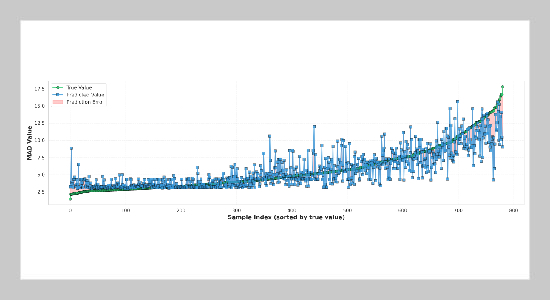
Comparison of model-predicted Mad values with true values across the sample sequence (sorted by true labels)
Copyright The Author(s). This is an open access article distributed under the terms of the Creative Commons Attribution License (CC BY 4.0), which permits unrestricted use, distribution, and reproduction in any medium, provided the original author and source are cited.
Download Citation: RIS | BibTeX | http://dx.doi.org/10.6180/jase.202607_30.035
Near-Infrared Spectroscopy (NIRS) has become one of the most widely used non-destructive techniques for rapid coal quality assessment due to its efficiency, low cost, and suitability for on-site industrial deployment. However, NIRS data collected under different measurement conditions often exhibit significant spectral distribution shifts, which substantially weaken the cross-domain generalization ability of conventional prediction models. To address this challenge, this paper proposes a multi-source spectral learning method tailored for NIRS-based coal analysis. The method integrates a unified multi-source domain adaptation framework, a dual-regression-head architecture, and a performance-driven dynamic weighting strategy, enabling effective cross-domain learning without requiring target-domain data. Experiments conducted on real coal NIRS datasets demonstrate that the proposed approach consistently outperforms existing baselines across multiple measurement scenarios, highlighting its strong potential for accurate and robust rapid coal quality detection.
Keywords: Coal quality assessment; multi-source domain adaptation; cross-domain generalization; transfer learning
- [1] Q. Wang, D. Zhang, Y. Dou, Q. Wang, and Y. Wang, (2025) “Advanced Multi-Parameter Prediction of Coal Quality Using LIBS and Ensemble Machine Learning Techniques” ACS Omega 10(33): 37574–37582.
- [2] L. Zou, J. Qiao, X. Yu, X. Chen, and M. Lei, (2023) “Intelligent proximate analysis of coal based on near-infrared spectroscopy and multioutput deep learning” IEEE Trans. Artif. Intell. 5(3): 1398–1410.
- [3] J. Li, R. Gao, Y. Zhang, L. Zhang, L. Dong, W. Ma, W. Yin, and S. Jia, (2025) “Research on accurate analysis of coal quality using NIRS-XRF fusion spectroscopy in complex coal type scenarios” Opt. Laser Technol. 181: 111734.
- [4] J. Tian, M. Li, X. Zhang, M. Lei, L. Ke, and L. Zou, (2024) “Enhancing Moisture Detection in Coal Gravels: A Deep Learning Based Adaptive Microwave Spectra Fusion Method” Spectrochim. Acta Part A Mol. Biomol. Spectrosc. 313: 124147.
- [5] L. Zou, S. Kou, Z. Xu, Z. Tan, and M. Lei, (2025) “Simultaneous prediction of bauxite quality parameters using TC-Unet and near-infrared spectroscopy” Memetic Computing 17(2): 25.
- [6] B. Hu and J. Wang, (2022) “A weighted multi-source domain adaptation approach for surface defect detection” IET Image Process. 16(8): 2210–2218.
- [7] A. J. Parrott, A. C. McIntyre, M. Holden, G. Colquhoun, Z.-P. Chen, D. Littlejohn, and A. Nordon, (2022) “Calibration model transfer in mid-infrared process analysis with in situ attenuated total reflectance immersion probes” Anal. Methods 14(19): 1889–1896.
- [8] A. Gretton, K. M. Borgwardt, M. J. Rasch, B. Schölkopf, and A. Smola, (2012) “A kernel two-sample test” J. Mach. Learn. Res. 13(1): 723–773.
- [9] B. Sun and K. Saenko. “Deep coral: Correlation alignment for deep domain adaptation”. In: Eur. Conf. Comput. Vis. 2016, 443–450.
- [10] M. Hassan Pour Zonoozi, V. Seydi, and M. Deypir, (2025) “An unsupervised adversarial domain adaptation based on variational auto-encoder” Mach. Learn. 114(5): 1–26.
- [11] S. Zhao, G. Wang, S. Zhang, Y. Gu, Y. Li, Z. Song, P. Xu, R. Hu, H. Chai, and K. Keutzer. “Multi-source distilling domain adaptation”. In: Proc. AAAI Conf. Artif. Intell. 34. 07. 2020, 12975–12983.
- [12] X. Peng, Q. Bai, X. Xia, Z. Huang, K. Saenko, and B. Wang. “Moment matching for multi-source domain adaptation”. In: Proc. IEEE/CVF Int. Conf. Comput. Vis. 2019, 1406–1415.
- [13] H. Zhao, S. Zhang, G. Wu, J. M. F. Moura, J. P. Costeira, and G. J. Gordon. “Adversarial multiple source domain adaptation”. In: Adv. Neural Inf. Process. Syst. 31. 2018.
- [14] L. Yang, Y. Balaji, S.-N. Lim, and A. Shrivastava. “Curriculum manager for source selection in multi-source domain adaptation”. In: Eur. Conf. Comput. Vis. 2020, 608–624.
- [15] L. Zhao, X. Wang, Z. Liu, Z. Wang, and Z. Chen, (2024) “Learnable Graph Guided Deep Multi-view Representation Learning via Information Bottleneck” IEEE Trans. Circuits Syst. Video Technol. 35(4): 3303–3314.
- [16] L. Zhao, Q. Xie, Z. Li, S. Wu, and Y. Yang, (2024) “Dynamic Graph Guided Progressive Partial View-Aligned Clustering” IEEE Trans. Neural Netw. Learn. Syst. 36(5): 9370–9382.
- [17] S. Ma, L. Zhao, M. Lu, Y. Guo, and B. Xu. ConsistencyAware Padding for Incomplete Multi-Modal Alignment Clustering Based on Self-Repellent Greedy Anchor Search. [Preprint]. 2025.
- [18] L. Zhao, P. Huang, T. Chen, C. Fu, Q. Hu, and Y. Zhang, (2023) “Multi-sentence complementarily generation for text-to image synthesis” IEEE Trans. Multimed. 26: 8323–8332.
- [19] C. Cortes and M. Mohri. “Domain adaptation in regression”. In: Int. Conf. Algorithmic Learn. Theory. 2011, 308–323.
- [20] I. Nejjar, Q. Wang, and O. Fink. “Dare-gram: Unsupervised domain adaptation regression by aligning inverse gram matrices”. In: Proc. IEEE/CVF Conf. Comput. Vis. Pattern Recognit. 2023, 11744–11754.
- [21] H.-R. Yang, C.-X. Ren, and Y.-W. Luo. “Cod: Learning conditional invariant representation for domain adaptation regression”. In: Eur. Conf. Comput. Vis. 2024, 108–125.
- [22] Y. Wu, G. Parmigiani, and B. Ren. Multi-source domain adaptation for regression. [Preprint]. 2023.
- [23] Y. Zhang, G. Yan, G. Zhao, S. Ma, Z. Liu, and G. Zhao, (2024) “A Dynamic Domain Adaptation Regression Method for Multiple Working Conditions Based on Continual Learning” Ind. Eng. Chem. Res. 63(40): 17252–17265.
- [24] Y. Mansour, M. Mohri, and A. Rostamizadeh. “Domain adaptation with multiple sources”. In: Adv. Neural Inf. Process. Syst. 21. 2008.
- [25] R. Xu, Z. Chen, W. Zuo, J. Yan, and L. Lin. “Deep cocktail network: Multi-source unsupervised domain adaptation with category shift”. In: Proc. IEEE Conf. Comput. Vis. Pattern Recognit. 2018, 3964–3973.
- [26] K. Saito, K. Watanabe, Y. Ushiku, and T. Harada. “Maximum classifier discrepancy for unsupervised domain adaptation”. In: Proc. IEEE Conf. Comput. Vis. Pattern Recognit. 2018, 3723–3732.
- [27] Y. Zuo, H. Yao, and C. Xu, (2021) “Attention-based multi-source domain adaptation” IEEE Trans. Image Process. 30: 3793–3803.
- [28] Y. Ganin and V. Lempitsky. “Unsupervised domain adaptation by backpropagation”. In: Int. Conf. Mach. Learn. 2015, 1180–1189.
- [29] M. Long, Z. Cao, J. Wang, and M. I. Jordan. “Conditional adversarial domain adaptation”. In: Adv. Neural Inf. Process. Syst. 31. 2018.
- [30] Z. Pei, Z. Cao, M. Long, and J. Wang. “Multiadversarial domain adaptation”. In: Proc. AAAI Conf. Artif. Intell. 32. 1. 2018.
- [31] R. Xu, G. Li, J. Yang, and L. Lin. “Larger norm more transferable: An adaptive feature norm approach for unsupervised domain adaptation”. In: Proc. IEEE/CVF Int. Conf. Comput. Vis. 2019, 1426–1435.
- [32] Y. Zhang, T. Liu, M. Long, and M. I. Jordan. “Bridging theory and algorithm for domain adaptation”. In: Int. Conf. Mach. Learn. 2019, 7404–7413.
- [33] J. Liang, D. Hu, and J. Feng. “Do we really need to access the source data? source hypothesis transfer for unsupervised domain adaptation”. In: Int. Conf. Mach. Learn. 2020, 6028–6039.
- [34] E. Tzeng, J. Hoffman, K. Saenko, and T. Darrell. “Adversarial discriminative domain adaptation”. In: Proc. IEEE Conf. Comput. Vis. Pattern Recognit. 2017, 7167–7176.
- [35] R. Shu, H. H. Bui, H. Narui, and S. Ermon. A dirt-t approach to unsupervised domain adaptation. [Preprint]. 2018.