




School of Automation and Electrical Engineering, Lanzhou Jiaotong University, Lanzhou, Gansu 730070, P.R. China
Received: July 10, 2024
Accepted: February 1, 2025
Publication Date: April 6, 2026
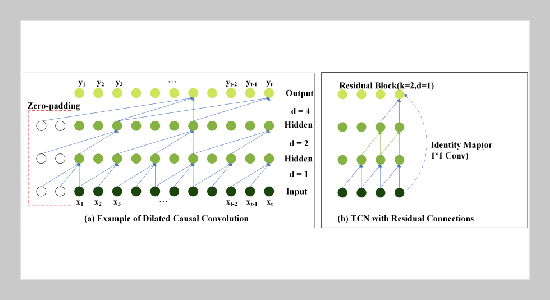
An example of causal dilated convolution and residual connection.
Copyright The Author(s). This is an open access article distributed under the terms of the Creative Commons Attribution License (CC BY 4.0), which permits unrestricted use, distribution, and reproduction in any medium, provided the original author and source are cited.
Download Citation: BibTeX | http://dx.doi.org/10.6180/jase.202512_28(12).0003
Data-driven soft sensor modeling has gained significant traction in modern chemical process monitoring and quality prediction. However, persistent challenges remain in accurately characterizing the complex dynamics inherent in chemical production systems, which typically exhibit significant time delays, strong nonlinearity, and time-varying characteristics. To address these critical challenges, a dynamic soft sensor modeling method based on temporal convolutional network (TCN) combined with channel spatiotemporal attention module and long short-term memory network (TCN-CBAM-LSTM) is proposed. Firstly, TCN is employed to extract deep nonlinear dynamic dependencies from process variables through its dilated causal convolution architecture, secondly, a convolutional block attention module (CBAM) is incorporated to enhance feature representation by adaptively focusing on critical spatiotemporal information across different sensor channels, finally, a long shortterm memory network (LSTM) is integrated to model intricate temporal patterns and long-range dependencies between process variables and quality indicators. This multi-stage architecture enables comprehensive learning of both local temporal features and global dynamic relationships within complex chemical processes. To verify the effectiveness of the proposed method, TCN-CBAM-LSTM was applied to a soft sensor modeling example for calculating the exhaust gas composition in a sulfur recovery unit (SRU). Under the same experimental conditions, it was also compared with convolutional neural network (CNN), variable weighted stacked autoencoder (VWSAE), spatiotemporal attention LSTM (STA-LSTM), CNN-LSTM, TCN, and TCN-LSTM. The results show that the TCN-CBAM-LSTM method has better performance and modeling accuracy, and its performance meets the needs of practical engineering applications.
Keywords: Soft sensor; Dynamic modeling; Temporal convolutional network; Convolutional block attention module; Long short-term memory network
- [1] Y. Jiang, S. Yin, J. Dong, and O. Kaynak, (2020) “A review on soft sensors for monitoring, control, and optimization of industrial processes” IEEE Sensors Journal 21(11): 12868–12881. DOI: 10.1109/JSEN.2020.3033153.
- [2] J.-S. Wang and S. Han, (2015) “Feed-Forward Neural Network Soft-Sensor Modeling of Flotation Process Based on Particle Swarm Optimization and Gravitational Search Algorithm” Computational Intelligence and Neuroscience 2015(1): 147843. DOI: 10.1155/2015/147843.
- [3] H. Kaneko and K. Funatsu, (2014) “Application of online support vector regression for soft sensors” AIChE Journal 60(2): 600–612. DOI: 10.1002/aic.14299.
- [4] M. de Castro-Cros, S. Rosso, E. Bahilo, M. Velasco, and C. Angulo, (2021) “Condition assessment of industrial gas turbine compressor using a drift soft sensor based in autoencoder” Sensors 21(8): 2708. DOI: 10.3390/s21082708.
- [5] M. Devakumar, G. Uma, M. Umapathy, et al., (2023) “Critical measurement parameters estimation in liquid rocket engine using LSTM-based soft sensor” Flow Measurement and Instrumentation 92: 102371. DOI: 10.1016/j.flowmeasinst.2023.102371.
- [6] A. R. B. Abad, P. S. Tehrani, M. Naveshki, H. Ghorbani, N. Mohamadian, S. Davoodi, S. K.-y. Aghdam, J. Moghadasi, and H. Saberi, (2021) “Predicting oil flow rate through orifice plate with robust machine learning algorithms” Flow Measurement and Instrumentation 81: 102047. DOI: 10.1016/j.flowmeasinst.2021.102047.
- [7] J. Fan, K. Zhang, Y. Huang, Y. Zhu, and B. Chen, (2023) “Parallel spatio-temporal attention-based TCN for multivariate time series prediction” Neural Computing and Applications 35(18): 13109–13118. DOI: 10.1007/s00521-021-05958-z.
- [8] J. He, Y. Feng, and J. Zhu. “TCN Stock Price Prediction Model Based on Channel Attention Mechanism”. In: 2023 IEEE International Conference on Control, Electronics and Computer Technology (ICCECT). IEEE. 2023, 850–855. DOI: 10.1109/ICCECT57938.2023.10140492.
- [9] T. Limouni, R. Yaagoubi, K. Bouziane, K. Guissi, and E. H. Baali, (2023) “Accurate one step and multistep forecasting of very short-term PV power using LSTMTCN model” Renewable Energy 205: 1010–1024. DOI: 10.1016/j.renene.2023.01.118.
- [10] H. V. Dudukcu, M. Taskiran, Z. G. C. Taskiran, and T. Yildirim, (2023) “Temporal Convolutional Networks with RNN approach for chaotic time series prediction” Applied soft computing 133: 109945. DOI: 10.1016/j.asoc.2022.109945.
- [11] X. Yuan, S. Qi, Y. Wang, K. Wang, C. Yang, and L. Ye, (2021) “Quality variable prediction for nonlinear dynamic industrial processes based on temporal convolutional networks” IEEE Sensors Journal 21(18): 20493–20503. DOI: 10.1109/JSEN.2021.3096215.
- [12] C. Sun, Y. Zhang, H. Zhao, H. Guo, Y. Zhang, and X. Hao, (2023) “A soft sensor model for cement specific surface area based on TCN-ASRU neural network” IEEE Transactions on Instrumentation and Measurement 72: 1–12. DOI: 10.1109/TIM.2023.3278292.
- [13] W. Cheng, Y. Wang, Z. Peng, X. Ren, Y. Shuai, S. Zang, H. Liu, H. Cheng, and J. Wu, (2021) “Highefficiency chaotic time series prediction based on time convolution neural network” Chaos, Solitons & Fractals 152: 111304. DOI: 10.1016/j.chaos.2021.111304.
- [14] T. H. T. Nguyen, N. Van Pham, V. N. N. Nguyen, H. M. Pham, Q. B. Phan, et al., (2022) “Forecasting Wind Speed Using A Hybrid Model Of Convolutional Neural Network And Long-Short Term Memory With Boruta Algorithm-Based Feature Selection” Journal of Applied Science and Engineering 26(8): 1053–1060. DOI: 10.6180/jase.202308_26(8).0001.
- [15] Y. Ren, S. Wang, and B. Xia, (2023) “Deep learning coupled model based on TCN-LSTM for particulate matter concentration prediction” Atmospheric Pollution Research 14(4): 101703. DOI: 10.1016/j.apr.2023.101703.
- [16] L. Fortuna, A. Rizzo, M. Sinatra, and M. G. Xibilia, (2003) “Soft analyzers for a sulfur recovery unit” Control Engineering Practice 11(12): 1491–1500. DOI: 10.1016/S0967-0661(03)00079-0.
- [17] X. Yuan, C. Ou, Y. Wang, C. Yang, and W. Gui, (2020) “Deep quality-related feature extraction for soft sensing modeling: A deep learning approach with hybrid VWSAE” Neurocomputing 396: 375–382. DOI: 10.1016/j.neucom.2018.11.107.
- [18] X. Yuan, L. Li, Y. A. Shardt, Y. Wang, and C. Yang, (2020) “Deep learning with spatiotemporal attentionbased LSTM for industrial soft sensor model development” IEEE Transactions on Industrial Electronics 68(5): 4404–4414. DOI: 10.1109/TIE.2020.2984443.
- [19] M. Mou and X. Zhao, (2022) “Gated broad learning system based on deep cascaded for soft sensor modeling of industrial process” IEEE Transactions on Instrumentation and Measurement 71: 1–11. DOI: 10.1109/TIM.2022.3170967.