




Chao Yang, Tiantian Liu, Fang Peng, and Tianyou Zhu
Big Data Center, State Grid Corporation of China, Beijing 100052, P.R.China
Received: July 31, 2025
Accepted: September 1, 2025
Publication Date: March 8, 2025
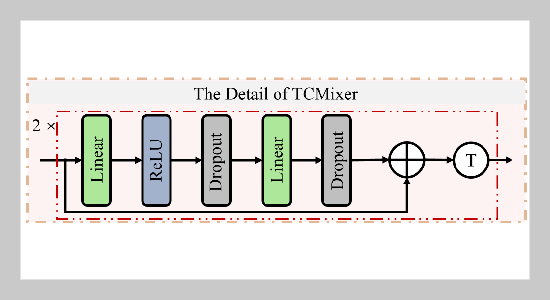
Architectural details of the Sparse TCMixer
Copyright The Author(s). This is an open access article distributed under the terms of the Creative Commons Attribution License (CC BY 4.0), which permits unrestricted use, distribution, and reproduction in any medium, provided the original author and source are cited.
Download Citation: RIS | BibTeX | http://dx.doi.org/10.6180/jase.202607_30.026
Scalable cloud databases allow users to dynamically adjust computational resources based on business needs. However, most current elastic scaling techniques face challenges in making sound decisions due to complex workload variations. Achieving efficient resource allocation requires accurate workload modeling and timely prediction of future workload changes. Therefore, we propose DBDW, an accurate and lightweight model for database workload prediction. DBDW consists of Local Branch and Global branch. The Global branch uses a Mixer architecture to model long-term cloud database workloads at a holistic level. The Local Branch employs multiple components to selectively emphasize local features via a gating strategy. It also uses a channel sparse clustering method to collaboratively represent multichannel information with low computational overhead. Experimental results show DBDW effectively models workload sequences using historical data. Its lowest prediction MAE/MSE for future workloads are 0.5953/0.5971. Furthermore, DBDW demonstrates significantly reduced computational costs: GPU memory usage during training is 304.14 MB , training speed reaches 0.3238 s/epoch , parameter count is 0.34 million, and FLOPs are 4.19 million. This confirms DBDW ensures accurate predictions while greatly reducing overhead, allowing deployment without affecting database operations.
Keywords: Database Workload; Time Series; Mixer; MLP
- [1] H. Xu, H. Liu, X. Chen, L. Wang, K. Jin, S. Hou, and Z. Li, (2025) “Elastic Scaling Method for Multi-tenant Databases Based on Hybrid Workload Prediction Model” International Journal of Software and Informatics 15(01): 69–86. DOI: 10.21655/ijsi.1673-7288.00346.
- [2] A. Verbitski, A. Gupta, D. Saha, M. Brahmadesam, K. Gupta, R. Mittal, S. Krishnamurthy, S. Maurice, T. Kharatishvili, and X. Bao. “Amazon aurora: Design considerations for high throughput cloud-native relational databases”. In: Proceedings of the 2017 ACM International Conference on Management of Data. 2017, 1041–1052. DOI: 10.1145/3035918.3056101.
- [3] W. Cao, Y. Zhang, X. Yang, F. Li, S. Wang, Q. Hu, X. Cheng, Z. Chen, Z. Liu, J. Fang, et al. “Polardb serverless: A cloud native database for disaggregated data centers”. In: Proceedings of the 2021 International Conference on Management of Data. 2021, 2477–2489. DOI: 10.1145/3448016.3457560.
- [4] J. C. Corbett, J. Dean, M. Epstein, A. Fikes, C. Frost, J. J. Furman, S. Ghemawat, A. Gubarev, C. Heiser, P. Hochschild, et al., (2013) “Spanner: Google’s globally distributed database” ACM Transactions on Computer Systems (TOCS) 31(3): 1–22. DOI: 10.1145/2491245.
- [5] P. Antonopoulos, A. Budovski, C. Diaconu, A. Hernandez Saenz, J. Hu, H. Kodavalla, D. Kossmann, S. Lingam, U. F. Minhas, N. Prakash, et al. “Socrates: The new sql server in the cloud”. In: Proceedings of the 2019 International Conference on Management of Data. 2019, 1743–1756. DOI: 10.1145/3299869.3314047.
- [6] S. Salza and M. Terranova. “Workload modeling for relational database systems”. In: Database Machines: Fourth International Workshop Grand Bahama Island, March 1985. Springer. 1985, 233–255. DOI: 10.1007/978-1-4612-5144-6_12.
- [7] T.-T. Nguyen, Y.-J. Yeom, T. Kim, D.-H. Park, and S. Kim, (2020) “Horizontal pod autoscaling in kubernetes for elastic container orchestration” Sensors 20(16): 4621. DOI: 10.3390/s20164621.
- [8] Y. Zhu, J. Liu, M. Guo, Y. Bao, W. Ma, Z. Liu, K. Song, and Y. Yang. “Bestconfig: tapping the performance potential of systems via automatic configuration tuning”. In: Proceedings of the 2017 symposium on cloud computing. 2017, 338–350. DOI: 10.1145/3127479.3128605.
- [9] L. Ma, D. Van Aken, A. Hefny, G. Mezerhane, A. Pavlo, and G. J. Gordon. “Query-based workload forecasting for self-driving database management systems”. In: Proceedings of the 2018 International Conference on Management of Data. 2018, 631–645. DOI: 10.1145/3183713.3196908.
- [10] A. Zafeiropoulos, E. Fotopoulou, N. Filinis, and S. Papavassiliou, (2022) “Reinforcement learning-assisted autoscaling mechanisms for serverless computing platforms” Simulation Modelling Practice and Theory 116: 102461. DOI: 10.1016/j.simpat.2021.102461.
- [11] J. Zhang, K. Zhou, G. Li, Y. Liu, M. Xie, B. Cheng, and J. Xing, (2021) “CDBTune+: An efficient deep reinforcement learning-based automatic cloud database tuning system” The VLDB Journal 30(6): 959–987. DOI: 10.1007/s00778-021-00670-9.
- [12] B. Mozafari, C. Curino, A. Jindal, and S. Madden. “Performance and resource modeling in highlyconcurrent OLTP workloads”. In: Proceedings of the 2013 acm sigmod international conference on management of data. 2013, 301–312. DOI: 10.1145/2463676.2467800y.
- [13] A. Mahgoub, P. Wood, A. Medoff, S. Mitra, F. Meyer, S. Chaterji, and S. Bagchi. “{SOPHIA}: Online reconfiguration of clustered {NoSQL} databases for {Time-Varying} workloads”. In: 2019 USENIX Annual Technical Conference (USENIX ATC 19). 2019, 223–240. DOI: 10.5555/3358807.3358827.
- [14] J. Wang, T. Li, A. Wang, X. Liu, L. Chen, J. Chen, J. Liu, J. Wu, F. Li, and Y. Gao, (2023) “Real-time workload pattern analysis for large-scale cloud databases” arXiv preprint arXiv:2307.02626: DOI: 10.48550/arXiv.2307.02626.
- [15] Z. Chen, J. Hu, G. Min, A. Y. Zomaya, and T. ElGhazawi, (2019) “Towards accurate prediction for highdimensional and highly-variable cloud workloads with deep learning” IEEE Transactions on Parallel and Distributed Systems 31(4): 923–934. DOI: 10.1109/TPDS.2019.2953745.
- [16] J. Bi, H. Yuan, and M. Zhou, (2019) “Temporal prediction of multiapplication consolidated workloads in distributed clouds” IEEE Transactions on Automation Science and Engineering 16(4): 1763–1773. DOI: 10.1109/TASE.2019.2895801.
- [17] O. Poppe, Q. Guo, W. Lang, P. Arora, M. Oslake, S. Xu, and A. Kalhan, (2022) “Moneyball: proactive auto-scaling in Microsoft Azure SQL database serverless” Proceedings of the VLDB Endowment 15(6): 1279–1287. DOI: 10.14778/3514061.3514073.
- [18] P. Padala, K.-Y. Hou, K. G. Shin, X. Zhu, M. Uysal, Z. Wang, S. Singhal, and A. Merchant. “Automated control of multiple virtualized resources”. In: Proceedings of the 4th ACM European conference on Computer systems. 2009, 13–26. DOI: 10.1145/1519065.1519068.
- [19] H. Zhou, S. Zhang, J. Peng, S. Zhang, J. Li, H. Xiong, and W. Zhang. “Informer: Beyond efficient transformer for long sequence time-series forecasting”. In: Proceedings of the AAAI conference on artificial intelligence. 35. 12. 2021, 11106 11115. DOI: 10.1609/aaai.v35i12.17325.
- [20] H. Wu, J. Xu, J. Wang, and M. Long, (2021) “Autoformer: Decomposition transformers with auto-correlation for long-term series forecasting” Advances in neural information processing systems 34: 22419–22430. DOI: 10.48550/arXiv.2106.13008.
- [21] T. Zhou, Z. Ma, Q. Wen, X. Wang, L. Sun, and R. Jin. “Fedformer: Frequency enhanced decomposed transformer for long-term series forecasting”. In: International conference on machine learning. PMLR. 2022, 27268–27286. DOI: 10.48550/arXiv.2201.12740.
- [22] Y. Liu, T. Hu, H. Zhang, H. Wu, S. Wang, L. Ma, and M. Long, (2023) “itransformer: Inverted transformers are effective for time series forecasting” arXiv preprint arXiv:2310.06625: DOI: 10.48550/arXiv.2310.06625.
- [23] A. Zeng, M. Chen, L. Zhang, and Q. Xu. “Are transformers effective for time series forecasting?” In: Proceedings of the AAAI conference on artificial intelligence. 37. 9. 2023, 11121–11128. DOI: 10.1609/aaai.v37i9.26317.
- [24] S.-A. Chen, C.-L. Li, N. Yoder, S. O. Arik, and T. Pfister, (2023) “Tsmixer: An all-mlp architecture for time series forecasting” arXiv preprint arXiv:2303.06053: DOI: 10.48550/arXiv.2303.06053.
- [25] C. Challu, K. G. Olivares, B. N. Oreshkin, F. G. Ramirez, M. M. Canseco, and A. Dubrawski. “Nhits: Neural hierarchical interpolation for time series forecasting”. In: Proceedings of the AAAI conference on artificial intelligence. 37. 6. 2023, 6989–6997. DOI: 10.1609/aaai.v37i6.25854.
- [26] D. Campos, M. Zhang, B. Yang, T. Kieu, C. Guo, and C. S. Jensen, (2023) “LightTS: Lightweight time series classification with adaptive ensemble distillation” Proceedings of the ACM on Management of Data 1(2): 1–27. DOI: 10.1145/3589316.
- [27] K. Yi, Q. Zhang, W. Fan, S. Wang, P. Wang, H. He, N. An, D. Lian, L. Cao, and Z. Niu, (2023) “Frequencydomain mlps are more effective learners in time series forecasting” Advances in Neural Information Processing Systems 36: 76656–76679. DOI: 10.48550/arXiv.2311.06184.
- [28] Q. Huang, L. Shen, R. Zhang, J. Cheng, S. Ding, Z. Zhou, and Y. Wang, (2024) “Hdmixer: Hierarchical dependency with extendable patch for multivariate time series forecasting” 38(11): 12608–12616. DOI: 10.1609/aaai.v38i11.29155.
- [29] Y. Zhao, Z. Ma, T. Zhou, M. Ye, L. Sun, and Y. Qian, (2023) “Gcformer: an efficient solution for accurate and scalable long-term multivariate time series forecasting”: 3464–3473. DOI: 10.1145/3583780.3615136.
- [30] Y. Nie, N. H. Nguyen, P. Sinthong, and J. Kalagnanam, (2022) “A time series is worth 64 words: Long-term forecasting with transformers” arXiv preprint arXiv:2211.14730: DOI: 10.48550/arXiv.2211.14730.