




Received: October 13, 2025
Accepted: April 27, 2026
Publication Date: July 18, 2026
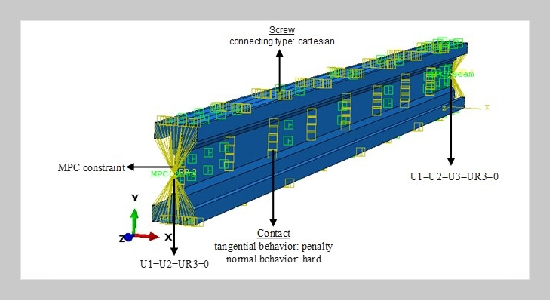
Details of boundary conditions, screw arrangement, and contact interaction in the finite element model
Copyright The Author(s). This is an open access article distributed under the terms of the Creative Commons Attribution License (CC BY 4.0), which permits unrestricted use, distribution, and reproduction in any medium, provided the original author and source are cited.
Download Citation: BibTeX | http://dx.doi.org/10.6180/jase.202610_33.047
In structural applications, CFS (cold-formed steel) built-up columns with web stiffeners are widely used for their lightweight and high load-carrying capacity. However, this study examines CFS-built-up columns under post-fire axial compression using validated ABAQUS models. Configuration B shows up to 22.4% higher load capacity than Configuration A between 700◦C and 900◦C. CS- and CU-shaped columns are stronger among the various stiffener geometries considered, while C-shaped columns are the least effective in resisting loads. Additionally, the use of wider stiffeners ( b/4 = 12.75 mm ) outperforms narrower ones (b/6 = 8.5 mm) by up to 15%at high temperatures, and longer stiffeners (b) provide a 14% increase in load capacity compared to shorter stiffeners (b/3). These findings validate that an optimized stiffener design improves structural efficiency and fire resistance. Hence, these findings have important implications for the design of fire-resistant CFS structures.
Keywords: CFS; post-fire; residual capacity; web stiffener; column configuration; numerical analysis; ABAQUS
- [1] R. Röß, M. Schäfers, and M. Mensinger. “Influence of residual stresses on innovative composite column sections using high strength steel”. In: CRC Press, 2022, 1160–1165. DOI: 10.1201/9781003348443.
- [2] H. C. Bui, D. K. Trinh, and M. T. Nguyen, (2022) “Effect of web stiffeners on lateral buckling of I-section simply supported beam” Steel Construction 15: 121–130. DOI: 10.1002/stco.202100007.
- [3] A. Shaat, A. Matloub, A. Ibrahim, and A. Dessouki, (2022) “Effect of web stiffeners on the lateral distortional buckling of channel section with hollow flanges” Ain Shams Engineering Journal 13: 101517. DOI: 10.1016/j.asej.2021.06.003.
- [4] P. Palanivelu, K. Kaliyamoorthi, A. R. Jabarullah, and R. Samymuthu, (2024) “Nonlinear Behavior of Cold-Formed Steel Columns: Investigating the Influence of Stiffener on Strength and Buckling Resistance” Engineering Proceedings 59: 148. DOI: 10.3390/engproc2023059148.
- [5] O. P. Deepak and P. Aravinth. “Numerical Investigation on Cold-Formed Steel Web Stiffened Lipped Channel Columns Subjected to Local-Distortional Interaction Mode Buckling”. In: International Conference on Advances in Materials Research. Springer, 2019, 615–628. DOI: 10.1007/978-981-15-8319-3_61.
- [6] L. Jiang, J. He, X. Ma, Y. Hu, Z. Chen, Z. Zhang, and H. Yang, (2024) “Compressive behavior of novel cold-formed steel built-up closed L-shaped section columns” Journal of Building Engineering 86: 108748. DOI: 10.1016/j.jobe.2024.108748.
- [7] J. Hua, Z. Yang, F. Wang, X. Xue, N. Wang, and L. Huang, (2022) “Relation between the metallographic structure and mechanical properties of a bimetallic steel bar after fire” Journal of Materials in Civil Engineering 34: 04022193. DOI: 10.1061/(ASCE)MT.1943-5533.0004351.
- [8] W.-J. Dan, R.-B. Gou, M. Yu, Y.-B. Ge, and T.-J. Li, (2022) “Experimental study on the post-fire mechanical behaviours of structural steels” Journal of Constructional Steel Research 199: 107629. DOI: 10.1016/j.jcsr.2022.107629.
- [9] G.-Q. Li, H. Lyu, and C. Zhang, (2017) “Post-fire mechanical properties of high strength Q690 structural steel” Journal of Constructional Steel Research 132: 108–116. DOI: 10.1016/j.jcsr.2016.12.027.
- [10] W. Wang, Y. Li, Z. Wang, and S. Pang, (2024) “Experimental and numerical study on the behavior of high strength Q960 steel columns after fire exposure” Thin-Walled Structures 198: 111748. DOI: 10.1016/j.tws.2024.111748.
- [11] X. Xue, T.-M. Chan, and B. Young. “Numerical investigation on post-fire resistance of cold-formed Q960 ultra high strength steel channel section stub columns”. In: Structures. 66. Elsevier, 2024, 106776. DOI: 10.1016/j.istruc.2024.106776.
- [12] X. Lan, S. Li, and O. Zhao, (2021) “Local buckling of hot-rolled stainless steel channel section stub columns after exposure to fire” Journal of Constructional Steel Research 187: 106950. DOI: 10.1016/j.jcsr.2021.106950.
- [13] C. Maraveas, Z. Fasoulakis, and K. D. Tsavdaridis, (2017) “Post-fire assessment and reinstatement of steel structures” Journal of structural fire engineering 8: 181–201. DOI: 10.1108/JSFE-03-2017-0028.
- [14] T. Molkens, K. A. Cashell, and B. Rossi, (2021) “Post-fire mechanical properties of carbon steel and safety factors for the reinstatement of steel structures” Engineering structures 234: 111975. DOI: 10.1016/j.engstruct.2021.111975.
- [15] J.-M. Franssen and V. Kodur. “Residual load bearing capacity of structures exposed to fire”. In: 2001, 1–12. DOI: 10.1061/40558(2001)89.
- [16] D. Pantousa, T. Karavasilis, and C. Maraveas, (2022) “Numerical investigation of the post-fire performance of steel columns” Buildings 12: 288. DOI: 10.3390/buildings12030288.
- [17] W. Wang and T. Liu, (2016) “Experimental and numerical study on post-fire behavior of high-strength Q460 steel columns” Advances in structural engineering 19: 1873–1888. DOI: 10.1177/1369433216649390.
- [18] J. Yang, X. Zhou, W. Wang, L. Xu, and Y. Shi, (2023) “Fire resistance of box-shape cold-formed steel built-up columns failing in global buckling: Test, simulation and design” Thin-Walled Structures 183: 110433. DOI: 10.1016/j.tws.2022.110433.
- [19] K. Luo, H. Li, J. Yang, S. Fang, F. Yan, J. Yu, X. Han, Y. Xu, and X. Ning, (2025) “Research on post-fire cold-formed steel back-to-back built-up columns with local buckling” Thin-Walled Structures 209: 112883. DOI: 10.1016/j.tws.2024.112883.
- [20] K. Luo, J. Yang, F. Yan, S. Fang, J. Yu, and H. Li, (2025) “Behavior of the cold-formed steel back-to-back built-up columns with distortional buckling after exposure to high temperatures” Fire Technology: 1–25. DOI: 10.1007/s10694-025-01766-2.
- [21] R. Zhang, W. Wang, W. Zeng, and J. Wang. “Local buckling behavior of cold-formed steel box-shaped built-up columns after fire exposure”. In: Structures. 84. Elsevier, 2026, 110952. DOI: 10.1016/j.istruc.2025.110952.
- [22] B. Standard, (1993) “Eurocode 3—Design of steel structures—” Bs En 1: 2005.
- [23] K. Roy, B. Chen, Z. Fang, A. Uzzaman, X. Chen, and J. B. P. Lim, (2021) “Local and distortional buckling behaviour of back-to-back built-up aluminium alloy channel section columns” Thin-Walled Structures 163: 107713. DOI: 10.1016/j.tws.2021.107713.
- [24] L. Zhang, F. Wang, Y. Liang, and O. Zhao, (2019) “Press-braked S690 high strength steel equal-leg angle and plain channel section stub columns: Testing, numerical simulation and design” Engineering Structures 201: 109764. DOI: 10.1016/j.engstruct.2019.109764.
- [25] F. Wang, O. Zhao, and B. Young, (2020) “Testing and numerical modelling of S960 ultra-high strength steel angle and channel section stub columns” Engineering Structures 204: 109902. DOI: 10.1016/j.engstruct.2019.109902.
- [26] A. E. Hady, M. E. Aghoury, S. Ibrahim, and E. Amoush, (2022) “Experimental investigation of steel built-up beam-columns composed of tracks and channels cold-formed sections” Journal of Building Engineering 51: 104295. DOI: 10.1016/j.jobe.2022.104295.