




Shih-An Li1, Hsuan-Ming Feng2*, Kung-Han Chen1, Jian-Ming Lin1, and Li-Hsiang Chou1
1Department of Electrical Engineering, Tamkang University, Tamsui, Taiwan 251, R.O.C.
2Department of Computer Science and Information Engineering, National Quemoy University, Kinmen, Taiwan 892, R.O.C.
Received: October 25, 2017
Accepted: February 27, 2018
Publication Date: August 16 2026
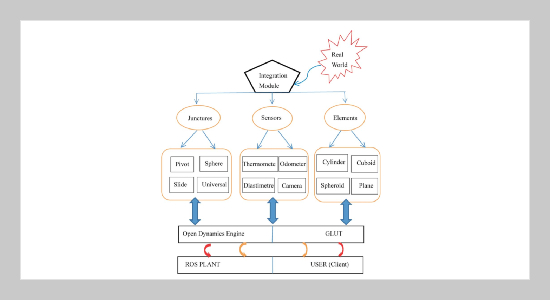
Gazebo platform in the ROS architecture.
Copyright The Author(s). This is an open access article distributed under the terms of the Creative Commons Attribution License (CC BY 4.0), which permits unrestricted use, distribution, and reproduction in any medium, provided the original author and source are cited.
Download Citation: BibTeX | http://dx.doi.org/10.6180/jase.201809_21(3).0006
This paper applies a virtual robot operating system (ROS) platform to concurrently perform the automatic map generation and appropriate path planning for robot navigation applications. The powerful ROS works as a self-constructed robotic facility to perfectly achieve the maps generation and robot localization functions. LiDAR dynamically scanned the required information from the outsides environment and matched the visual maps for reaching the best path coverage and predicting the accurate robot location. ROS-based GAZEBO plant with the flexible and friendly interface is taken to simultaneously imitate the robot environment. In the illustrated experiments, an efficient A* algorithm is approved to build the near optimal routing path within one second executing time. Hector SLAM technology is employed to automatically generate the robot maps for completing nonlinear and complexed navigation applications.
Keywords: Robot Operating System; GAZEBO Simulator; A* Algorithm; LiDAR
- [1] Kumar, N., Vámossy, Z. and Szabó-Resch, Z. M., “Robot Obstacle Avoidance Using Bumper Event,” Proc. of the 11th IEEE International Symposium on Applied Computational Intelligence and Informatics (SACI 2016), May 12-14, Timioara, Romania, pp. 485-489 (2016). doi: 10.1109/SACI.2016.7507426
- [2] Choi, H., Kim, E. and Yang, G.-W., “Scan Likelihood Evaluation in Fast SLAM Using Binary Bayes Filter,” Proc. of 2013 IEEE 11th IVMSP Workshop (2013). doi: 10.1109/IVMSPW.2013.6611891
- [3] Jasna, S. B., Supriya, P. and Nambiar, T. N. P, “Remodeled A* Algorithm for Mobile Robot Agents with Obstacle Positioning,” IEEE International Conference on Computational Intelligence and Computing Research (ICCIC) (2016). doi: 10.1109/ICCIC.2016.7919535
- [4] Wu, X., Abrahantes, M. and Edgington, M., “MUSSE: a Designed Multi-ultrasonic-sensor System for Echolocation on Multiple Robots,” Proc. of 2016 Asia-Pacific Conference on Intelligent Robot Systems, 20-22 July (2016). doi: 10.1109/ACIRS.2016.7556192
- [5] Smith, R. C. and Cheeseman, P., “On the Representation and Estimation of Spatial Uncertainty,” International Journal of Robotics Research (1986). doi: 10.1177/027836498600500404
- [6] Montemerlo, M., Thrun, S., Koller, D. and Wegbreit, B., “Fastslam: a Factored Solution to the Simultaneous Localization and Mapping Problem,” Proc. of 2002 Eighteenth National Conference on Artificial Intelligence, pp. 593-598 (2002).
- [7] Dissanayake, M. W. M. G., Newman, P., Durrant-Whyte, H., Clark, S. and Csorba, M., “An Experimental and Theoretical Investigation into Simultaneous Localization and Map Building,” Experimental Robotics VI, Vol. 250, Springer London, pp. 265-274 (2000). doi: 10.1007/BFb0119405
- [8] Medina, S., Lancheros, P., Sanabria, L., Velasco, N. and Solaque, L., “Localization and Mapping Approximation for Autonomous Ground Platforms, Implementing SLAM Algorithms,” 2014 III International Congress of Engineering Mechatronics and Automation (CIIMA), Oct., pp. 22-24 (2014). doi: 10.1109/CIIMA.2014.6983431
- [9] Balasuriya, B. L. E. A., Chathuranga, B. A. H., Jayasundara, B. H. M. D., Napagoda, N. R. A. C., Kumarawadu, S. P., Chandima, D. P. and Jayasekara, A. G. B. P., “Outdoor Robot Navigation Using Gmapping Based SLAM Algorithm,” Moratuwa Engineering Research Conference (MERCon), Moratuwa, Sri Lanka, 5-6 April (2016). doi: 10.1109/MERCon.2016.7480175
- [10] Lepej, P. and Rakun, J., “Simultaneous Localisation and Mapping in a Complex Field Environment,” Biosystems Engineering, Vol. 150, pp. 160-169 (2016). doi: 10.1016/j.biosystemseng.2016.08.004
- [11] Sileshi, B. G., Oliver, J., Toledo, R., Gonalves, J. and Costa, P., “On the Behaviour of Low Cost Laser Scanners in HW/SW Particle Filter SLAM Applications,” Robotics and Autonomous Systems, Vol. 80, pp. 11-23 (2016). doi: 10.1016/j.robot.2016.03.002
- [12] He, Y. and Mei, Y., “An Efficient Registration Algorithm Based on Spin Image for LiDAR 3D Point Cloud Models,” Neurocomputing, Vol. 151, Part 1, pp. 354-363 (2015). doi: 10.1016/j.neucom.2014.09.029
- [13] Kohlbrecher, S., Meyer, J., von Stryk, O. and Klingauf, U., “A Flexible and Scalable SLAM System with Full 3D Motion Estimation,” 2011 IEEE International Symposium on Safety, Security, and Rescue Robotics (SSRR), pp. 155-160 (2011). doi: 10.1109/SSRR.2011.6106777
- [14] Kohlbrecher, S., Meyer, J., Graber, T., Petersen, K., Klingauf, U. and von Stryk, O., “Hector Open Source Modules for Autonomous Mapping and Navigation with Rescue Robots,” RoboCup 2013: Robot World Cup XVII, pp. 624-631 (2014). doi: 10.1007/978-3-662-44468-9_58
- [15] Hussein, M., Iagnemma, K. and Renner, M., “Global Localization of Autonomous Robots in Forest Environments,” Photogrammetric Engineering & Remote Sensing, Vol. 81, No. 11, pp. 839-846 (2015). doi: 10.14358/PERS.81.11.839
- [16] Guruji, A. K., Agarwal, H. and Parsediy, D. K., “Time-efficient A* Algorithm for Robot Path Planning,” Procedia Technology, Vol. 23, pp. 144-149 (2016). doi: 10.1016/j.protcy.2016.03.010
- [17] Goto, T., Kosaka, T. and Noborio, H., “On the Heuristics of A* or a Algorithm in ITS and Robot Path-planning,” Proc. of 2003 IEEE/RSJ International Conference on Intelligent Robots and Systems, Las Vegas, Nevada, pp. 1159-1166 (2003). doi: 10.1109/IROS.2003.1248802
- [18] Koenig, N. and Howard, A., “Design and Use Paradigms for Gazebo, an Open-source Multi-robot Simulator,” Proc. of 2004 IEEE International Conference on Robotics and Automation (ICRA), pp. 2149-2154 (2004). doi: 10.1109/ROBOT.2004.1302377
- [19] Trivun, D., Šalaka, E. and Osmanković, D., “Active SLAM-based Algorithm for Autonomous Exploration with Mobile Robot,” Proc. of 2015 IEEE International Conference on Industrial Technology (ICIT) (2015). doi: 10.1109/ICIT.2015.7125079
- [20] Nguyen, H. K. and Wongsaisuwan, M., “A Study on Unscented SLAM with Path Planning Algorithm Integration,” Proc. of 2014 11th International Conference on Electrical Engineering/Electronics, Computer, Telecommunications and Information Technology (ECTI-CON), 14-17 May (2014). doi: 10.1109/ECTICon.2014.6839824
- [21] Leddisaravi, K., Alitappeh, R. I. and Guimarães, F. G., “Multi-objective Mobile Robot Path Planning Based on A* Search,” Proc. of 6th International Conference on Computer and Knowledge Engineering (ICCKE 2016), October 20-21, 2016, Ferdowsi University of Mashhad, pp. 7-12 (2016). doi: 10.1109/ICCKE.2016.7802107
- [22] Ueland, E. S., Skjetne, R. and Andreas, R. D., “Marine Autonomous Exploration Using a Lidar and SLAM,” Proc. of 36th International Conference on Ocean, Offshore and Arctic Engineering (ASME 2017), Vol. 6 (2017).
- [23] Huang, W. H., Design of Mapping and Exploration System with ROS, M.S. Dissertation, Tamkang University, Taiwan (2016).