





Balasubramanian E1, Sasitharan A2, Chandrasekhar U1, Karthik K3 and Lung-Jieh Yang4
1Vel Tech University, Avadi, Chennai
2Bubblefly Technology Pvt Ltd, New Delhi
3Madras Institute of Technology, Chennai
4Department of Mechanical and Electromechanical Engineering, Tamkang University, Tamsui, Taiwan 251, R.O.C.
Received: October 17, 2017
Accepted: February 27, 2018
Publication Date: August 16, 2026
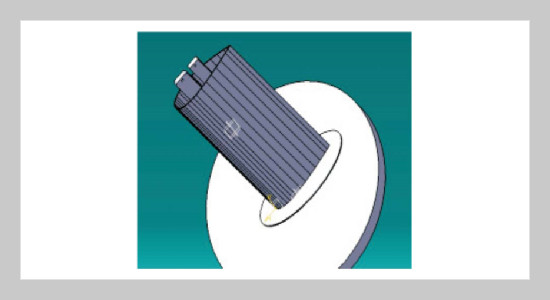
A solid bar and aerofoil section.
Copyright The Author(s). This is an open access article distributed under the terms of the Creative Commons Attribution License (CC BY 4.0), which permits unrestricted use, distribution, and reproduction in any medium, provided the original author and source are cited.
Download Citation: BibTeX | http://dx.doi.org/10.6180/jase.201806_21(2).0005
Experimental assessment of lift and thrust forces of flapping wing micro aerial vehicles (FWMAVs) is of paramount interest to assess its pay load carrying capability. In this work, a simple and cost effective test bench is developed to measure the forces of ornithopter. Two compressive load cells are calibrated and assembled in an appropriate mode to capture the generated forces. A labview based graphical user interface is designed to acquire real time force data and thereby control the angle of attack of ornithopter. Through varying wind speeds, flapping frequencies and angle of attacks (AOA),
wind tunnel experiments are conducted for two ornithopters E-Bird and Golden Snitch, with wing spans of 27 cm and 21.5 cm respectively. Experimental results suggested that, E-Bird has attained maximum lift force of 28.7 g at 60 AOA and golden snitch has 13.5 g lift force at 35 AOA. The
developed compact test rig can measure the lift and thrust forces up to 200 grams with an accuracy 0.1 gram of FWMAVs.
Keywords: Ornithopter, Lift and Thrust Forces, Load Cells, Data Acquisition, Wind Tunnel, Graphical User Interface
- [1] Willmott, A. P. and Ellington, C. P., “The Mechanics of Flight in the Hawkmoth Manduca Sexta. I. Kinematics of Hovering and Forward Flight,” Journal of Experimental Biology, Vol. 200, No. 21, pp. 2705–2722 (1997).
- [2] Gerdes, J. W., Gupta, S. K. and Wilkerson, S. A., “A Review of Bird-inspired Flapping Wing Miniature Air Vehicle Designs,” Journal of Mechanisms and Robotics, Vol. 4, No. 2, p. 021003 (2012). doi: 10.1115/1.4005525
- [3] Shyy, W., Aono, H., Chimakurthi, S. K., Trizila, P., Kang, C. K., Cesnik, C. E. and Liu, H., “Recent Progress in Flapping Wing Aerodynamics and Aeroelasticity,” Progress in Aerospace Sciences, Vol. 46, No. 7, pp. 284–327 (2010). doi: 10.1016/j.paerosci.2010.01.001
- [4] Tsai, B. J. and Fu, Y. C., “Design and Aerodynamic Analysis of a Flapping-wing Micro Aerial Vehicle,” Aerospace Science and Technology, Vol. 13, No. 7, pp. 383–392 (2009). doi: 10.1016/j.ast.2009.07.007
- [5] Fujikawa, T., Hirakawa, K., Sato, Y., Makata, Y. and Kikuchi, K., “Motion Analysis of Small Flapping Robot for Various Design and Control Parameters,” IEEE International Conference on Robotics and Biomimetics, pp. 13–18 (2007). doi: 10.1109/ROBIO.2007.4522127
- [6] Fenelon, M. A. and Furukawa, T., “Design of an Active Flapping Wing Mechanism and a Micro Aerial Vehicle Using a Rotary Actuator,” Journal of Mechanism and Machine Theory, Vol. 45, No. 2, pp. 137–146 (2010). doi: 10.1016/j.mechmachtheory.2009.01.007
- [7] Kim, D. K., Kim, H. I., Han, J. H. and Kwon, K. J., “Experimental Investigation on the Aerodynamic Characteristics of a Bio-mimetic Flapping Wing with Macro-fiber Composites,” Journal of Intelligent Material Systems and Structures, Vol. 19, No. 3, pp. 423–431 (2007). doi: 10.1177/1045389X07083618
- [8] Zakaria, M. J., Bayoumy, A. M., Elshabka and Abd Elhamid, O. E., “Experimental Aerodynamic Characteristics of Flapping Membrane Wings,” 13th International Conference on Aerospace Sciences & Aviation Technology, pp. 26–28 (2009).
- [9] Wood, R. J., “Design, Fabrication, and Analysis of a 3 DOF, 3 cm Flapping-wing MAV,” IEEE/RSJ International Conference on Intelligent Robots and Systems, pp. 1576–1581 (2007). doi: 10.1109/IROS.2007.4399495
- [10] Harmon, R. L., “Aerodynamic Modeling of a Flapping Membrane Wing Using Motion Tracking Experiments,” ProQuest (2008).
- [11] Kuang, P. D., Dorothy, M. and Chung, S. J., “Robobat: Dynamics and Control of a Robotic Bat Flapping Flying Testbed,” AIAA Infotech at Aerospace Conference, pp. 1435–1437 (2011). doi: 10.2514/6.2011-1435
- [12] Curtis, D. H., Reeder, M. F., Svanberg, C. E., Cobb, R. G. and Parker, G. H., “Flapping Wing Micro Air Vehicle Bench Test Setup,” International Journal of Micro Air Vehicles, Vol. 4, No. 1, pp. 51–77 (2012). doi: 10.1260/1756-8293.4.1.51
- [13] Park, H. C., Priamadi, E. and Truong, Q. T., “Effect of Flapping-wing Kinematics on Force Generation,” International Journal of Intelligent Unmanned Systems, Vol. 1, No. 3, pp. 245–255 (2013). doi: 10.1108/IJIUS-03-2013-0015
- [14] Rose, C. and Ronald, S. F., “Comparison of Ornithopter Wind Tunnel Force Measurements with Free Flight,” IEEE International Conference on Robotics and Automation, pp. 1816–1821 (2014). doi: 10.1109/ICRA.2014.6907097
- [15] Srigrarom, S. and Chan, W. L., “Ornithopter Type Flapping Wings for Autonomous Micro Air Vehicles,” Aerospace, Vol. 2, No. 2, pp. 235–278 (2015). doi: 10.3390/aerospace2020235
- [16] Abas, M. F. B., Rafie, A. S. B. M., Yusoff, H. B. and Ahmad, K. A. B., “Flapping Wing Micro-aerial-vehicle: Kinematics, Membranes, and Flapping Mechanisms of Ornithopter and Insect Flight,” Chinese Journal of Aeronautics, Vol. 29, No. 5, pp. 1159–1177 (2016). doi: 10.1016/j.cja.2016.08.003
- [17] Yang, L. J., “The Micro-air-vehicle Golden Snitch and Its Figure-of-8 Flapping,” Journal of Applied Science and Engineering, Vol. 15, No. 3, pp. 197–212 (2012). doi: 10.6180/jase.2012.15.3.01
- [18] Pope, A. and Goin, K. L., High-speed Wind Tunnel Testing, John Wiley & Sons, New York (1965).
- [19] Yang, L. J., Ko, A. F. and Hsu, C. K., “Wing Stiffness on Light Flapping Micro Aerial Vehicles,” Journal of Aircraft, Vol. 49, No. 2, pp. 423–431 (2012). doi: 10.2514/1.C031320
- [20] Yang, L. J., Hsu, C. K., Han, H. C. and Miao, J. M., “Light Flapping Micro Aerial Vehicle Using Electrical-discharge Wire-cutting Technique,” Journal of Aircraft, Vol. 46, No. 6, pp. 1866–1874 (2009). doi: 10.2514/1.38862