


Xiaojuan Liang, Chunjie Xie, and Wenting Qiu
Minxi Vocational and Technical College, Longyan, 364000, China
Received: July 20, 2026
Accepted: August 13, 2026
Publication Date: September 06, 2026
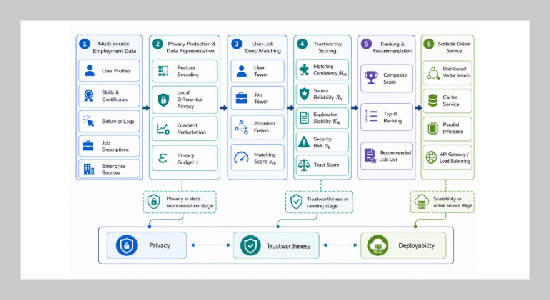
Overall Architecture of the DP-TCERS Trusted Job Recommendation System.
Copyright The Author(s). This is an open access article distributed under the terms of the Creative Commons Attribution License (CC BY 4.0), which permits unrestricted use, distribution, and reproduction in any medium, provided the original author and source are cited.
Download Citation: BibTeX | http://dx.doi.org/10.6180/jase.202612_35.018
Intelligent employment recommendation for industrial talent must process multi-source data profiles, certificates, behavior logs, and company sources yet existing methods emphasize accuracy over privacy and high-concurrency deployment. This study designs DP-TCERS, a differential-privacy trusted computing framework: it perturbs user/job features via local differential privacy and gradient noise against inference attacks, builds attention-fused towers for matching, scores trustworthiness from consistency and reliability, and lowers overhead via caching and parallel inference. Simulations show precision@10/recall@10/F1@10/NDCG@10 of 0.773/0.732/0.752/0.765 below non-DP matching but above CF, NCF, DeepFM – with attack success rates falling to 0.198-0.231 and latency at 10,000 users reaching 294 ms versus 1,486 ms single-node.
Keywords: industrial talent recommendation, differential privacy, trusted computing, privacy-preserving recommendation, scalable information systems, and recommendation security.
- [1] Y. Mashayekhi, N. Li, B. Kang, J. Lijffijt, and T. De Bie, (2024) “A Challenge-based Survey of E-recruitment Recommendation Systems” ACM Computing Surveys 56(10): 1-33. DOI: https://doi.org/10.1145/3659942.
- [2] F. P. Poncio, (2024) “Navigating Techniques in Job Recommender Systems on Internship Profile Matching: A Systematic Review” Journal of Research in Innovative Teaching & Learning 17(2): 352-367. DOI: https://doi.org/10.1108/JRIT-01-2024-0016.
- [3] S. A. Alsaif, M. S. Hidri, H. A. Eleraky, I. Ferjani, and R. Amami, (2022) “Learning-based Matched Representation System for Job Recommendation” Computers 11(11): 161. DOI: https://doi.org/10.3390/computers11110161.
- [4] R. H. El-Deeb, W. Abdelmoez, and N. El-Bendary, (2025) “Enhancing E-Recruitment Recommendations Through Text Summarization Techniques” Information 16(4): 333. DOI: https://doi.org/10.3390/info16040333.
- [5] D. Roy and M. Dutta, (2022) “A Systematic Review and Research Perspective on Recommender Systems” Journal of Big Data 9: 59. DOI: https://doi.org/10.1186/s40537-022-00592-5.
- [6] Y. H. Alfaifi, (2024) “Recommender Systems Applications: Data Sources, Features, and Challenges” Information 15(10): 660. DOI: https://doi.org/10.3390/info15100660.
- [7] S. Wang, X. Zhang, Y. Wang, and F. Ricci, (2024) “Trustworthy Recommender Systems” ACM Transactions on Intelligent Systems and Technology 15(4): 84:1-84:20. DOI: https://doi.org/10.1145/3627826.
- [8] Y. Wang, W. Ma, M. Zhang, Y. Liu, and S. Ma, (2023) “A Survey on the Fairness of Recommender Systems” ACM Transactions on Information Systems 41(3): 52:1-52:43. DOI: https://doi.org/10.1145/3547333.
- [9] Z. Xu, H. Zeng, J. Tan, Z. Fu, Y. Zhang, and Q. Ai, (2023) “A Reusable Model-Agnostic Framework for Faithfully Explainable Recommendation and System Scrutability” ACM Transactions on Information Systems 42(1): 29:1-29:29. DOI: https://doi.org/10.1145/3605357.
- [10] P. Vahdatian, M. Latifi, and M. Ahsan, (2025) “Designing Trustworthy Recommender Systems: A Glass-Box, Interpretable, and Auditable Approach” Electronics 14(24): 4890. DOI: https://doi.org/10.3390/electronics14244890.
- [11] Z. Xu, C. Chu, and S. Song, (2024) “An Effective Federated Recommendation Framework with Differential Privacy” Electronics 13(8): 1589. DOI: https://doi.org/10.3390/electronics13081589.
- [12] H. Zhang, F. Luo, J. Wu, X. He, and Y. Li, (2023) “LightFR: Lightweight Federated Recommendation with Privacy-Preserving Matrix Factorization” ACM Transactions on Information Systems 41(4): 90:1-90:28. DOI: https://doi.org/10.1145/3578361.
- [13] J. Neera, X. Chen, N. Aslam, K. Wang, and Z. Shu, (2023) “Private and Utility Enhanced Recommendations With Local Differential Privacy and Gaussian Mixture Model” IEEE Transactions on Knowledge and Data Engineering 35(4): 4151-4163. DOI: https://doi.org/10.1109/TKDE.2021.3126577.
- [14] J. Luo, X. Yang, X. Yi, and E. Han, (2023) “Privacy-preserving Recommendation System Based on User Classification” Journal of Information Security and Applications 79: 103630. DOI: https://doi.org/10.1016/j.jisa.2023.103630.
- [15] Y. Ge, S. Liu, Z. Fu, J. Tan, Z. Li, S. Xu, Y. Li, Y. Xian, and Y. Zhang, (2025) “A Survey on Trustworthy Recommender Systems” ACM Transactions on Recommender Systems 3(2): 13:1-13:68. DOI: https://doi.org/10.1145/3652891.