



Nanjing Vocational University of Industry Technology, Logistics Management Service Center, Nanjing Jiangsu, 210000, China
Received: July 21, 2026
Accepted: August 17, 2026
Publication Date: August 26, 2026
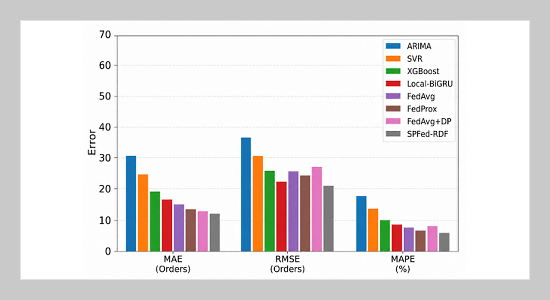
Comparison of Catering Demand Prediction Errors of Different Models
Copyright The Author(s). This is an open access article distributed under the terms of the Creative Commons Attribution License (CC BY 4.0), which permits unrestricted use, distribution, and reproduction in any medium, provided the original author and source are cited.
Download Citation: BibTeX | http://dx.doi.org/10.6180/jase.202612_35.008
Restaurant demand forecasting underpins inventory planning, staff scheduling, and spoilage control, yet order, membership, delivery, and payment data are scattered across stores and platforms, so centralized modeling risks exposing consumer behavior. This study proposes SPFed-RDF, a scalable, privacy-preserving federated learning framework for collaborative demand forecasting without sharing raw data. Each node performs local feature-processing (imputation, normalization, temporal encoding), and a BiGRU-Attention model extracts temporal demand features; during training, gradient clipping, differential-privacy noise, Top-k compression, secure aggregation, and dynamic weighted aggregation (by sample size, error, and communication stability) jointly address non-IID heterogeneity, privacy leakage, and communication overhead. Results show SPFed-RDF achieves RMSE 20.91, beating ARIMA, SVR, XGBoost, Local-BiGRU, FedAvg, FedProx, and FedAvg+DP by 18.35% versus FedAvg (23.44% under severe non-IID). With 100 clients, Top-k compression cuts communication from 1280 MB to 752 MB (41.27%), and member-inference attack success drops from 78.46% to 44.84%.
Keywords: federated learning, restaurant demand forecasting, consumer data privacy, differential privacy, secure aggregation
- [1] A. Schmidt, M. W. U. Kabir, and M. T. Hoque, (2022) “Machine Learning Based Restaurant Sales Forecasting” Machine Learning and Knowledge Extraction 4(1): 105-130. DOI: https://doi.org/10.3390/make4010006.
- [2] B. Chae, C. Sheu, and E. O. Park, (2024) “The Value of Data, Machine Learning, and Deep Learning in Restaurant Demand Forecasting: Insights and Lessons Learned from a Large Restaurant Chain” Decision Support Systems 184: 114291. DOI: https://doi.org/10.1016/j.dss.2024.114291.
- [3] M. S. Hossain and F. Parvin, (2025) “A Comparative Study of Various Statistical and Machine Learning Models for Predicting Restaurant Demand in Bangladesh” PLOS ONE 20(6): e0325449. DOI: https://doi.org/10.1371/journal.pone.0325449.
- [4] C. Baek, S. Kim, D. Nam, and J. Park, (2021) “Enhancing Differential Privacy for Federated Learning at Scale” IEEE Access 9: 148090-148103. DOI: https://doi.org/10.1109/ACCESS.2021.3124020.
- [5] Z. Liu, J. Guo, K.-Y. Lam, and J. Zhao, (2023) “Efficient Dropout-Resilient Aggregation for Privacy-Preserving Machine Learning” IEEE Transactions on Information Forensics and Security 18: 1839-1854. DOI: https://doi.org/10.1109/TIFS.2022.3163592.
- [6] T. Qi, F. Wu, C. Wu, L. He, Y. Huang, and X. Xie, (2023) “Differentially Private Knowledge Transfer for Federated Learning” Nature Communications 14(1): 3785. DOI: https://doi.org/10.1038/s41467-023-38794-w.
- [7] S. Kim, (2025) “Development of an AI-Based Restaurant Menu Demand Prediction Model Utilizing Sales and Meteorological Data” Food Science and Biotechnology 34(15): 3597-3606. DOI: https://doi.org/10.1007/s10068-025-01956-2.
- [8] F. Haselbeck, J. Killinger, K. Menrad, T. Hannus, and D. G. Grimm, (2022) “Machine Learning Outperforms Classical Forecasting on Horticultural Sales Predictions” Machine Learning with Applications 7: 100239. DOI: https://doi.org/10.1016/j.mlwa.2021.100239.
- [9] C. Wu, F. Wu, L. Lyu, Y. Huang, and X. Xie, (2022) “Communication-Efficient Federated Learning via Knowledge Distillation” Nature Communications 13(1): 2032. DOI: https://doi.org/10.1038/s41467-022-29763-x.
- [10] Y. Liu, Y. Kang, T. Zou, Y. Pu, Y. He, X. Ye, Y. Ouyang, Y.-Q. Zhang, and Q. Yang, (2024) “Vertical Federated Learning: Concepts, Advances, and Challenges” IEEE Transactions on Knowledge and Data Engineering 36(7): 3615-3634. DOI: https://doi.org/10.1109/TKDE.2024.3352628.
- [11] P. Qi, D. Chiaro, A. Guzzo, M. Ianni, G. Fortino, and F. Piccialli, (2024) “Model Aggregation Techniques in Federated Learning: A Comprehensive Survey” Future Generation Computer Systems 150: 272-293. DOI: https://doi.org/10.1016/j.future.2023.09.008.
- [12] H. Wang, F. Xie, Q. Duan, and J. Li, (2022) “Federated Learning for Supply Chain Demand Forecasting” Mathematical Problems in Engineering 2022: 4109070. DOI: https://doi.org/10.1155/2022/4109070.