Luis H. Martínez-Palmeth1This email address is being protected from spambots. You need JavaScript enabled to view it., Mauricio Duarte-Toro2, Jackson Gil-Hernandez2, Víctor Rojas2, and Juan Ceballos2
1School of Mechanical Engineering, Universidad Industrial de Santander, 680002, Bucaramanga, Colombia. Research Group in Design and Manufacturing– DIMA
2Program of Civil Engineering, Universidad Surcolombiana, Neiva, 110311, Colombia.
Received: September 14, 2025 Accepted: January 3, 2026 Publication Date: February 26, 2026
Copyright The Author(s). This is an open access article distributed under the terms of the Creative Commons Attribution License (CC BY 4.0), which permits unrestricted use, distribution, and reproduction in any medium, provided the original author and source are cited.
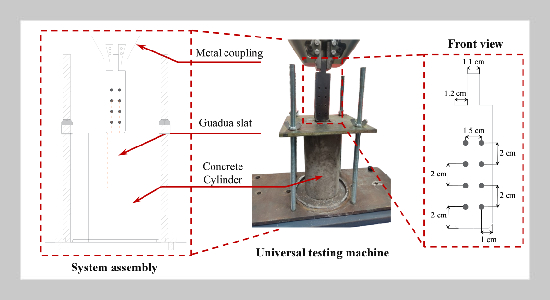
This study investigates the bond behavior between concrete and Guadua angustifolia Kunth bamboo using a pull-out test adapted from ASTM C234. A multifactorial experimental design was employed to evaluate two key treatment parameters: surface texture (smooth [S] or grooved [G]) and the application of epoxy resin (with [R] or without [WR]). This resulted in four distinct treatment configurations (SR, GR, SWR, GWR). A total of 36 tests were conducted on concrete specimens at curing ages of 7, 14, and 28 days. The results revealed a significant influence of both treatment and curing time on bond performance. Epoxy resin application emerged as the most critical factor, with the grooved and resin-treated specimens (GR) achieving the highest bond strength at 28 days- 3.92 times greater than that of smooth, untreated specimens (SWR)-alongside a 7% higher friction coefficient. A finite element model was developed and calibrated with experimental data, accurately predicting bond stress (within a 2% margin of error) and providing insights into failure mechanisms. Failure was typically characterized by adhesive failure and pull-out, with the GR treatment exhibiting a larger critical displacement. These findings demonstrate that the synergistic combination of mechanical grooving and epoxy resin treatment drastically enhances the Guadua-concrete interface, highlighting its potential for use in sustainable structural reinforcement systems.
Keywords: Adhesion; Friction; Pull-out-concrete; Sustainable reinforcement; Bamboo-concrete interface; FEM validation
[2] K.Ghavami,(1995) “Ultimate load behaviour of bamboo reinforced lightweight concrete beams" Cement and Concrete Composites 17(4): 281–288. DOI: https: //doi.org/10.1016/0958-9465(95)00018-8.
[3] M.Mishra,M.K.Kumar,andD.Maity,(2019)“Experimental evaluation of the behaviour of bamboo-reinforced beam–column joints" Innovative Infrastructure Solutions 4(1): 47. DOI: 10.1007/s41062-019-0237-9.
[4] E. O. Boakye, J. B. Osei, and M. Adom-Asamoah, (2018) “Finite Element Modelling of Bamboo Reinforced Concrete Beams" Journal of Construction and Building Materials Engineering 4(2): 1–10.
[5] W.R. Vargas Vásquez, A. Cerna Vásquez, and J. N. Cuéllar Cajahuaringa, (2020) “Adherencia en el concreto reforzado conbambú" Anales Científicos 81(2): 365–375. DOI: 10.21704/ac.v81i2.1666.
[6] W.A.PovedaMontoya. “Comparación del bambú con el acero como material de refuerzo a flexión en concreto". español. (Tesis de Licenciatura). Costa Rica: Instituto Tecnológico de Costa Rica, Escuela de Ingeniería en Construcción, 2011.
[7] A. Cedeño and J. González, (2001) “Studies on the bond stresses developed between steel and concrete with rebars of diameter 3/8", 1/2", 5/8", 3/4" and 1"" Tekhné (5): 56–68.
[8] ASTMInternational. Standard Test Method for Comparing Concretes on the Basis of the Bond Developed with Reinforcing Steel. Withdrawn 1999. Historical Stan dard. West Conshohocken, PA, 1991.
[9] D. Awalluddin, M. A. Mohd Ariffin, Y. Ahmad, N. F. Zamri, M. M. A. B. Abdullah, R. Abd Razak, H.-S. Lee, and J. K. Singh, (2022) “Bond Behavior of De formed Bamboo (Bambusa vulgaris) Embedded in Fly Ash Geopolymer Concrete" Sustainability 14(7): 4326. DOI: 10.3390/su14074326.
[10] American Concrete Institute. Standard Practice for Selecting Proportions for Normal, Heavyweight, and Mass Concrete. Standard Practice ACI 211.1-91. Reap proved 2002 (Originally approved 1991). Farmington Hills, MI, USA: American Concrete Institute, 2002.
[11] ASTMInternational. Standard Test Method for Relative Density (Specific Gravity) and Absorption of Coarse Ag gregate. Active Standard. West Conshohocken, PA: ASTM International, 2015.
[12] ASTM International. Standard Test Method for Relative Density (Specific Gravity) and Absorption of Fine Aggregate. Active Standard (2015 edition). West Conshohocken, PA: ASTM International, 2015.
[13] ASTM International. Standard Test Method for Sieve Analysis of Fine and Coarse Aggregates. Current Active Standard. West Conshohocken, PA: ASTM Interna tional, 2019.
[14] ASTM International. Standard Test Method for Bulk Density (“Unit Weight”) and Voids in Aggregate. Current Active Standard. West Conshohocken, PA: ASTMInternational, 2017.
[15] ASTM International. Standard Test Method for Total Evaporable Moisture Content of Aggregate by Drying. Withdrawn 2019. Superseded by C566-19. West Con shohocken, PA: ASTM International, 2013.
[16] G. Dhondt. CalculiX CrunchiX User’s Manual. Version 2.21. Free, open-source finite element software. CalculiX. 29, 2023.
[17] D. Nuralinah, A. Pujiraharjo, R. M. Simatupang, and M.Veronica, (2024) “Flexural Behavior of Bamboo Reinforced Concrete Beam under Variation Condition" Civil Engineering and Architecture 12(3): 1904–1914. DOI: 10.13189/cea.2024.120346.
We use cookies on this website to personalize content to improve your user experience and analyze our traffic. By using this site you agree to its use of cookies.