




Minhong Sun, Tiancheng Xu, Hongchen Guo, Hua Zhong
Department of Communication Engineering, Hangzhou Dianzi University, Hangzhou 310018, P.R. China
Received: April 29, 2016
Accepted: March 11, 2018
Publication Date: August 16, 2026
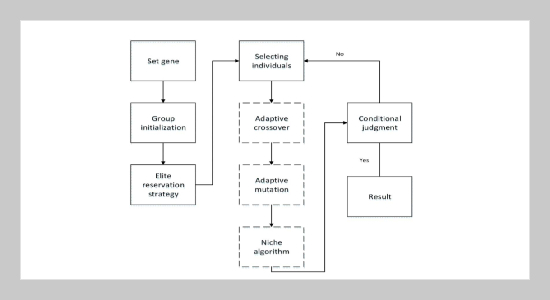
Flow chart of the improved GA.
Copyright The Author(s). This is an open access article distributed under the terms of the Creative Commons Attribution License (CC BY 4.0), which permits unrestricted use, distribution, and reproduction in any medium, provided the original author and source are cited.
Download Citation: BibTeX | https://doi.org/10.6180/jase.201806_21(2).0014
In recent years, the identification of the same-model wideband wireless transmitter manufactured by a same manufacturer has emerged as a big challenge. In this paper, a model-based approach is proposed for the identification of the same type wideband wireless transmitter. A Hammerstein-Wiener model is adopted for modeling the wideband wireless transmitter and an improved genetic algorithm is proposed for identifying the model. The estimated model parameters are taken as a feature vector for the identification of the wideband wireless transmitter. The simulation results verify the effectiveness of the proposed method. Moreover, the improved genetic algorithm achieves better estimation precision and higher identification rate than the basic genetic algorithm, the classic least squares iteration method, the AWPSO and the neural network algorithm.
Keywords: Transmitter Identification; System Identification; Hammerstein-Wiener Model; Genetic Algorithm
- [1] S. U. Rehman, et al., (2014) “Radio-frequency Fingerprinting for Mitigating Primary User Emulation Attack in Low-end Cognitive Radios” IET Communications 8(8): 1274–1284. DOI: 10.1049/iet-com.2013.0568.
- [2] Y. K. Lei, “Individual Communication Transmitter Identification Using Correntropy-based Collaborative Representation”. In: International Congress on Image and Signal Processing, Biomedical Engineering and Informatics. IEEE. 2017, 1194–1200.
- [3] H. Wen, et al., (2013) “A Framework of the PHY-layer Approach to Defense Against Security Threats in Cognitive Radionetworks” IEEE Network 27(3): 34–39. DOI: 10.1109/MNET.2013.6523806.
- [4] Y. Zhang, et al., (2013) “Fingerprint Identification Based on Wavelet Transform” Aeronautical Computing Technique 1. DOI: 10.3969/j.issn.1671-654x.2013.01.001.
- [5] Y. Y. Liu, et al., (2014) “Individual Transmitter Identification Based on New Feature Parameter of Signal Envelope” Radio Communications Technology 4. DOI: 10.3969/j.issn.1003-3114.2014.04.022.
- [6] M. W. Liu and J. F. Doherty, (2011) “Nonlinearity Estimation for Specific Emitter Identification in Multipath Channels” IEEE Transactions on Information Forensics and Security 6(3): 1076–1085. DOI: 10.1109/SARNOF.2009.4850327.
- [7] F. Taringou, et al., (2010) “Behaviour Modelling of Wideband RF Transmitters Using Hammerstein-Wiener models” Circuits Devices & Systems let 4(4): 282–290. DOI: 10.1049/iet-cds.2009.0258.
- [8] Y. Mao and F. Ding, (2015) “A Novel Data Filtering Based Multi-innovation Stochastic Gradient Algorithm for Hammerstein Nonlinear Systems” Digital Signal Processing 46: 215–225. DOI: 10.1016/j.dsp.2015.07.002.
- [9] O. Hammi, et al., “Nonuniform Memory Polynomial Behavioral Model for Wireless Transmitters and Power Amplifiers”. In: Microwave Conference Proceedings (APMC), 2012 Asia-Pacific. IEEE. 2012, 836–838.
- [10] L. Zhou, et al., (2014) “Gradient-based Iterative Identification for Wiener Nonlinear Systems with Nonuniform Sampling” Nonlinear Dynamics 76(1): 627–634. DOI: 10.1007/s11071-013-1156-5.
- [11] P. Abinayadhevi and S. J. S. Prasad, “Identification of pH Process Using Hammerstein-Wiener Model”. In: Intelligent Systems and Control (ISCO), 2015 IEEE 9th International Conference on. IEEE. 2015.
- [12] S. Talaie and M. A. Shoorehdeli, “Nonlinear System Identification of Hammerstein-Wiener Model Using AWPSO”. In: Intelligent Systems, Iranian Conference on. 2014.
- [13] F. Yang, et al., (2013) “Nonlinear System Modeling and Identification of Small Helicopter Based on Genetic Algorithm” International Journal of Intelligent Computing & Cybernetics 6(1): 45–61. DOI: 10.1108/17563781311301517.
- [14] F. M. Barradas, et al., (2014) “Polynomials and LUTs in PA Behavioral Modeling: a Fair Theoretical Comparison” IEEE Transactions on Microwave Theory and Techniques 62(12): 3274–3285. DOI: 10.1109/TMTT.2014.2365188.
- [15] Q. K. Song, et al., “Wavelet Network Controller Based on Improved Genetic Algorithm”. In: Measurement, Information and Control (ICMIC), 2013 International Conference on. IEEE. 2013, 1111–1117.