





Saktioto1, Anisa Alya Syafri1, Mulhida1, Bambang Widiyatmoko2, Dwi Hanto2, Yan Soerbakti1, Reeky Fardinata1, Okfalisa3, Dedi Irawan4, and Rina Amelia5
1Department of Physics, Universitas Riau, Pekanbaru 28293, Indonesia
2Research Center for Photonics, KST BJ HABIBIE, South Tangerang 15314, Indonesia
3Department of Informatics Engineering, UIN Sultan Syarif Kasim, Pekanbaru 28293, Indonesia
4Department of Physics Education, Universitas Riau, Pekanbaru 28293, Indonesia
5Department of Community Medicine, Universitas Sumatera Utara, Medan 20155, Indonesia
Received: February 29, 2024
Accepted: November 1, 2024
Publication Date: April 6, 2026
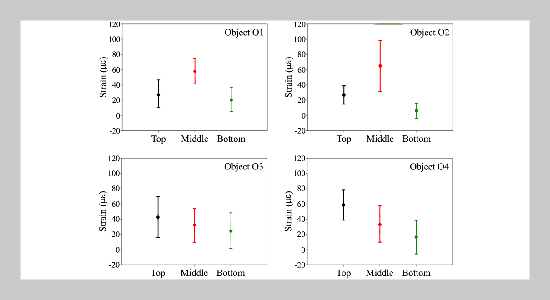
FBG strain based on its position in the mask for the four objects under normal breathing conditions.
Copyright The Author(s). This is an open access article distributed under the terms of the Creative Commons Attribution License (CC BY 4.0), which permits unrestricted use, distribution, and reproduction in any medium, provided the original author and source are cited.
Download Citation: BibTeX | http://dx.doi.org/10.6180/jase.202511_28(11).0005
Subtle sensing is one of the important aspects required in the performance of modern medical technology, especially the detection of elusive human respiratory risks. In this regard, the fiber Bragg grating (FBG) sensor offers a high-sensitivity measurement of supplemental oxygen-assisted human respiratory characteristics through a strain approach. The FBG wavelength of 1550 nm is induced by nasal airflow and back-body surface on resting and active objects. The treated FBG will undergo deformation resulting in a change in the Bragg wavelength, which is then measured using an optical sensing interrogator and processed to obtain the strain value. The measurement results show significant FBG strain values at the micro-scale. The addition of oxygen flow in the body can increase the stretch that occurs during breathing. Therefore, the FBG sensor is more effectively used in conditions with the addition of oxygen flow.
Keywords: Fiber Bragg grating; oxygen flow; respiratory; strain
- [1] W.-H. Shi, W.-M. Lv, T.-Y. Sun, and B.-S. Zhang, (2019) “Optoelectronic platform and technology” Frontiers of Information Technology and Electronic Engineering 20: 439–457. DOI: 10.1631/FITEE.1800451.
- [2] D. Tosi, E. Schena, C. Molardi, and S. Korganbayev, (2018) “Fiber optic sensors for sub-centimeter spatially resolved measurements: Review and biomedical applications” Optical Fiber Technology 43: 6–19. DOI: 10.1016/j.yofte.2018.03.007.
- [3] L. Dziuda, J. Lewandowski, F. Skibniewski, and G. Nowicki, (2012) “Fibre-optic sensor for respiration and heart rate monitoring in the MRI environment” Procedia Engineering 47: 1291–1294. DOI: 10.1016/j.proeng.2012.09.391.
- [4] A. Leal-Junior, C. Marques, and A. Frizera, (2022) “Diaphragm-assisted impact amplitude and localization measurement system with FBG sensors” Optical Fiber Technology 70: 102854. DOI: 10.1016/j.yofte.2022.102854.
- [5] J. Yu, C. Li, X. Qiu, and H. Chen, (2021) “A full-optical strain FBG sensor for in-situ monitoring of fatigue stages via tunable DFB laser demodulation” Optical and Quantum Electronics 53: 1–12. DOI: 10.1007/s11082-021-02800-7.
- [6] P. Hariprasad, C. Chanchal, P. Anita, G. Arun, and S. Sandeep, (2023) “Development of a prototype fiber-optic biosensor for the detection of lipase inhibitors” Kuwait Journal of Science 50: 333–338. DOI: 10.1016/j.kjs.2023.05.009.
- [7] T. Saktioto, F. D. Fadilla, Y. Soerbakti, and D. Irawan, (2021) “Application of fiber Bragg grating sensor system for simulation detection of the heart rate” Journal of Physics: Conference Series 2049: 012002. DOI: 10.1088/1742-6596/2049/1/012002.
- [8] H. Z. Yang, S. W. Harun, and H. Ahmad, (2011) “Theoretical and experimental studies on concave mirror-based fiber optic displacement sensor” Sensor Review 31: 65–69. DOI: 10.1108/02602281111099107.
- [9] C. Hong, Y. Yuan, Y. Yang, Y. Zhang, and Z. A. Abro, (2019) “A simple FBG pressure sensor fabricated using fused deposition modelling process” Sensors and Actuators A: Physical 285: 269–274. DOI: 10.1016/j.sna.2018.11.024.
- [10] C. Hong, Y. Zhang, and L. Borana, (2019) “Design, fabrication and testing of a 3D printed FBG pressure sensor” IEEE Access 7: 38577–38583. DOI: 10.1109/ACCESS.2019.2905349.
- [11] N. A. Rosman, C. B. M. Rashidi, S. A. Aljunid, and R. Endut, (2020) “Temperature monitoring system using fiber Bragg grating (FBG) approach” AIP Conference Proceedings 2203: 020065. DOI: 10.1063/1.5142157.
- [12] X. Wang, Y. Jiang, S. Xu, H. Liu, and X. Li, (2022) “Fiber Bragg grating-based smart garment for monitoring human body temperature” Sensors 22: 4252. DOI: 10.3390/s22114252.
- [13] T. Saktioto, Y. Soerbakti, A. Thoibah, B. Meyzia, R. F. Syahputra, D. Irawan, and H. Hairi, (2023) “Numerical investigation of physical parameters in cardiac vessels as a new medical support science for complex blood flow characteristics” Baghdad Science Journal 20: 2322–2329. DOI: 10.21123/bsj.2023.7076.
- [14] Defrianto, T. Saktioto, N. Hikma, Y. Soerbakti, D. Irawan, Okfalisa, B. Widiyatmoko, and D. Hanto, (2022) “External perspective of lung airflow model through diaphragm breathing sensor using fiber optic elastic belt” Indian Journal of Pure and Applied Physics 60: 561–566. DOI: 10.56042/ijpap.v60i7.62342.
- [15] S. Saktioto, D. Defrianto, A. Thoibah, Y. Soerbakti, R. F. Syahputra, S. Syamsudhuha, D. Irawan, H. Hairi, O. Okfalisa, and R. Amelia, (2023) “Simplified kinetic model of heart pressure for human dynamical blood flow” Indonesian Journal of Electrical Engineering and Informatics 11: 870–882. DOI: 10.52549/ijeei.v11i3.3473.
- [16] T. Saktioto, D. Defrianto, N. Hikma, Y. Soerbakti, S. Syamsudhuha, D. Irawan, O. Okfalisa, B. Widiyatmoko, and D. Hanto, (2022) “Airflow vibration of diaphragmatic breathing: model and demonstration using optical biosensor” Telkomnika (Telecommunication Computing Electronics and Control) 21: 667–674. DOI: 10.12928/TELKOMNIKA.v21i3.23613.
- [17] N. Hikma, T. Saktioto, and Y. Soerbakti, (2023) “Vibration analysis of diaphragmatic breathing activity using single-mode fiber and fiber Bragg grating” AIP Conference Proceedings 2858: 080001. DOI: 10.1063/5.0163142.
- [18] H. A. Mohammed and M. H. Yaacob, (2020) “A novel modified fiber Bragg grating (FBG) based ammonia sensor coated with polyaniline/graphite nanofibers nanocomposites” Optical Fiber Technology 58: 102282. DOI: 10.1016/j.yofte.2020.102282.
- [19] Z. Ruan, L. Pei, T. Ning, J. Wang, J. Wang, J. Li, Y. Xie, Q. Zhao, and J. Zheng, (2021) “Simple structure of tapered FBG filled with magnetic fluid to realize magnetic field sensor” Optical Fiber Technology 67: 102698. DOI: 10.1016/j.yofte.2021.102698.
- [20] C. Cui, L. Gao, N. Dai, and Q. Xu, (2021) “Fiber Bragg grating inclinometer-enabled IoT sensing system with low power consumption and small size” Sensors and Materials 33: 2321–2331. DOI: 10.18494/SAM.2021.3281.
- [21] X. Li, Y. Yang, W. Zhang, Z. Wang, Y. Yuan, H. Hu, and D. Xu, (2021) “An FBG pressure sensor based on spring-diaphragm elastic structure for ultimate pressure detection” IEEE Sensors Journal 22: 2213–2220. DOI: 10.1109/JSEN.2021.3136212.
- [22] Y. He, Q. Yang, S. Sun, M. Luo, R. Liu, and G.-D. Peng, (2020) “A multi-point voltage sensing system based on PZT and FBG” International Journal of Electrical Power and Energy Systems 117: 105607. DOI: 10.1016/j.ijepes.2019.105607.
- [23] J. K. Sahota, N. Gupta, and D. Dhawan, (2020) “Fiber Bragg grating sensors for monitoring of physical parameters: A comprehensive review” Optical Engineering 59: 060901. DOI: 10.1117/1.oe.59.6.060901.
- [24] C. Tavares, C. Leitão, D. L. Presti, M. F. Domingues, N. Alberto, H. Silva, and P. Antunes, (2022) “Respiratory and heart rate monitoring using an FBG 3D-printed wearable system” Biomedical Optics Express 13: 2299–2311. DOI: 10.1364/boe.452115.
- [25] M. Filosa, L. Massari, D. Ferraro, G. D’Alesio, J. D’Abbraccio, A. Aliperta, D. L. Presti, J. D. Tocco, M. Zaltieri, C. Massaroni, M. C. Carrozza, M. Ferrarin, M. D. Rienzo, E. Schena, and C. M. Oddo, (2022) “A meta-learning algorithm for respiratory flow prediction from FBG-based wearables in unrestrained conditions” Artificial Intelligence in Medicine 130: 102328. DOI: 10.1016/j.artmed.2022.102328.
- [26] W. Chen, J. Wang, F. Wan, and P. Wang, (2019) “Review of optical fibre sensors for electrical equipment characteristic state parameters detection” High Voltage 4: 271–281. DOI: 10.1049/hve.2019.0157.
- [27] V. Mishra, N. Singh, U. Tiwari, and P. Kapur, (2011) “Fiber grating sensors in medicine: Current and emerging applications” Sensors and Actuators A: Physical 167: 279–290. DOI: 10.1016/j.sna.2011.02.045.
- [28] C. E. Campanella, A. Cuccovillo, C. Campanella, A. Yurt, and V. M. N. Passaro, (2018) “Fibre Bragg grating based strain sensors: Review of technology and applications” Sensors 18: 3115. DOI: 10.3390/s18093115.
- [29] R. Li, Y. Chen, Y. Tan, Z. Zhou, T. Li, and J. Mao, (2018) “Sensitivity enhancement of FBG-based strain sensor” Sensors 18: 1607. DOI: 10.3390/s18051607.
- [30] M. S. Siobal, (2016) “Monitoring exhaled carbon dioxide” Respiratory Care 61: 1397–1416. DOI: 10.4187/respcare.04919.
- [31] A. Issatayeva, A. Beisenova, D. Tosi, and C. Molardi, (2021) “Fiber-optic based wearables for the continuous monitoring of respiratory rate” Biophotonics in Exercise Science, Sports Medicine, Health Monitoring Technologies, and Wearables II 11638: 1163805. DOI: 10.1117/12.2582461.
- [32] C. Shi, Z. Tang, H. Zhang, and Y. Liu, (2023) “Development of an FBG-based wearable sensor for simultaneous respiration and heartbeat measurement” IEEE Transactions on Instrumentation and Measurement 72: 1–9. DOI: 10.1109/TIM.2022.3228276.
- [33] J. Zhang, Z. Lian, Z. Zhou, Z. Song, M. Liu, and K. Yang, (2022) “Leakage detection in a buried gas pipeline based on distributed optical fiber time-domain acoustic wave signal” Engineering Failure Analysis 141: 106594. DOI: 10.1016/j.engfailanal.2022.106594.
- [34] J. Gómez, J. R. Casas, and S. Villalba, (2020) “Structural health monitoring with distributed optical fiber sensors of tunnel lining affected by nearby construction activity” Automation in Construction 117: 103261. DOI: 10.1016/j.autcon.2020.103261.
- [35] H. Merdji, A. Curtiaud, A. Aheto, A. Studer, V.-P. Harjola, A. Monnier, K. Duarte, N. Girerd, M. Kibler, H. Ait-Oufella, J. Helms, A. Mebazaa, B. Levy, A. Kimmoun, and F. Meziani, (2022) “Performance of early capillary refill time measurement on outcomes in cardiogenic shock: An observational, prospective multicentric study” American Journal of Respiratory and Critical Care Medicine 206: 1230–1238. DOI: 10.1164/rccm.202204-0687OC.
- [36] R. Min, X. Hu, L. Pereira, S. Soares, L. C. B. Silva, G. Wang, L. Martins, H. Qu, P. Antunes, C. Marques, and X. Li, (2022) “Polymer optical fiber for monitoring human physiological and body function: A comprehensive review on mechanisms, materials, and applications” Optics and Laser Technology 147: 107626. DOI: 10.1016/j.optlastec.2021.107626.