




Joanna Antos1,2, Daria Wieczorek2, Katarzyna Staszak3, Yuk-Ping Chou4, Li-Hang Hsu4, Tang-Long Shen4, and Ying-Lien Chen4
1Department of Water Supply and Bioeconomy, Faculty of Environmental Engineering and Energy, Poznan University of Technology, Berdychowo 4, 60-965 Poznan, Poland
2Department of Instrumental Technology and Analysis, Poznan University of Economics and Business, 61-875 Poznan, Poland
3Institute of Chemical Technology and Engineering, Faculty of Chemical Technology, Poznan University of Technology, ul. Berdychowo 4, 60-965 Poznan, Poland
4Department of Plant Pathology and Microbiology, National Taiwan University, Taipei, Taiwan
Received: July 29, 2024
Accepted: December 17, 2024
Publication Date: April 6, 2026
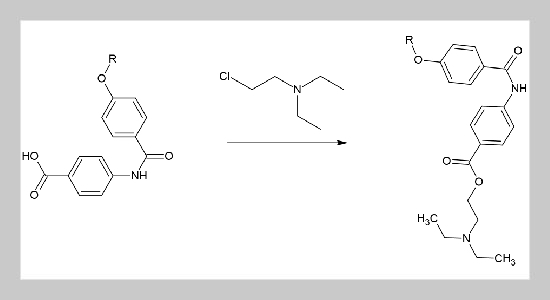
Formation of N -substituted amidoester
Copyright The Author(s). This is an open access article distributed under the terms of the Creative Commons Attribution License (CC BY 4.0), which permits unrestricted use, distribution, and reproduction in any medium, provided the original author and source are cited.
Download Citation: BibTeX | http://dx.doi.org/10.6180/jase.202510_28(10).0012
Otilonium bromide is a cationic surfactant with established medical applications, revealing a promising dimension in its versatile nature. Beyond its conventional use, the compound demonstrates notable antifungal properties, signaling a substantial extension of its application potential. Due to the spreading drug resistance of many microorganisms to active substances and antibiotics, it is necessary to search for and create new compounds that will exhibit more aggressive mechanisms of action. Based on the methods of synthesis of otilonium bromide, new derivatives of the compound were created to broaden its applicability beyond its traditional pharmaceutical utility. Delving into the intricate synthesis processes employed, this study provides a detailed exploration of the newly created derivatives of otilonium bromide. The broadening of the applicability of otilonium bromide, especially in response to emerging challenges posed by microbial resistance, is intended to make a significant contribution to the evolving landscape of antimicrobial therapeutics. The findings not only unveil the expanded capabilities of otilonium bromide but also reveal new avenues for the development of compounds with enhanced efficacy and resilience in combating microbial threats.
Keywords: otilonium bromide; cationic surfactants; drugs; antifungal properties; quaternary compounds
- [1] C. Mannucci, J. Bertini, A. Cocchini, A. Perico, F. Salvagnini, and A. Triolo, (1992) “Simultaneous Determination of Otilonium Bromide and Diazepam by FirstDerivative Spectroscopy” Journal of Pharmaceutical Sciences 81: 1175–1177. DOI: 10.1002/jps.2600811209.
- [2] W. D. Chey, W. Y. Chey, A. T. Heath, G. E. Dukes, E. G. Carter, A. Northcutt, and V. Z. Ameen, (2004) “LongTerm Safety and Efficacy of Alosetron in Women with Severe Diarrhea-Predominant Irritable Bowel Syndrome” The American Journal of Gastroenterology 99: 2195–2203. DOI: 10.1111/j.1572-0241.2004.30509.x.
- [3] J. Rychter, F. Espín, D. Gallego, P. Vergara, M. Jiménez, and P. Clavé, (2014) “Colonic smooth muscle cells and colonic motility patterns as a target for irritable bowel syndrome therapy: mechanisms of action of otilonium bromide” Therapeutic Advances in Gastroenterology 7: 156–166. DOI: 10.1177/1756283X14525250.
- [4] A. Shrivastava and A. Mittal, (2022) “A Mini Review on Characteristics and Analytical Methods of Otilonium Bromide” Critical Reviews in Analytical Chemistry 52: 1717–1725. DOI: 10.1080/10408347.2021.1913983.
- [5] F. Baldi, A. Longanesi, A. Blasi, S. Monello, R. Cestari, G. Missale, E. Corazziari, G. Badiali, M. Pescatori, and G. Anastasio, (1991) “Clinical and functional evaluation of the efficacy of otilonium bromide: a multicenter study in Italy.” The Italian journal of gastroenterology 23(8 Suppl 1): 60–63.
- [6] Battaglia, Morselli-Labate, Camarri, Francavilla, Marco, Mastropaolo, and Naccarato, (1998) “Otilonium bromide in irritable bowel syndrome: a double-blind, placebo-controlled, 15-week study” Alimentary Pharmacology Therapeutics 12: 1003–1010. DOI: 10.1046/j.1365-2036.1998.00397.x.
- [7] F.-Y. Chang, C.-L. Lu, J.-C. Luo, T.-S. Chen, M.-J. Chen, and H.-J. Chang, (2011) “The Evaluation of Otilonium Bromide Treatment in Asian Patients With Irritable Bowel Syndrome” Journal of Neurogastroenterology and Motility 17: 402–410. DOI: 10.5056/jnm.2011.17.4.402.
- [8] P. Clavé, M. Acalovschi, J. K. Triantafillidis, Y. P. Uspensky, C. Kalayci, V. Shee, and J. Tack, (2011) “Randomised clinical trial: otilonium bromide improves frequency of abdominal pain, severity of distention and time to relapse in patients with irritable bowel syndrome” Alimentary Pharmacology Therapeutics 34: 432–442. DOI: 10.1111/j.1365-2036.2011.04730.x.
- [9] M. Glende, A. M. Morselli-Labate, G. Battaglia, and S. Evangelista, (2002) “Extended analysis of a doubleblind, placebo-controlled, 15-week study with otilonium bromide in irritable bowel syndrome” European Journal of Gastroenterology Hepatology 14: 1331–1338. DOI: 10.1097/00042737-200212000-00008.
- [10] M. Villagrasa, J. Boix, P. Humbert, and J. Quer, (1991) “Aleatory clinical study comparing otilonium bromide with a fiber-rich diet in the treatment of irritable bowel syndrome.” The Italian journal of gastroenterology 23(8 Suppl 1): 67–70.
- [11] M. Ghelardoni, V. Pestellini, N. Pisanti, and G. Volterra, (1973) “Quaternary salts of substituted 2- aminoethyl N-benzoylaminobenzoate. New class of smooth muscle relaxant agents” Journal of Medicinal Chemistry 16: 1063–1065. DOI: 10.1021/jm00267a029.
- [12] J. Chunxiang, W. Tao, F. Huang, C. Wenbin, S. Jingxin, and Xiaofei. Preparation method of otilonium bromide. China Patent CN105037193A, 2015.
- [13] C. Zhen, H. Lu, Y.-y. Jiang, and F. Yang, (2022) “P092 Otilonium bromide is a potent antifungal agent against fluconazole-and flucytosine-resistant Cryptococcus neoformans strains” Medical Mycology 60(Supplement_1): myac072P092.
- [14] A. L. Cunningham, O. E. Palomero, B. J. Voss, M. S. Trent, and B. W. Davies, (2021) “Irritable Bowel Syndrome Therapeutic Has Broad-Spectrum Antimicrobial Activity” Antimicrobial Agents and Chemotherapy 65: DOI: 10.1128/AAC.00443-21.
- [15] Y. Gong and Y. R. Kim, (2023) “Therapeutic potential of otilonium bromide against Vibrio vulnificus” Research in Microbiology 174: 103992. DOI: 10.1016/j.resmic.2022.103992.
- [16] C. Zhen, L. Wang, Y. Feng, M. Whiteway, S. Hang, J. Yu, H. Lu, and Y. Jiang, (2024) “Otilonium Bromide Exhibits Potent Antifungal Effects by Blocking Ergosterol Plasma Membrane Localization and Triggering Cytotoxic Autophagy in Candida Albicans” Advanced Science: DOI: 10.1002/advs.202406473.
- [17] Y. Xu, Y. Niu, C. Wu, J. Yan, X. Rao, Z. Shi, K. Xu, H. Algadi, and Z. Guo, (2024) “Synthesis, characterization, antifungal properties of quaternary ammonium salts
derived from natural rosin” Biomass Conversion and Biorefinery 14: 18803–18811. DOI: 10.1007/s13399-023-04637-4. - [18] D. Cao, X. Yuan, X. Jiang, T. Wu, Y. Xiang, Z. Ji, J. Liu, X. Dong, K. Bi, T. Tønjum, et al., (2024) “Antimicrobial and Antibiofilm Effects of Bithionol against Mycobacterium abscessus” Antibiotics 13(6): 529.
- [19] R. Gani, C. Jiménez-González, and D. J. Constable, (2005) “Method for selection of solvents for promotion of organic reactions” Computers Chemical Engineering 29: 1661–1676. DOI: 10.1016/j.compchemeng.2005.02.021.
- [20] C. Bolchi, F. Bavo, L. Regazzoni, and M. Pallavicini, (2018) “Preparation of enantiopure methionine, arginine, tryptophan, and proline benzyl esters in green ethers by Fischer–Speier reaction” Amino Acids 50: 1261–1268. DOI: 10.1007/s00726-018-2599-2.
- [21] V. Bušić, S. Roca, D. Vikić-Topi´c, K. Vrandečić, J. Ćosić, M. Molnar, and D. Gašo-Sokač, (2020) “Eco-friendly quaternization of nicotinamide and 2-bromoacetophenones in deep eutectic solvents. Antifungal activity of the products” Environmental Chemistry Letters 18: 889–894. DOI: 10.1007/s10311-020-00973-3.
- [22] T.-T. Wang and Q.-L. Iou, (2002) “The solvent effect and the structural effect of halides on the quaternization Et3N+RX→Et3RNX” Chemical Engineering Journal 87: 197–206. DOI: 10.1016/S1385-8947(01)00230-3.
- [23] D. Giunta, G. N. Roviello, and M. Solinas, (2024) “Design and synthesis of new benzoxazole derivatives and study of their interactions with a G4 model by UV spectroscopy and in silico methods” Journal of Molecular Liquids 410: 125491. DOI: 10.1016/j.molliq.2024.125491.
- [24] N. Zec, M. Vraneš, M. Bešter-Rogaˇc, T. Trti´c-Petrovi´c, A. Dimitrijevi´c, I. Cobanov, and S. Gadžuri´c, (2018) ˇ “Influence of the alkyl chain length on densities and volumetric properties of 1,3-dialkylimidazolium bromide ionic liquids and their aqueous solutions” The Journal of Chemical Thermodynamics 121: 72–78. DOI: 10.1016/j.jct.2018.02.001.
- [25] T. Myrdek, C. Popescu, and W. Kunz, (2021) “Physicalchemical properties of newly synthesized tetraalkylammonium alkyl ether carboxylate ionic liquids” Journal of Molecular Liquids 322: 114947. DOI: 10.1016/j.molliq.2020.114947.
- [26] C. Xu, C. Liu, K. Chen, P. Zeng, E. W. C. Chan, and S. Chen, (2022) “Otilonium bromide boosts antimicrobial activities of colistin against Gram-negative pathogens and their persisters” Communications Biology 5: 613. DOI: 10.1038/s42003-022-03561-z.
- [27] J. Fedorowicz and J. S ˛aczewski, (2024) “Advances in the Synthesis of Biologically Active Quaternary Ammonium Compounds” International Journal of Molecular Sciences 25: 4649. DOI: 10.3390/ijms25094649.
- [28] C. Croitoru and I. C. Roata, (2020) “Ionic Liquids as Antifungal Agents for Wood Preservation” Molecules 25: 4289. DOI: 10.3390/molecules25184289.