




Daniel Adu-Gyamfi1,2 and Fengli Zhang1
1School of Information and Software Engineering, University of Electronic Science and Technology of China, Chengdu 610054, China
2Department of Computer Science and Informatics, University of Energy and Natural Resources, P O Box 214 Sunyani, Ghana
Received: September 24, 2019
Accepted: February 13, 2020
Publication Date: May 10, 2026
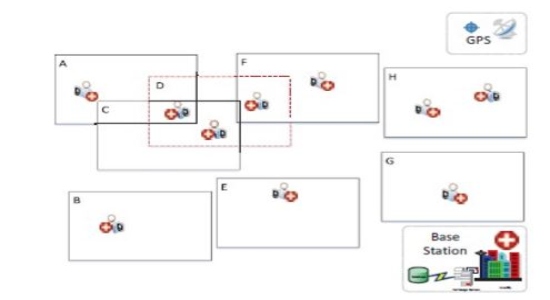
A schematic view of tracking the position instances of a patient. Assume that a patient is traveling with a GPS enabled mobile device. The rectangles with labels A, B, C, D, E, F, G, H are used to capture the respective position instances of an outdoor mobile patient over time. The rectangle D with red broken-line denotes the optimal solution. Thus, among all the eight rectangles the D contains a total of three position instances of the patient representing the maximized weighted-sum of the position data. The “Base Station” is the medical centre where the GPS data are processed by the data analytic experts.
Copyright The Author(s). This is an open access article distributed under the terms of the Creative Commons Attribution License (CC BY 4.0), which permits unrestricted use, distribution, and reproduction in any medium, provided the original author and source are cited.
Download Citation: BibTeX | http://dx.doi.org/10.6180/jase.202009_23(3).0005
In recent decades, the public healthcare settings have devoted their attention to the derail of global pandemics. As a result, the public health professionals have adopted patients monitoring as one of the immediate measures to combat disease spreading. Incorrectness of data is a disadvantage of the traditional monitoring system as it is unable to efficiently handle the complex dynamic behavior of patients. The research community seeks to provide compelling techniques or algorithms that can be used to detect the location and travel of potentially hazardous and/or contagious patients in the case of pandemics. Heuristically, the mobility dynamics and activity records of patients are vital resources to support health researches. The activity records of patients contain their whereabouts in time, and that may provide some relevant knowledge for the analysis of disease spreading. This article presents a trajectory data mining technique to support the detection of outdoor mobile patient. The proposed technique examines the spatio-temporal trajectories of the patient via monitoring strategies with the aid of a global position system (GPS) device. The result of the experiment, using GeoLife big dataset has proven the proposed technique as efficient for monitoring an outdoor mobile patient, and it is easy to integrate into mobile health information systems that are intended for outdoor monitoring purposes towards derail of global pandemics.
Keywords: Health Information System; Mobile Data Analysis; Mobile Outdoor Patient; Patient Monitoring Technique; Spatio-Temporal Trajectory
- [1] Sangkyun Lee and Andreas Holzinger. Knowledge discovery from complex high dimensional data. In Solving Large Scale Learning Tasks. Challenges and Algorithms, pages 148–167. Springer, 2016.
- [2] Tom Yeh, John J. Lee, and Trevor Darrell. Fast concurrent object localization and recognition. In 2009 IEEE Conference on Computer Vision and Pattern Recognition, pages 280–287. IEEE, 2009.
- [3] Francesco Lettich, Salvatore Orlando, and Claudio Silvestri. Processing streams of spatial k-NN queries and position updates on manycore GPUs. In Proceedings of the 23rd SIGSPATIAL International Conference on Advances in Geographic Information Systems, pages 1–10, 2015.
- [4] Mohammad Mehedi Hassan, Shamsul Huda, Md Zia Uddin, Ahmad Almogren, and Majed Alrubaian. Human activity recognition from body sensor data using deep learning. Journal of medical systems, 42(6):99, 2018.
- [5] Marta C. Gonzalez, Cesar A. Hidalgo, and Albert-Laszlo Barabasi. Understanding individual human mobility patterns. nature, 453(7196):779–782, 2008.
- [6] Thomas Beltrame, Robert Amelard, Alexander Wong, and Richard L. Hughson. Extracting aerobic system dynamics during unsupervised activities of daily living using wearable sensor machine learning models. Journal of Applied Physiology, 124(2):473–481, 2018.
- [7] Pedro Nogueira, Joana Urbano, Luís Paulo Reis, Henrique Lopes Cardoso, Daniel Castro Silva, Ana Paula Rocha, Joaquim Gonçalves, and Brígida Mónica Faria. A Review of Commercial and Medical-Grade Physiological Monitoring Devices for Biofeedback-Assisted Quality of Life Improvement Studies. Journal of medical systems, 42(6):101, 2018.
- [8] Massimo Esposito, Aniello Minutolo, Rosario Megna, Manolo Forastiere, Mario Magliulo, and Giuseppe De Pietro. A smart mobile, self-configuring, context-aware architecture for personal health monitoring. Engineering Applications of Artificial Intelligence, 67:136–156, 2018.
- [9] Calvin Or, Ellen Tong, Joseph Tan, and Summer Chan. Exploring factors affecting voluntary adoption of electronic medical records among physicians and clinical assistants of small or solo private general practice clinics. Journal of medical systems, 42(7):121, 2018.
- [10] Deepika Singh, Erinc Merdivan, Ismini Psychoula, Johannes Kropf, Sten Hanke, Matthieu Geist, and Andreas Holzinger. Human activity recognition using recurrent neural networks. In International Cross-Domain Conference for Machine Learning and Knowledge Extraction, pages 267–274. Springer, 2017.
- [11] Ruizhi Wu, Guangchun Luo, Junming Shao, Ling Tian, and Chengzong Peng. Location prediction on trajectory data: A review. Big data mining and analytics, 1(2):108– 127, 2018.
- [12] Yu Zheng. Trajectory data mining: an overview. ACM Transactions on Intelligent Systems and Technology (TIST), 6(3):1–41, 2015.
- [13] Daichi Amagata and Takahiro Hara. A general framework for MaxRS and MaxCRS monitoring in spatial data streams. ACM Transactions on Spatial Algorithms and Systems (TSAS), 3(1):1–34, 2017.
- [14] Daniel Adu-Gyamfi, Fan Zhou, Fengli Zhang, Kittur Philemon Kibiwott, and Victor Dela Tattrah. Realtime Monitoring of Mobile User using Trajectory Data Mining. In 2019 IEEE International Conference on Electrical, Computer and Communication Technologies (ICECCT), pages 1–8. IEEE, 2019.
- [15] Yu Zheng, Xing Xie, and Wei-Ying Ma. GeoLife: A collaborative social networking service among user, location and trajectory. IEEE Data Eng. Bull., 33(2):32– 39, 2010.
- [16] Petko Bakalov and Vassilis J. Tsotras. Continuous spatiotemporal trajectory joins. In International conference on GeoSensor Networks, pages 109–128. Springer, 2006.
- [17] Fa Li, Xi Long, Shenglan Du, Jiawen Zhang, Zizheng Liu, Moying Li, Feng Li, Zhipeng Gui, and Hanruo Yu. Analyzing campus mobility patterns of college students by using GPS trajectory data and graph-based approach. In 2015 23rd International Conference on Geoinformatics, pages 1–5. IEEE, 2015.
- [18] Negin Ebadi, Jee Eun Kang, and Samiul Hasan. Constructing activity–mobility trajectories of college students based on smart card transaction data. International Journal of Transportation Science and Technology, 6(4):316–329, 2017.
- [19] Eunjoon Cho, Seth A. Myers, and Jure Leskovec. Friendship and mobility: user movement in location-based social networks. In Proceedings of the 17th ACM SIGKDD international conference on Knowledge discovery and data mining, pages 1082–1090, 2011.