




Wenbin Xie1, Zhen Zhang1, Yuefei Wang1, Yuanyuan Zhang1, and Liucun Zhu1
1Advanced Science and Technology Research Institute, Beibu Gulf University, Qinzhou 535011, China
Received: July 17, 2019
Accepted: January 05, 2020
Publication Date: May 10, 2026
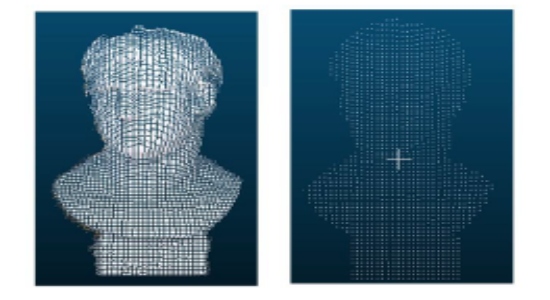
Point Cloud Distribution at Different Distances from Kinect v2.
Copyright The Author(s). This is an open access article distributed under the terms of the Creative Commons Attribution License (CC BY 4.0), which permits unrestricted use, distribution, and reproduction in any medium, provided the original author and source are cited.
Download Citation: BibTeX | http://dx.doi.org/10.6180/jase.202006_23(2).0006
Using Fast Point Feature Histograms feature from point cloud for 3D object recognition or registration, Fast Point Feature Histograms feature descriptor is arbitrarily and inefficiently calculated by subjectively adjusting the neighborhood radius, and the whole process can’t be completed automatically. An adaptive neighborhood-selection Fast Point Feature Histograms point cloud feature extraction algorithm has proposed to solve this problem. Firstly, we estimate the point cloud density of many pairs of point clouds. Secondly, compute the neighborhood radius to extract the Fast Point Feature Histograms features for Sample Consensus Initial Alignment registration, and count the radius and the density when the registration performance is optimal, and then the cubic spline interpolation fitting is used to obtain the function expression of the radius and the density. Finally, the Fast Point Feature Histograms feature extraction algorithm has combined with the function to form adaptive neighborhood-selection Fast Point Feature Histograms feature extraction algorithm. The experimental results have shown that the proposed algorithm can adaptively choose the appropriate neighborhood radius according to the density of point cloud, and improve the Fast Point Feature Histograms feature matching performance. At the same time, it is improved the computing speed to a better value, which is of guiding significance.
Keywords: Fast Point Feature Histograms; Sample Consensus Initial Alignment; Point Cloud Density; Neighborhood Radius; Adaptive Selection
- [1] Radu Bogdan Rusu, Nico Blodow, Zoltan Csaba Marton, and Michael Beetz. Aligning point cloud views using persistent feature histograms. In 2008 IEEE/RSJ International Conference on Intelligent Robots and Systems, IROS, pages 3384–3391, 2008.
- [2] Wei He, Zhijun Li, and C. L. Philip Chen. A survey of human-centered intelligent robots: Issues and challenges. IEEE/CAA Journal of Automatica Sinica, 4(4):602609, 2017.
- [3] Radu Bogdan Rusu, Zoltan Csaba Marton, Nico Blodow, and Michael Beetz. Persistent point feature histograms for 3D point clouds. In Intelligent Autonomous Systems 10, IAS 2008, pages 119–128, 2008.
- [4] Radu Bogdan Rusu, Nico Blodow, and Michael Beetz. Fast Point Feature Histograms (FPFH) for 3D registration. In In Proceedings of IEEE International Conference on Robotics and Automation, IEEE, pages 3212–3217, 2009.
- [5] L. Zhang and L. T. Jiang. Research on 3D Object Recognition based on RealSense. Information Technology, 10:7883, 2017.
- [6] Jing Huang and Suya You. Detecting objects in scene point cloud: A combinational approach. In Proceedings- 2013 International Conference on 3D Vision, 3DV 2013, pages 175–182, 2013.
- [7] Sarah Ershadi Nasab, Shohreh Kasaei, Esmaeil Sanaei, Ali Ossia, and Majid Mobini. Multiview 3D reconstruction and human point cloud classification. In 22nd Iranian Conference on Electrical Engineering, ICEE 2014, pages 1119–1124, 2014.
- [8] D. Ai, M. Wang, and G. B. Ni. Research and Realization of 3D Restruction based on FPFH. Computer Measurement and Control, 24(7):232–236, 2016.
- [9] Raymond A. Yeh, Chen Chen, Teck Yian Lim, Alexander G. Schwing, Mark Hasegawa-Johnson, and Minh N. Do. Semantic image inpainting with deep generative models. In Proceedings- 30th IEEE Conference on Computer Vision and Pattern Recognition, CVPR 2017, volume 2017-Janua, pages 6882–6890, 2017.
- [10] Xiao-yong Xu and Tai-yong Zhong. Construction and Realization of Cubic Spline Interpolation Function. O.I. Automation, 25(11):76–78, 2006.
- [11] Yuantao Chen, Jin Wang, Songjie Liu, Xi Chen, Jie Xiong, Jingbo Xie, and Kai Yang. Multiscale fast correlation filtering tracking algorithm based on a feature fusion model. In Concurrency Computation. John Wiley and Sons Ltd, 2019.
- [12] Guangwei Gao, Dong Zhu, Meng Yang, Huimin Lu, Wankou Yang, and Hao Gao. Face image superresolution with pose via nuclear norm regularized structural orthogonal Procrustes regression. Neural Computing and Applications, 2018.
- [13] Yuantao Chen, Weihong Xu, Jingwen Zuo, and Kai Yang. The fire recognition algorithm using dynamic feature fusion and IV-SVM classifier. Cluster Computing, 22:7665–7675, may 2019.
- [14] Ya Tu, Yun Lin, Jin Wang, and Jeong Uk Kim. Semisupervised learning with generative adversarial networks on digital signal modulation classification. Computers, Materials and Continua, 55(2):243–254, 2018.
- [15] Yuantao Chen, Jin Wang, Xi Chen, Mingwei Zhu, Kai Yang, Zhi Wang, and Runlong Xia. Single-Image Super-Resolution Algorithm Based on Structural Self-Similarity and DeformationBlockFeatures. IEEE Access, 7:58791–58801, 2019.
- [16] Yuantao Chen, Jin Wang, Xi Chen, Arun Kumar Sangaiah, Kai Yang, and Zhouhong Cao. Image superresolution algorithm based on dual-channel convolutional neural networks. Applied Sciences (Switzerland), 9(11), 2019.
- [17] Y. T. Chen, R. L. Xia, Z. Wang, J. M. Tang, K. Yang, Z. H. Cao Multimed. Tools Appl, and Undefined 2019. The visual saliency detection algorithm research based on hierarchical principle component analysis method. Multimedia Tools and Applications, 2019.
- [18] Yuantao Chen, Jin Wang, Runlong Xia, Qian Zhang, Zhouhong Cao, and Kai Yang. The visual object tracking algorithm research based on adaptive combination kernel. Journal of Ambient Intelligence and Humanized Computing, 10(12):4855–4867, dec 2019.
- [19] Yoshua Bengio, Aaron Courville, and Pascal Vincent. Representation learning: A review and new perspectives. IEEE Transactions on Pattern Analysis and Machine Intelligence, 35(8):1798–1828, 2013.
- [20] Feng Tang, Yiting Ying, Jin Wang, and Qunsheng Peng. A novel texture synthesis based algorithm for object removal in photographs. Lecture Notes in Computer Science (including subseries Lecture Notes in Artificial Intelligence and Lecture Notes in Bioinformatics), 3321:248–258, 2004.
- [21] Yuantao Chen, Jie Xiong, Weihong Xu, and Jingwen Zuo. A novel online incremental and decremental learning algorithm based on variable support vector machine. Cluster Computing, 22:7435–7445, may 2019.
- [22] Guangwei Gao, Jian Yang, Songsong Wu, Xiaoyuan Jing, and Dong Yue. Bayesian sample steered discriminative regression for biometric image classification. Applied Soft Computing Journal, 37:48–59, 2015.
- [23] Guangwei Gao, Yi Yu, Meng Yang, H. Chang, Pu Huang, and Dong Yue. Cross-resolution face recognition with pose variations via multilayer locality-constrained structural orthogonal procrustes regression. Information Sciences, 506:19–36, 2020.
- [24] Yi Yu, Suhua Tang, Kiyoharu Aizawa, and Akiko Aizawa. Category-Based Deep CCA for Fine-Grained Venue Discovery from Multimodal Data. IEEE Transactions on Neural Networks and Learning Systems, 30(4):1250–1258, 2019.