




Ming-Hsiu Tsai and Sian-Ren Huang
Department of Civil Engineering, Tamkang University, New Taipei City, Taiwan 251, R.O.C.
Received: September 05, 2018
Accepted: May 07, 2019
Publication Date: May 10, 2026
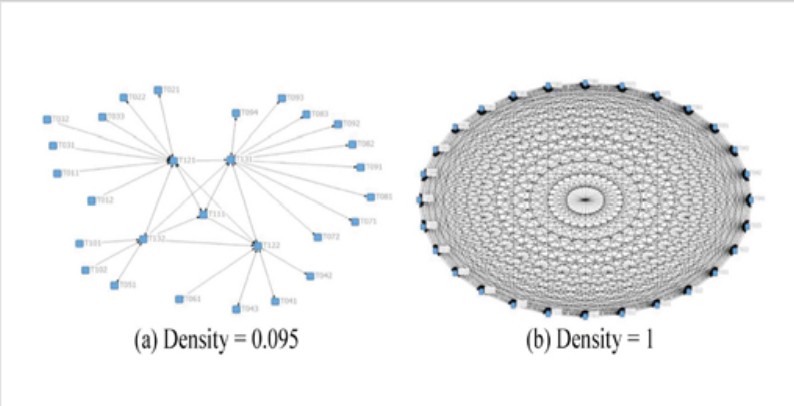
(a) Communication network with only formal connections (mapped from the organizational relationships in Figure 8); (b) Communication network with full connections.
Copyright The Author(s). This is an open access article distributed under the terms of the Creative Commons Attribution License (CC BY 4.0), which permits unrestricted use, distribution, and reproduction in any medium, provided the original author and source are cited.
Download Citation: BibTeX | http://dx.doi.org/10.6180/jase.202003_23(1).0010
A larger construction project requires the involvement of more professionals in the project team. The efficiency of collaborative interactions among heterogeneous professionals during construction is critical to project success. A social-network-based simulation tool can assist project managers in experimenting and analyzing the efficiency of project teams. Accordingly, this study adopted the social network philosophy to create a team member interaction mechanism and applied the agent-based modeling and simulation approach to develop an agent-based project team collaborative efficiency simulation (PTCES) model for estimating the collaborative efficiency of project teams. In the PTCES model, agents with their collaborative network can execute assigned activities collaboratively so that the team efficiency can be estimated by the simulation manner. An actual building construction case was examined experimentally to calibrate and validate the proposed model, and the results proved the quantitative ability of the PTCES model in estimating team efficiency under different circumstances. The case simulation results also indicated the importance of developing a collaborative culture and reducing the reworking risk for improving the project efficiency. Moreover, a higher collaborative network density was determined to engender higher project efficiency and shorter project duration; however, the impact converged with increasing network density. The proposed model contributes to favorably observing the effect of social network aspects of project management and to efficiently estimating the efficiency and duration of construction projects.
Keywords: Collaboration, Project Management, Agent-based Modeling and Simulation, Social Network, Construction Process Simulation
- [1] Son, J., and E. M. Rojas (2011) Evolution of collaboration in temporary project teams: an agent-based modeling and simulation approach, J. Constr. Eng. Manage 137(8), 619–628. doi: 10.1061/(ASCE)CO.1943-7862.0000331
- [2] Bertelsen, S. (2003) Construction as a Complex System, presented at the 11th Annual Meeting of the Int.
- [3] Gould, F., and N. Joyce (2009) Construction Project Management. 3rd ED. Pearson Higher.
- [4] Giri, B. E., D. Manongga, and A. Iriani (2014) Using social networking analysis (SNA) to analyze collaboration between students (case study: students of Open University in Kupang), International Journal of Computer Applications 85(1), 39–44. doi: 10.5120/148083022
- [5] Labarbe, E., and D. Thiel (2014) Information sharing to reduce misperceptions of interactions among complementary projects: a multi-agent approach, Journal of Artificial Societies and Social Simulation 179(1), 1–9.
- [6] Jin, Y., and R. E. Levitt (1996) The virtual design team: a computational model of project organizations, Computational and Mathematical Organization Theory 2(3), 171–195. doi: 10.1007/BF00127273
- [7] Busi, M., and U. S. Bititci (2006) Collaborative performance management: present gaps and future research, International Journal of Productivity and Performance Management 55(1), 7–25. doi: 10.1108/17410400610 635471
- [8] Horii, T., Jin, Y., and R. E. Levitt (2005) Modeling and analyzing cultural influences on project team performance, Computational and Mathematical Organization Theory 10(4), 305–321. doi: 10.1007/s10588-0056283-1
- [9] Carroll, T., and R. M. Burton (2000) Organizations and complexity: searching for the edge of chaos, Computational and Mathematical Organization Theory 6(4), 319–337. doi: 10.1023/A:1009633728444
- [10] Macal, C. M., and M. J. North (2010) Tutorial on agent-based modelling and simulation, Journal of Simulation 4(3), 151–162. doi: 10.1057/jos.2010.3
- [11] Chinowsky, P., J. Diekmann, and V. Galotti (2008) Social network model of construction, J. Constr. Eng. Manage. 134(10), 804–812. doi: 10.1061/(ASCE) 0733-9364(2008)134:10(804)
- [12] Levitt, R. E. (2012) The virtual design team: designing project organizations as engineers design bridges, Journal of Organization Design 1(2), 14–41. doi: 10.1287/ mnsc.45.11.1479
- [13] Park, H., S. H. Han, E. M. Rojas, J. Son, and W. Jung (2011) Social network analysis of collaborative ventures for overseas construction projects, J. Constr. Eng. Manage. 137(5), 344–355. doi: 10.1061/(ASCE) CO.1943-7862.0000301
- [14] Easley, R. F, S. Devaraj, and J. M. Crant (2003) Relating collaborative technology use to teamwork quality and performance: an empirical analysis, Journal of Management Information Systems 19(4), 247–268.
- [15] Love, P. E. D., G. D. Holt, L. Y. Shen, H. Li, and Z. Irani (2002) Using systems dynamics to better understand change and rework in construction project management systems, International Journal of Project Management 20(6), 425–436. doi: 10.1016/S02637863(01)00039-4
- [16] Cheng, M. Y., M. H. Tsai, and Z. W. Xiao (2005) Construction management process reengineering: organizational human resource planning for multiple projects, Automation in Construction 15(6), 785–799. doi: 10.1016/j.autcon.2005.10.014
- [17] Chang, A. S, F. Y. Shen, and W. Ibbs (2010) Design and construction coordination problems and planning for design–build project new users, Canadian Journal of Civil Engineering 37(12), 1525–1534. doi: 10.1139/ L10-090
- [18] Du, J., and M. El-Gafy (2012) Virtual organizational imitation for construction enterprises: agent-based simulation framework for exploring human and organizational implications in construction management, Journal of Computing in Civil Engineering 26(3), 282297. doi: 10.1061/(ASCE)CP.1943-5487.0000122
- [19] Wilensky, U., and W. Rand (2015) An introduction to agent-based modeling: modeling natural, social, and engineered complex systems with NetLogo (MIT Press), Kindle Edition 68(8). The MIT Press, 6484–6485. doi: 10.1063/PT.3.2884
- [20] Rapoport, A. (1953) Spread of information through a population with socio-structural bias: II. Various models with partial transitivity. Bulletin of Mathematical Biophysics 15(4), 535–546. doi: 10.1007/BF02476441
- [21] Levitt, R. E., J. Thomsen, and T. R. Christiansen (1999) Simulating project work processes and organizations: toward a micro-contingency theory of organizational design, Management Science 45(11), 1479–1495. doi: 10.1287/mnsc.45.11.1479
- [22] Fridsma, D. B. (2003) Organizational Simulation of Medical Work: an Information-processing Approach, Stanford University, USA.
- [23] Galbraith, J. R. (1984) Organization design: an information processing view, Organizational Effectiveness 8(3), 21–26. doi: 10.1287/inte.4.3.28
- [24] Liben, N. D., and J. Kleinberg (2007) The link-prediction problem for social networks, Journal of the American Society for Information Science and Technology 58(7), 1019–1031. doi: 10.1002/asi.20591
- [25] Kossinets, G., and D. J. Watts (2006) Empirical analysis of an evolving social networt, Science 311(5757), 88–90. doi: 10.1126/science.1116869
- [26] Informaton on http://jmvidal.cse.sc.edu/papers/mas.pdf.
- [27] Wilensky, U. (1999) NetLogo, Center for Connected Learning and Computer-Based Modeling Northwestern University, Evanston, IL. Center for Connected Learning and Computer-Based Modeling. Northwestern University, Evanston.
- [28] Xiang, X., R. Kennedy, G. Madey, and S. Cabaniss (2005) Verification and validation of agent-based scientific simulation models, Agent-Directed Simulation Conference 47–55.
- [29] Sargent, R. G. (2012) Verification and validation of simulation models. 7(1), 12–24. doi: 10.1057/jos.2012. 20
- [30] Rutkowski, T. M., K. Kakusho, V. Kryssanov, and M. Minoh (2004) Evaluation of the Communication Atmosphere. Knowledge-Based Intelligent Information and Engineering Systems 3213(53). Heidelberg: Springer Berlin Heidelberg, Berlin, 364–370. doi: 10.1007/ 978-3-540-30132-5_53