




Abdulqader D. Faisal1, Ali A. Aljubouri1, and Wafaa Khalid Khalef1
1University of Technology, Department of Applied Sciences, Baghdad, Iraq
Received: November 17, 2019
Accepted: April 07, 2020
Publication Date: May 10, 2026
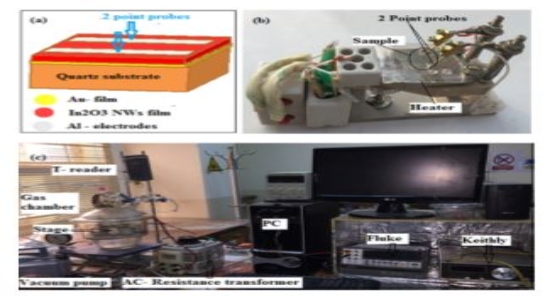
Schematic diagram of (a) the fabricated sensor device, (b) Homemade measurement stage, (c) Gas sensor setup.
Copyright The Author(s). This is an open access article distributed under the terms of the Creative Commons Attribution License (CC BY 4.0), which permits unrestricted use, distribution, and reproduction in any medium, provided the original author and source are cited.
Download Citation: BibTeX | http://dx.doi.org/10.6180/jase.202009_23(3).0010
In this paper, Indium oxide nanowires (In2O3 NWs) were successfully synthesized on quartz substrate pre-coated with gold nanoparticles (Au NPs) using chemical vapor deposition (CVD). The nanowires were characterized via x-ray diffraction (XRD), scanning electron microscope (SEM), Ultraviolet-Visible (UV-VIS) spectrophotometer. The sputtered of Au NPs on quartz were analyzed by atomic force microscopy (AFM). The structural, morphological, and optical properties were investigated. The XRD structure reviled a single crystal, with cubic crystal, with preferred orientation along (222). The SEM revealed nanowires growth. The obtained band gap value of 3.6 eV confirmed the formation of In2O3 nanostructures. Regarding to the characteristics of In2O3 NWs, it was fabricated as an ethanol gas sensor at 10-1500 ppm and an optimized temperature of 210 ℃. The minimum ethanol gas response of Ra/Rg = 1.6 was obtained at a concentration of 10 ppm. The corresponding response and recovery time were achieved at the lowest concentration of 10 ppm is 10 s and 10 s respectively. So, the In2O3 NWs film synthesized via CVD can be considered as a good ethanol gas sensor device at low concentration. In2O3 NWs growth and gas sensing mechanism were also explained.
Keywords: Chemical vapor deposition (CVD); Gas sensor; In2O3 nanowires
- [1] Antonio Tricoli, Marco Righettoni, and Alexandra Teleki. Semiconductor Sensors Semiconductor Gas Sensors : Dry Synthesis and Application Angewandte. Wiley Online Library, pages 7632–7659, 2010.
- [2] Niranjan S. Ramgir, Yang Yang, and Margit Zacharias. Nanowire-based sensors, aug 2010.
- [3] Qianqiu Tang, Wenqiang Wang, and Gengchao Wang. The perfect matching between the low-cost Fe2O3 nanowire anode and the NiO nanoflake cathode significantly enhances the energy density of asymmetric supercapacitors. Journal of Materials Chemistry A, 3(12):6662–6670, 2015.
- [4] Prabhakar Rai, Yun Su Kim, Hyeon Min Song, Min Kyung Song, and Yeon Tae Yu. The role of gold catalyst on the sensing behavior of ZnO nanorods for CO and NO 2 gases. Sensors and Actuators, B: Chemical, 165(1):133–142, 2012.
- [5] P. M. Perillo and D. F. Rodríguez. The gas sensing properties at room temperature of TiO2 nanotubes by anodization. Sensors and Actuators, B: Chemical, 171- 172:639–643, 2012.
- [6] Abhijit A. Yadav. SnO2 thin film electrodes deposited by spray pyrolysis for electrochemical supercapacitor applications. Journal of Materials Science: Materials in Electronics, 27(2):1866–1872, feb 2016.
- [7] Ali A. Aljubouri, Abdulqader D. Faisal, and Wafaa K. Khalef. Fabrication of temperature sensor based on copper oxide nanowires grown on titanium coated glass substrate. Materials Science- Poland, 36(3):460–468, 2018.
- [8] Bingxin Xiao, Fei Wang, Chengbo Zhai, Pan Wang, Chuanhai Xiao, and Mingzhe Zhang. Facile synthesis of In2O3 nanoparticles for sensing properties at low detection temperature. Sensors and Actuators, B: Chemical, 235:251–257, 2016.
- [9] Maryam Amirhoseiny, Zainuriah Hassan, and Ng Shashiong. Synthesis of nanocrystalline In2O3 on different Si substrates at wet oxidation environment. Optik, 124(17):2679–2681, 2013.
- [10] Xiumei Xu, Dawei Wang, Jing Liu, Peng Sun, Yue Guan, Heng Zhang, Yanfeng Sun, Fengmin Liu, Xishuang Liang, Yuan Gao, and Geyu Lu. Template-free synthesis of novel In2O3 nanostructures and their application to gas sensors. Sensors and Actuators, B: Chemical, 185:32–38, 2013.
- [11] K. P. Sibin, Niharika Swain, Prasanta Chowdhury, Arjun Dey, N. Sridhara, H. D. Shashikala, Anand Kumar Sharma, and Harish C. Barshilia. Optical and electrical properties of ITO thin films sputtered on flexible FEP substrate as passive thermal control system for space applications. Solar Energy Materials and Solar Cells, 145:314–322, 2016.
- [12] Bishnu Prasad Bastakoti, Hamid Oveisi, Chi Chang Hu, Kevin C. W. Wu, Norihiro Suzuki, Kimiko Takai, Yuichiro Kamachi, Masataka Imura, and Yusuke Yamauchi. Mesoporous carbon incorporated with In2O3 nanoparticles as high-performance supercapacitors. European Journal of Inorganic Chemistry, (7):1109–1112, mar 2013.
- [13] M. Osiak, W. Khunsin, E. Armstrong, T. Kennedy, C. M. Sotomayor Torres, K. M. Ryan, and C. O’Dwyer. Epitaxial growth of visible to infra-red transparent conducting In 2O3 nanodot dispersions and reversible charge storage as a Li-ion battery anode. Nanotechnology, 24(6):65401–65411, 2013.
- [14] Dong Ju Kim and Han Ki Kim. Optimization of titanium-doped indium oxide anodes for heterojunction organic solar cells. Physica Status Solidi (A) Applications and Materials Science, 214(2), feb 2017.
- [15] Zhao Qiang Zheng, Lian Feng Zhu, and Bing Wang. In2O3 Nanotower Hydrogen Gas Sensors Based on Both Schottky Junction and Thermoelectronic Emission. Nanoscale Research Letters, 10(1), dec 2015.
- [16] Pei Li, Huiqing Fan, Yu Cai, and Mengmeng Xu. Zn-doped In2O3 hollow spheres: Mild solution reaction synthesis and enhanced Cl2 sensing performance. CrystEngComm, 16(13):2715–2722, apr 2014.
- [17] Su Zhang, Peng Song, Zhongxi Yang, and Qi Wang. Facile hydrothermal synthesis of mesoporous In2O3 nanoparticles with superior formaldehyde-sensing properties. Physica E: Low-Dimensional Systems and Nanostructures, 97:38–44, 2018.
- [18] Chang Sup Moon, Hae Ryong Kim, Graeme Auchterlonie, John Drennan, and Jong Heun Lee. Highly sensitive and fast responding CO sensor using SnO2 nanosheets. Sensors and Actuators, B: Chemical, 131(2):556–564, 2008.
- [19] Changhui Zhao, Baoyu Huang, Erqing Xie, Jinyuan Zhou, and Zhenxing Zhang. Improving gas-sensing properties of electrospun In2O3 nanotubes by Mg acceptor doping. Sensors and Actuators, B: Chemical, 207(Part A):313–320, 2015.
- [20] Yu Cian Wang, Chih Yao Chen, Cheng Wen Kuo, Ta Ming Kuan, Cheng Yeh Yu, and I. Chen Chen. Lowtemperature grown indium oxide nanowire-based antireflection coatings for multi-crystalline silicon solar cells. Physica Status Solidi (A) Applications and Materials Science, 213(8):2259–2263, aug 2016.
- [21] Zhi Xuan Cheng, Xiang Bing Dong, Qing Yi Pan, Jian cheng Zhang, and Xiao Wen Dong. Preparation and characterization of In2O3 nanorods. Materials Letters, 60(25-26):3137–3140, 2006.
- [22] Jun Yang, Chunxia Li, Zewei Quan, Deyan Kong, Xiaoming Zhang, Piaoping Yang, and Jun Lin. One-step aqueous solvothermal synthesis of in 2O 3 nanocrystals. Crystal Growth and Design, 8(2):695–699, feb 2008.
- [23] Zaiyin Huang, Chunfang Chai, Xuecai Tan, Jian Wu, Aiqun Yuan, and Zeguang Zhou. Photoluminescence properties of the In2O3 octahedrons synthesized by carbothermal reduction method. Materials Letters, 61(29):5137–5140, 2007.
- [24] Po Chiang Chen, Guozhen Shen, Saowalak Sukcharoenchoke, and Chongwu Zhou. Flexible and transparent supercapacitor based on In2 O 3 nanowire/carbon nanotube heterogeneous films. Applied Physics Letters, 94(4), 2009.
- [25] Sergio Roso, Toni Vilic, Atsushi Urakawa, and Eduard Llobet. Gas Sensing Properties of In2O3 Cubes Prepared by a Hydrothermal Method. In Procedia Engineering, volume 168, pages 247–250, 2016.
- [26] Liu Jian, Huang Shihua, and He Lö. Metal-catalyzed growth of In2O3 nanotowers using thermal evaporation and oxidation method. Journal of Semiconductors, 36(12), 2015.
- [27] Fatma Nur Tuzluca, Yasar Ozkan Yesilbag, Tuba Akkus, and Mehmet Ertugrul. Effects of graphite on the synthesis of 1-D single crystal In2O3 nanostructures at high temperature. Materials Science in Semiconductor Processing, 66:62–68, 2017.
- [28] Ahsanulhaq Qurashi, E. M. El-Maghraby, Toshinari Yamazaki, and Toshio Kikuta. Catalyst supported growth of In2O3 nanostructures and their hydrogen gas sensing properties. Sensors and Actuators, B: Chemical, 147(1):48–54, 2010.
- [29] Zheng Wei Pan, Zu Rong Dai, and Zhong Lin Wang. Nanobelts of semiconducting oxides. Science, 291(5510):1947–1949, 2001.
- [30] Y. Li, Y. Bando, and D. Golberg. Single-Crystalline In2O3 Nanotubes Filled with In. Advanced Materials, 15(78):581–585, apr 2003.
- [31] N. Barsan, D. Koziej, U. Weimar Sensors Chemical, Actuators B:, and Undefined 2007. Metal oxide-based gas sensor research: How to? Sensors and Actuators, B: Chemical, 121(1):18–35, 2007.
- [32] Guillem Domènech-Gil, Jordi Samà, Paolo Pellegrino, Sven Barth, Isabel Gràcia, Carles Cané, and Albert Romano-Rodriguez. Gas nanosensors based on individual indium oxide nanostructures. In Procedia Engineering, volume 120, pages 795–798, 2015.
- [33] A. Vomiero, S. Bianchi, E. Comini, G. Faglia, M. Ferroni, N. Poli, and G. Sberveglieri. In2O3 nanowires for gas sensors: morphology and sensing characterisation. Thin Solid Films, 515(23):8356–8359, 2007.
- [34] Zhongming Zeng, Kai Wang, Zengxing Zhang, Jiajun Chen, and Weilie Zhou. The detection of H2S at room temperature by using individual indium oxide nanowire transistors. Nanotechnology, 20(4), 2009.
- [35] Ahsanulhaq Qurashi, E. M. El-Maghraby, Toshinari Yamazaki, Yanbai Shen, and Toshio Kikuta. A generic approach for controlled synthesis of In2O3 nanostructures for gas sensing applications, 2009.
- [36] Pengcheng Xu, Zhixuan Cheng, Qingyi Pan, Jiaqiang Xu, Qun Xiang, Weijun Yu, and Yuliang Chu. High aspect ratio In2O3 nanowires: Synthesis, mechanism and NO2 gas-sensing properties. Sensors and Actuators, B: Chemical, 130(2):802–808, 2008.
- [37] T. Wagner, T. Sauerwald, C. D. Kohl, T. Waitz, C. Weidmann, and M. Tiemann. Gas sensor based on ordered mesoporous In2O3. Thin Solid Films, 517(22):6170–6175, 2009.
- [38] E. F. Keskenler, G. Turgut, and S. Dogan. Investigation of structural and optical properties of ZnO films co-doped with fluorine and indium. Superlattices and Microstructures, 52(1):107–115, 2012.
- [39] Chang Hoon Lee, Minsik Kim, Taekhoon Kim, Ansoon Kim, Jungsun Paek, Ju Wook Lee, Sung Yool Choi, Kyuwon Kim, Jong Bong Park, and Kwangyeol Lee. Ambient pressure syntheses of size-controlled corundumtype In2O3 nanocubes. Journal of the American Chemical Society, 128(29):9326–9327, jul 2006.
- [40] K. K. Makhija, Arabinda Ray, R. M. Patel, U. B. Trivedi, and H. N. Kapse. Indium oxide thin film based ammonia gas and ethanol vapour sensor. Bulletin of Materials Science, 28(1):9–17, 2005.
- [41] Guillem Domènech-Gil, Sven Barth, Jordi Samà, Paolo Pellegrino, Isabel Gràcia, Carles Cané, and Albert Romano-Rodriguez. Gas sensors based on individual indium oxide nanowire. Sensors and Actuators, B: Chemical, 238:447–454, 2017.