


Toqeer Ali Syed1, Muhammad Tayyab Naqash2, Waqas Nawaz1, Abdallah Namoun1,3, and Munir Azam Muhammad4
1Faculty of Computer and Information System, Islamic University of Madinah, Saudi Arabia.
2Civil Engineering Department, Faculty of Engineering, Islamic University of Madinah, Madinah 42351, Saudi Arabia.
3AI Center, Faculty of Computer and Information Systems, Islamic University of Madinah, Madinah 42351, Saudi Arabia.
4Khwaja Fareed University of Engineering & Information Technology, Faculty of Computer and Information System, Rahim Yar Khan, Punjab, Pakistan.
Received: September 14, 2024
Accepted: December 3, 2024
Publication Date: April 6, 2026
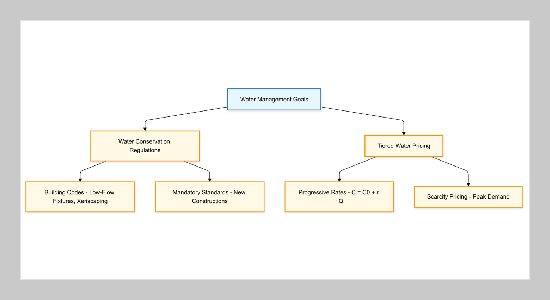
Water Management Goals.
Copyright The Author(s). This is an open access article distributed under the terms of the Creative Commons Attribution License (CC BY 4.0), which permits unrestricted use, distribution, and reproduction in any medium, provided the original author and source are cited.
Download Citation: BibTeX | http://dx.doi.org/10.6180/jase.202510_28(10).0015
Water resource management worldwide faces significant challenges, including high consumption rates, scarcity, and ageing infrastructure. This paper proposes a comprehensive approach to address these issues through five key solutions. Advanced Metering Infrastructure (AMI) first facilitates real-time data collection and consumer awareness campaigns. Secondly, wastewater recycling and reuse are promoted by upgrading wastewater treatment plants and fostering public-private partnerships. Thirdly, reducing network losses is achieved through leak detection systems and regular maintenance. Fourthly, policy enhancement and regulatory frameworks are strengthened by implementing regulations for new developments and incentives for water-saving technologies. Lastly, community engagement and education initiatives are undertaken to promote sustainable water practices. This multifaceted strategy aims to improve water conservation, efficiency, and resilience of the water supply system. This paper proposes solutions that can be applied to the Madinah AL Munawara region of Saudi Arabia, an area of utmost importance, demonstrating the applicability and effectiveness of these solutions in addressing regional water management challenges.
Keywords: Smart water metering, Water Conservation, Internet of things, Water efficiency, Madinah, Vision 2030, advanced metering infrastructure (AMI), Sustainability.
- [1] K. O. S. ARABIA. Environment & Nature (2023). Accessed Sep. 18, 2023.
- [2] M. T. Naqash, T. A. Syed, S. S. Alqahtani, M. S. Siddiqui, A. Alzahrani, and M. Nauman, (2023) “A blockchain based framework for efficient water management and leakage detection in urban areas” Urban Science 7(4): 99. DOI: 10.3390/urbansci7040099.
- [3] M. T. Naqash, M. H. Aburamadan, O. Harireche, A. AlKassem, and Q. U. Farooq, (2021) “The Potential of Wind Energy and Design Implications on Wind Farms in
Saudi Arabia” International Journal of Renewable Energy Development 10(4): 839–856. DOI: 10.14710/ijred.2021.38238. - [4] E. Zanghi, M. Brown Do Coutto Filho, and J. C. Stacchini de Souza, (2024) “Collaborative Smart Energy Metering System Inspired by Blockchain Technology” International Journal of Innovative Science: DOI: 10.1108/IJIS-07-2022-0127.
- [5] N. Sushma, H. N. Suresh, J. M. Lakshmi, P. N. Srinivasu, A. K. Bhoi, and P. Barsocchi, (2023) “A Unified Metering System Deployed for Water and Energy Monitoring in Smart City” IEEE Access: DOI: 10.1109/ACCESS.2023.3299825.
- [6] V. Slaný, A. Lučanský, P. Koudelka, J. Mareček, E. Krčálová, and R. Martínek, (2020) “An Integrated IoT Architecture for Smart Metering Using Next Generation Sensor for Water Management Based on LoRaWAN Technology: A Pilot Study” Sensors (Switzerland): DOI: 10.3390/s20174712.
- [7] O. A. Masia and L. D. Erasmus. “Smart Metering Implementation for Enabling Water Conservation and Water Demand Management”. In: Africon. 2013.
- [8] T. Randall and R. Koech, (2019) “Smart Water Metering Technology for Water Management in Urban Areas” Water e-Journal: DOI: 10.21139/wej.2019.001.
- [9] M. Suresh, U. Muthukumar, and J. Chandapillai. “A Novel Smart Water-Meter Based on IoT and Smartphone App for City Distribution Management”. In: TENSYMP 2017 – IEEE International Symposium on Technologies for Smart Cities. 2017. DOI: 10.1109/TENCONSpring.2017.8070088.
- [10] M. T. Naqash and Q. U. Farooq, (2024) “Geothermal and Wind Energy: Sustainable Solutions for Pakistan’s Energy Economics” Science and Technology for Energy Transition: DOI: 10.2516/stet/2024016.
- [11] M. T. Naqash, (2023) “Assessment Of Renewable Energy Potential In A Region Based On Climatic Conditions” International Journal of Energy, Environment, and Economics 30(1): 62–67.
- [12] S. Alvisi et al., (2019) “Wireless Middleware Solutions for Smart Water Metering” Sensors (Switzerland): DOI: 10.3390/s19081853.
- [13] G. Gosavi, G. Gawde, and G. Gosavi. “Smart Water Flow Monitoring and Forecasting System”. In: RTEICT 2017 – 2nd IEEE International Conference on Recent Trends in Electronics, Information and Communication Technology, Proceedings. 2017. DOI: 10.1109/RTEICT.2017.8256792.
- [14] M. Kavya, A. Mathew, P. R. Shekar, and S. P., (2023) “Short Term Water Demand Forecast Modelling Using Artificial Intelligence for Smart Water Management” Sustainable Cities and Society: DOI: 10.1016/j.scs.2023.104610.
- [15] S. J. Livingston, M. R. S. Simeon, B. Vikas, and P. H. Chandan, (2019) “A Hybrid Approach for Water Utilization in Smart Cities Using Machine Learning Techniques” International Journal of Innovative Technology and Exploring Engineering:
- [16] H. March, Á. F. Morote, A. M. Rico, and D. Saurí, (2017) “Household Smart Water Metering in Spain: Insights from the Experience of Remote Meter Reading in Alicante” Sustainability: DOI: 10.3390/su9040582.
- [17] M. Kumar Jha, R. Kumari Sah, M. S. Rashmitha, R. Sinha, B. Sujatha, and K. V. Suma. “Smart Water Monitoring System for Real-Time Water Quality and Usage Monitoring”. In: Proceedings of the International Conference on Inventive Research in Computing Applications (ICIRCA). 2018. DOI: 10.1109/ICIRCA.2018.8597179.
- [18] P. R. R. Karhe and M. V. D. Kachawa, (2019) “IoT Based Water Management System” International Journal of Recent Innovation Trends in Computing and Communication: DOI: 10.17762/ijritcc.v7i9.5358.
- [19] X. J. Li and P. H. J. Chong, (2019) “Design and Implementation of a Self-Powered Smart Water Meter” Sensors (Switzerland): DOI: 10.3390/s19194177.
- [20] S. W. C. C. (SWCC). Sustainability Report 2021. Riyadh, Saudi Arabia. 2021.
- [21] R. Gyaang, P. Appiah, and J. Asumda, (2023) “Current Smart Metering System in Ghana: Challenges and Mitigation Techniques” International Journal of Computer Applications: DOI: 10.5120/ijca2023922899.
- [22] H. Shahinzadeh and A. Hasanalizadeh-Khosroshahi, (2014) “Implementation of Smart Metering Systems: Challenges and Solutions” TELKOMNIKA Indonesian Journal of Electrical Engineering: DOI: 10.11591/telkomnika.v12i7.5599.
- [23] J. B. Hur, D. Y. Koo, and Y. J. Shin, (2015) “Privacypreserving Smart Metering with Authentication in a Smart Grid” Applied Sciences: DOI: 10.3390/app5041503.
- [24] J. E. Rubio, C. Alcaraz, and J. Lopez, (2017) “Recommender System for Privacy-preserving Solutions in Smart Metering” Pervasive and Mobile Computing: DOI: 10.1016/j.pmcj.2017.03.008.
- [25] P. I. Radoglou-Grammatikis and P. G. Sarigiannidis, (2019) “Securing the Smart Grid: A Comprehensive Compilation of Intrusion Detection and Prevention Systems” IEEE Access: DOI: 10.1109/ACCESS.2019.2909807.
- [26] S. Rajaguru, B. Johansson, and M. Granath. “Exploring Smart Meters: What We Know and What We Need to Know”. In: International Conference on Business Informatics Research. Springer. 2023, 105–120. DOI: 10.1007/978-3-031-43126-5_8.
- [27] L. Zhou, F. Y. Xu, and Y. N. Ma. “Impact of Smart Metering on Energy Efficiency”. In: 2010 International Conference on Machine Learning and Cybernetics (ICMLC). 2010. DOI: 10.1109/ICMLC.2010.5580715.
- [28] K. Sharma and L. M. Saini, (2015) “Performance Analysis of Smart Metering for Smart Grid: An Overview” Renewable and Sustainable Energy Reviews: DOI: 10.1016/j.rser.2015.04.170.
- [29] A. Podgornik, B. Sucic, P. Bevk, and D. Stanicic. “The impact of smart metering on energy efficiency in lowincome housing in Mediterranean”. In: Climate-Smart Technologies: Integrating Renewable Energy and Energy Efficiency in Mitigation and Adaptation Responses. Springer. 2013, 597–614. DOI: 10.1007/978-3-642-37753-2_45.
- [30] S. I. EXPO. KSA to hit UN Sustainable Development Goals by 2030 with 80bnWaterSpend. Accessed May 19, 2024.
- [31] T. A. Syed, M. Y. Khan, S. Jan, S. Albouq, S. S. Alqahtany, and M. T. Naqash, (2024) “Integrating Digital Twins and Artificial Intelligence Multi-Modal Transformers into Water Resource Management: Overview and Advanced Predictive Framework” AI 5: 1977–2017. DOI: 10.3390/ai5040098.
- [32] Publications. Publications | PUB, Singapore’s National Water Agency. Accessed May 18, 2024.
- [33] I. Water. Irish Water: One of the World’s Largest Meter Installation Programmes. Accessed May 18, 2024.
- [34] Y. V. Water. Digital Metering Joint Program | Yarra Valley Water. Accessed May 18, 2024.
- [35] C. McMaster and W. C. Liebold. New York City Innovates as it Implements AMI | Smart Energy International. Accessed May 18, 2024.