




Kaibin Wei1, Jianqiang Jing1, Haifeng Li2, Xiannian Xie1, and Furong Li1
1School of Electronic Information and Electrical Engineering, Tianshui Normal University, Tianshui, 741000, China
2School of Mathematics and Statistics, Fuyang Normal University, Fuyang 236037, China
Received: August 23, 2025
Accepted: September 27, 2025
Publication Date: April 2, 2026
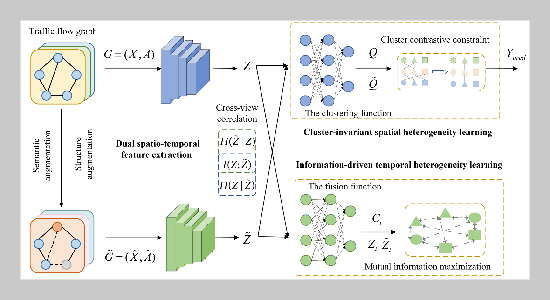
The illustration of STHL, consisting of dual spatio-temporal feature extraction, cluster-invariant spatial heterogeneity learning, and information-driven temporal heterogeneity learning
Copyright The Author(s). This is an open access article distributed under the terms of the Creative Commons Attribution License (CC BY 4.0), which permits unrestricted use, distribution, and reproduction in any medium, provided the original author and source are cited.
Download Citation: BibTeX | https://doi.org/10.6180/jase.202606_29(6).0011
Accurate traffic flow forecasting is crucial for enhancing urban transportation efficiency and travel experiences. However, existing methods face challenges in capturing the complex spatio-temporal heterogeneity of traffic data. This paper introduces a novel Spatio-Temporal Heterogeneous Learning (STHL) framework for traffic flow
forecasting. The framework encompasses three key components: dualspatio-temporal feature extraction, cluster invariant spatial heterogeneity learning, and information-driven temporal heterogeneity learning. Dual spatio temporal feature extraction employs semantic and structural augmentations to enrich traffic flow representation learning, capturing spatial and temporal dependencies comprehensively. Cluster-invariant spatial heterogeneity learning distinguishes traffic patterns across urban regions, while information-driven temporal heterogeneity learning injects time- aware heterogeneity into node representations. Experiments on four real- world traffic
flow datasets demonstrate that our method outperforms existing state-of-the-art approaches in terms of MAE and MAPEmetrics, showcasing its effectiveness in capturing spatio-temporal heterogeneity for enhanced traffic flowprediction accuracy.
Keywords: Traffic flow forecasting; Spatio-temporal heterogeneous learning; graph contrastive learning
- [1] W. Zhao, G. Yuan, Y. Zhang, X. Liu, S. Liu, and L. Zhang, (2025) “An Interpretable and Efficient Multi-scale Spatio-Temporal Neural Network for Traffic Flow Forecasting” Expert Systems with Applications: 128961. DOI: 10.1016/j.eswa.2025.128961.
- [2] Y. Luo, J. Zheng, X. Wang, X. Jiang, Z. Zhu, et al., (2025) “ST-GMLP: A concise spatial-temporal framework based on gated multi-layer perceptron for traffic flow forecasting” Neural Networks 184: 107074. DOI: 10.1016/j.neunet.2024.107074.
- [3] J. Gao, M. Liu, P. Li, A. A. Laghari, A. R. Javed, N. Victor, and T. R. Gadekallu, (2023) “Deep Incomplete Multiview Clustering via Information Bottleneck for Pattern Mining of Data in Extreme-Environment IoT” IEEE Internet of Things Journal 11(16): 26700–26712. DOI: 10.1109/JIOT.2023.3325272.
- [4] W. Hu, Y. Wu, and Z. Yang, (2024) “An analysis of credit risk prediction for small and micro enterprises” Journal of Artificial Intelligence Research 1(2): 1–14. DOI: 10.70891/JAIR.2024.110004.
- [5] J. Gao, M. Liu, P. Li, J. Zhang, and Z. Chen, (2024) “Deep Multiview Adaptive Clustering With Semantic Invariance” IEEE Transactions on Neural Networks and Learning Systems 35(9): 12965–12978. DOI: 10.1109/TNNLS.2023.3265699.
- [6] S. Mandia, R. Mitharwal, and K. Singh, (2024) “Automatic student engagement measurement using machine learning techniques: A literature study of data and methods” Multimedia Tools and Applications 83(16): 49641–49672. DOI: doi.org/10.1007/s11042-023-17534-9.
- [7] Q. Luo, S. He, X. Han, Y. Wang, and H. Li, (2024) “LSTTN: A long-short term transformer-based spatiotemporal neural network for traffic flow forecasting” Knowledge-Based Systems 293: 111637. DOI: 10.1016/j.knosys.2024.111637.
- [8] W. Kong, Z. Guo, and Y. Liu. “Spatio-temporal pivotal graph neural networks for traffic flow forecasting”. In: Proceedings of the AAAI conference on artificial intelligence. 38. 8. 2024, 8627–8635. DOI: 10.1609/aaai.v38i8.28707.
- [9] Z. Li, J. Zhou, Z. Lin, and T. Zhou, (2024) “Dynamic spatial aware graph transformer for spatiotemporal traffic flow forecasting” Knowledge-based systems 297: 111946. DOI: 10.1016/j.knosys.2024.111946.
- [10] Q. Bing, P. Zhao, C. Ren, X. Wang, and Y. Zhao, (2024) “Short-term traffic flow forecasting method based on secondary decomposition and conventional neural network-transformer” Sustainability 16(11): 4567. DOI: 10.3390/su16114567.
- [11] Z. Fang, Q. Long, G. Song, and K. Xie. “Spatial-temporal graph ode networks for traffic flow forecasting”. In: Proceedings of the 27th ACM SIGKDD conference on knowledge discovery & data mining. 2021, 364–373.
- [12] G. Huo, Y. Zhang, B. Wang, J. Gao, Y. Hu, and B. Yin, (2023) “Hierarchical spatio-temporal graph convolutional networks and transformer network for traffic flow forecasting” IEEE Transactions on Intelligent Transportation Systems 24(4): 3855–3867. DOI: 10.1109/TITS.2023.3234512.
- [13] S. Lan, Y. Ma, W. Huang, W. Wang, H. Yang, and P. Li. “Dstagnn: Dynamic spatial-temporal aware graph neural network for traffic flow forecasting”. In: International conference on machine learning. 2022, 11906–11917.
- [14] C. Chen, Y. Liu, L. Chen, and C. Zhang, (2022) “Bidirectional spatial-temporal adaptive transformer for urban traffic flow forecasting” IEEE Transactions on Neural Networks and Learning Systems 34(10): 6913–6925. DOI: 10.1109/TNNLS.2022.3183903.
- [15] Y. Zhao, X. Luo, W. Ju, C. Chen, X.-S. Hua, and M. Zhang. “Dynamic hypergraph structure learning for traffic flow forecasting”. In: 2023 IEEE 39th International Conference on Data Engineering (ICDE). 2023, 2303–2316.
- [16] J. Gao, C. Guo, Y. Liu, P. Li, J. Zhang, and M. Liu. “Dynamic-static Feature Fusion with Multi-scale Attention for Continuous Blood Glucose Prediction”. In: IEEE International Conference on Acoustics, Speech and Signal Processing. 2025, 1–5. DOI: 10.1109/ICASSP49660.2025.10888380.
- [17] J. Ji, J. Wang, C. Huang, J. Wu, B. Xu, Z. Wu, J. Zhang, and Y. Zheng. “Spatio-temporal self-supervised learning for traffic flow prediction”. In: Proceedings of the AAAI conference on artificial intelligence. 37. 4. 2023, 4356–4364. DOI: 10.1609/aaai.v37i4.25555.
- [18] Y. Jiang and S. Yin, (2023) “Heterogenous-view occluded expression data recognition based on cycle-consistent adversarial network and K-SVD dictionary learning under intelligent cooperative robot environment” Computer Science and Information Systems 20(4): 1869–1883. DOI: 10.2298/CSIS221228034J.
- [19] Y. Qi, Z. Men, and S. Xie, (2025) “Research on Wind and Photovoltaic Power Generation Forecasting Method Based on Digital Twin and Deep Learning” Software Engineering 28(03): 57–63. DOI: 10.19644 / j.cnki.issn2096-1472.2025.003.011.