





Received: July 24, 2017
Accepted: February 27, 2018
Publication Date: August 16, 2018
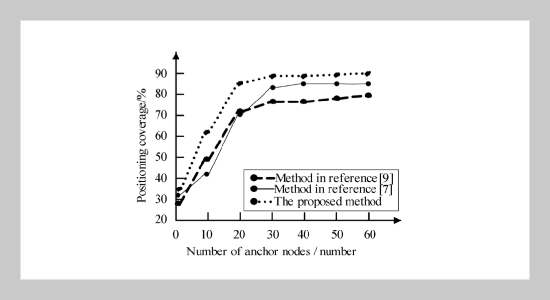
Comparison of wireless sensor network positioning coverage in different methods.
Copyright The Author(s). This is an open access article distributed under the terms of the Creative Commons Attribution License (CC BY 4.0), which permits unrestricted use, distribution, and reproduction in any medium, provided the original author and source are cited.
Download Citation: BibTeX | http://dx.doi.org/10.6180/jase.201809_21(3).0015
Static wireless network sensor does not consider the mobility problem of nodes in the design process, which leads to the current node location method cannot meet the needs of dynamic wireless sensor network positioning. Aiming at the shortcomings such as low positioning accuracy and long response time of traditional node location strategy, a dynamic node location optimization method is proposed. The method uses the optimized inter-node distance model to optimize the path, and minimizes the estimated area of the unknown node through the rotatable directional antenna mounted on the anchor node so that the estimation of the path is closer to the actual distance. The experimental results showed that the proposed method has better accuracy and stability than the current positioning method.
Keywords: Wireless Sensor, Network Dynamic Node, Node Location Optimization, Inter-node Distance Model
- [1] Leu, J. S., Chiang, T. H., Yu, M. C., et al., “Energy Efficient Clustering Scheme for Prolonging the Lifetime of Wireless Sensor Network with Isolated Nodes,” IEEE Communications Letters, Vol. 19, No. 2, pp. 259-262 (2015). doi: 10.1109/LCOMM.2014.2379715
- [2] Zhao, L. H. and Liu, W. Y., “Boundary Node Identification for Wireless Sensor Network Based on Connection Information,” Science Technology and Engineering, Vol. 16, No. 15, pp. 216-222 (2016).
- [3] He, L., Kong, L., Gu, Y., et al., “Evaluating the On-demand Mobile Charging in Wireless Sensor Networks,” IEEE Transactions on Mobile Computing, Vol. 14, No. 9, pp. 1861-1875 (2015). doi: 10.1109/TMC.2014.2368557
- [4] Ahmed, A. A., “A Comparative Study of QoS Performance for Location Based and Corona Based Realtime Routing Protocol in Mobile Wireless Sensor Networks,” Wireless Networks, Vol. 21, No. 3, pp. 1015-1031 (2015). doi: 10.1007/s11276-014-0834-7
- [5] Ge, H., “Adaptive Consensus of Wireless Sensor Networks under Local Measurement by a Sink Node,” International Journal of Control, Vol. 88, No. 2, pp. 256-263 (2015). doi: 10.1080/00207179.2014.948916
- [6] Wang, Y. Y. and Zeng, R., “Node Localization Algorithm in Wireless Sensor Network Based on Imrpvoed Single Anchor Node,” Laser Journal, Vol. 32, No. 11, pp. 128-131 (2015).
- [7] Zhao, X. M., Zhang, H. Y., Jin, Y., et al., “Node Localization Scheme in Wireless Sensor Networks under Beacon Drifting Scenes,” Journal on Communications, Vol. 36, No. 2, pp. 38-47 (2015).
- [8] Wang, J. H., “A Node Location Algorithm in Wireless Sensor Network Based on DV-Hop,” Computer Engineering, Vol. 41, No. 1, pp. 82-86 (2015).
- [9] Collotta, M., Bello, L. L. and Pau, G., “A Novel Approach for Dynamic Traffic Lights Management Based on Wireless Sensor Networks and Multiple Fuzzy Logic Controllers,” Expert Systems with Applications, Vol. 42, No. 13, pp. 5403-5415 (2015). doi: 10.1016/j.eswa.2015.02.011