



Received: November 24, 2025
Accepted: January 03, 2026
Publication Date: March 15, 2026
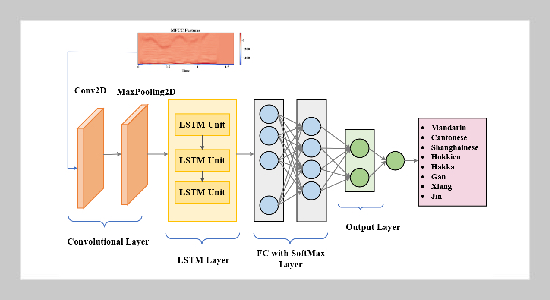
Dialect Recognition Network Architecture using CNN and LSTM for dialect classification
Copyright The Author(s). This is an open access article distributed under the terms of the Creative Commons Attribution License (CC BY 4.0), which permits unrestricted use, distribution, and reproduction in any medium, provided the original author and source are cited.
Download Citation: BibTeX | https://doi.org/10.6180/jase.202608_31.018
The preservation of regional dialects in China has become increasingly important due to the dominance of Mandarin, driven by urbanization and globalization, which threatens local languages and cultures. This paper addresses the challenge of dialect restoration by leveraging advanced AI models, including Convolutional Neural Networks (CNN) and Long Short-Term Memory (LSTM) networks, to restore and maintain regional dialects in the digital era. The objective of this research is to develop a scalable, real-time framework for dialect restoration that ensures both linguistic accuracy and cultural preservation. The proposed method utilizes FastSpeech2 for text-to-speech synthesis and HiFi-GAN for high-fidelity speech generation, overcoming the limitations of traditional models. The framework also integrates Mel-Frequency Cepstral Coefficients (MFCCs) for feature extraction and the Arithmetic Optimization Algorithm (AOA) for efficient optimization, which improves both accuracy and processing speed. The results demonstrate the effectiveness of the proposed method, achieving an accuracy of 0.9812, precision of 0.9811, recall of 0.9808, and F1-score of 0.9805, indicating
high performance in dialect classification and restoration. The Mean Opinion Score (MOS) for speech quality ranges from 4.52 to 4.72, with Mandarin achieving the highest score of 4.72. The Word Error Rate (WER) is between 1.58% and 2.45%, with Mandarin showing the lowest error rate of 1.58%. These results confirm the potential of the proposed framework in preserving regional dialects and ensuring their continued cultural significance.
Keywords: Regional dialects, AI-based restoration, Convolutional Neural Networks, Long Short-Term Memory, FastSpeech2, HiFi-GAN
- [1] W. Mo, S. Xiao, and Q. Li, (2025) “AHP–Entropy Method for Sustainable Development Potential Evaluation and Rural Revitalization: Evidence from 80 Traditional Villages in Cantonese Cultural Region, China” Sustainability 17(21): 9582. DOI: 10.3390/su17219582.
- [2] G. T. Hue et al., (2022) “The Development and Changes of Singapore Chinese Society in 19–20th Century—An Analysis from the Perspective of Dialect Group Cemetery Hills” Histories 2(3): 288–314. DOI: 10.3390/histories2030022.
- [3] L. Wu, Q. Zhan, Y. Li, and C. Chen, (2025) “Palazzo Farnese and Dong’s Fortified Compound: An Art-Anthropological Cross-Cultural Analysis of Architectural Form, Symbolic Ornamentation, and Public Perception” Buildings 15(15): 2720. DOI: 10.3390/buildings15152720.
- [4] L. Wang, C. Sun, M. Wang, and X. Xiao, (2024) “Construction and Characterization of Traditional Village Landscape Cultural Genome Atlases: A Case Study in Xupu County, Hunan, China” Sustainability 16(21): 9524. DOI: 10.3390/su16219524.
- [5] M. Jelassi, K. Matteli, H. Ben Khalfallah, and J. Demongeot, (2024) “Enhancing Personalized Mental Health Support Through Artificial Intelligence: Advances in Speech and Text Analysis Within Online Therapy Platforms” Information 15(12): 813. DOI: 10.3390/info15120813.
- [6] Y. Kumar et al., (2024) “Applying Swin Architecture to Diverse Sign Language Datasets” Electronics 13(8): 1509. DOI: 10.3390/electronics13081509.
- [7] Y. Li, S. Marneros, A. Efstathiades, and G. Papageorgiou, (2025) “A Framework of Core Competencies for Effective Hotel Management in an Era of Turbulent Economic Fluctuations and Digital Transformation: The Case of Shanghai, China” Tourism and Hospitality 6(3): 130. DOI: 10.3390/tourhosp6030130.
- [8] Z. Zhou, B. Yin, M. Huang, X. Pan, and D. Yang, (2025) “Exploring the Spatial Distribution of Toponyms and Its Correlation with Landscape Characteristics: A Case Study in Wuhan, China” Heritage 8(6): 213. DOI: 10.3390/heritage8060213.
- [9] Y. Wang et al., (2023) “A toponymic cultural heritage protection evaluation method considering environmental effects in a context of cultural tourism integration” Current Issues in Tourism 26(7): 1162–1182. DOI: 10.1080/13683500.2022.2049713.
- [10] M. Jia, J. Chen, Y. Chen, Y. Ge, L. Zheng, and S. Yang, (2025) “Coupling Relationship Between Tourists’ Space Perception and Tourism Image in Nanxun Ancient Town Based on Social Media Data Visualization” Buildings 15(9): 1465. DOI: 10.3390/buildings15091465.
- [11] W. Lan, J. Li, J. Wang, Y. Wang, and Z. Lei, (2025) “Cultural Diversity Conservation in Historic Districts via Spatial-Gene Perspectives: The Small Wild Goose Pagoda District, Xi’an” Sustainability 17(5): 2189. DOI: 10.3390/su17052189.
- [12] M. Hu, J. Suh, and C. Pedro, (2023) “An Integrated Framework for Preservation of Hawaii Indigenous Culture: Learning from Vernacular Knowledge” Buildings 13(5): 1190. DOI: 10.3390/buildings13051190.
- [13] Y. Guo, Z. Li, and X. Chen, (2025) “Sustainable Disorder: The Hybrid Logic of ‘Sense of Place’ Construction in Tourist Spaces—A Case Study of Harbin Morning Market” Sustainability 17(21): 9675. DOI: 10.3390/su17219675.
- [14] G. Alkhateeb, J. Storie, and M. Kulvik, (2024) “Post-Conflict Urban Landscape Storytelling: Two Approaches to Contemporary Virtual Visualisation of Oral Narratives” Land 13(4): 406. DOI: 10.3390/land13040406.
- [15] L. Chen, Y. Song, X. Niu, X. Luan, L. Yang, and S. Qin, (2025) “Epitome of the Region—Regional Nostalgia Design Based on Digital Twins” Behavioral Sciences 15(1): 12. DOI: 10.3390/bs15010012.
- [16] Q. Li, Q. Mai, M. Wang, and M. Ma, (2024) “Chinese dialect speech recognition: a comprehensive survey” Artificial Intelligence Review 57(2): 25. DOI: 10.1007/s10462-023-10668-0.
- [17] L. Wang and K. King, (2024) “Language ideologies, language policies, and shifting regional dialect proficiencies in three Chinese cities” Journal of Multilingual and Multicultural Development 45(6): 2166–2182. DOI: 10.1080/01434632.2022.2044339.
- [18] Y. Duan, M. Chen, Y. Liu, Y. Wang, and L. Zhang, (2025) “Research on the Cultural Landscape Features and Regional Variations of Traditional Villages and Dwellings in Multicultural Blending Areas: A Case Study of the Jiangxi-Anhui Junction Region” Applied Sciences 15(4): 2185. DOI: 10.3390/app15042185.
- [19] H. Zhang, M. F. Seilhamer, and Y. L. Cheung, (2023) “Identity construction on shop signs in Singapore’s Chinatown: a study of linguistic choices by Chinese Singaporeans and New Chinese immigrants” International Multilingual Research Journal 17(1): 15–32. DOI: 10.1080/19313152.2022.2080445.
- [20] Y. Kuang, F. Zheng, C. Lin, and Y. Hu, (2025) “Research on Chinese Traditional Architectural Culture and Inheritance Strategy: A Case Study of the Goulou Cluster of Yue Dialects in Guangxi” Buildings 15(3): 489. DOI: 10.3390/buildings15030489.
- [21] A. J. Privitera, S. H. S. Ng, A. P.-H. Kong, and B. S. Weekes, (2024) “AI and Aphasia in the Digital Age: A Critical Review” Brain Sciences 14(4): 383. DOI: 10.3390/brainsci14040383.
- [22] J. Qian et al., (2024) “Quantifying Urban Linguistic Diversity Related to Rainfall and Flood across China with Social Media Data” ISPRS International Journal of Geo-Information 13(3): 92. DOI: 10.3390/ijgi13030092.
- [23] A. R. Szromek and M. Bugdol, (2024) “Sharing Heritage through Open Innovation—An Attempt to Apply the Concept of Open Innovation in Heritage Education and the Reconstruction of Cultural Identity” Heritage 7(1): 193–205. DOI: 10.3390/heritage7010010.
- [24] R. Pizarro Contreras, Z. Zhao, and G. Zhang, (2025) “The Reproduction Without Alterity of AI: LatamGPT as a Form of Dissent and Technological Reappropriation” NanoEthics 19(3): 16. DOI: 10.1007 / s11569 – 025 – 00480-1.
- [25] J. Li, M. He, Z. Yang, and K. W. M. Siu, (2025) “Anthropological Insights into Emotion Semantics in Intangible Cultural Heritage Museums: A Case Study of Eastern Sichuan, China” Electronics 14(5): 891. DOI: 10.3390/electronics14050891.
- [26] Chinese Dialect Speech-to-English Dataset. Kaggle Dataset. Accessed Nov. 18, 2025. 2025. eprint: https://www.kaggle.com/datasets/zyan1999/chinese-dialect-speech-to-english-dataset.
- [27] X. Yue, L. Miao, and J. Ding, (2025) “Research on Wu Dialect Recognition and Regional Variations Based on Deep Learning” Applied Sciences 15(18): 10227. DOI: 10.3390/app151810227.