




Wafaa A. Hussain, Enas Muhi Hadi, Mukhlis M. Ismail and Luay H. Alwan
Department of Applied Sciences, University of Technology, Baghdad, Iraq
Received: May 13, 2019
Accepted: October 24, 2019
Publication Date: May 10, 2026
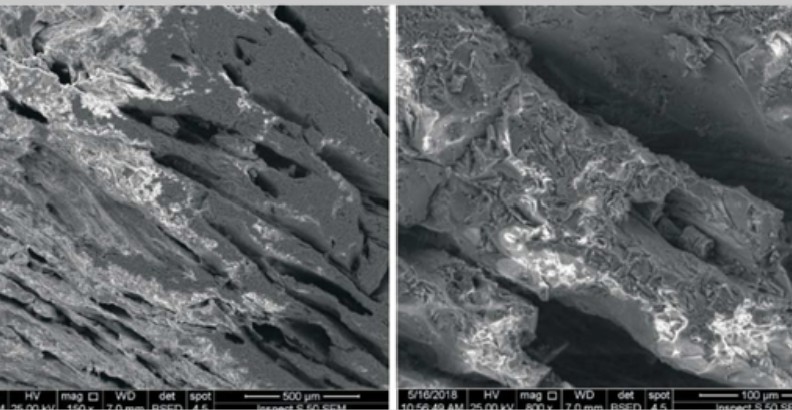
SEM images of 3A sample before carbonization a (magnification x150), b (magnification x800).
Copyright The Author(s). This is an open access article distributed under the terms of the Creative Commons Attribution License (CC BY 4.0), which permits unrestricted use, distribution, and reproduction in any medium, provided the original author and source are cited.
Download Citation: BibTeX | http://dx.doi.org/10.6180/jase.202003_23(1).0008
There is an urgent need to identify cheaper and efficient methods of removing contaminants as the demand for clean water rises. In this study, the household water filters were prepared from low-cost materials based on kaolin powder and combustible materials as palm fronds powder which acts as pore creating agent. The filter samples with different content (0, 10, 20, 30) wt% of palm fronds powder were fabricated using a dry pressing method and fired at 1250 °C. Thereafter, the porous ceramic filter samples were carbonized at 950 °C for 6 hrs. The ceramic filters were characterized by X-ray diffraction and SEM. Physical properties (linear shrinkage (L.Sh.), apparent porosity (A.P.), water absorption (W. A.), apparent solid density (A.S.D.), permeability and diametrical compression strength) before and after carbonization was also studied. The total dissolved solids (TDS), turbidity (Tur.), pH, conductivity (Ec), free Cl, and salt percentage (sal %) of water from both household water filters with and without activated carbon was also examined before and after filtration. The presence of heavy metals from the water was analyzed before and after filtration.
Keywords: Porous Ceramic Household Water Filter, Kaolin Powder, Carbonization
- [1] World Health Organization (WHO) (1971) International Standards for Drinking-Water, 3rd Edition., Geneva, Switzerland, p. 9.
- [2] Whipple, G. C. (1907) The Value of Pure Water, John Wiley and Sons, New York, p. 58.
- [3] Das, C., and S. Bose (2017) Advanced Ceramic Membranes and Applications, Taylor and Francis Group.
- [4] Mwabi, J. K., F. E. Adeyemo, T. O. Mahlangu, B. B. Mamba, B. M. Brouckaert, C. D. Swartz, G. Offringa, L. Mpenyana-Monyatsi, and M. N. B. Momba (2011) Household water treatment systems: a solution to the production of safe drinking water by the low-income communities of Southern Africa, Physics and Chemistry of the Earth 36, 1120–1128. doi: 10.1016/j.pce. 2011.07.078
- [5] Kingery, W., H. Bowen, and D. Uhlmann (1976) Introduction to Ceramics, 2nd ed., New York: Wiley.
- [6] Agbo, S. C., E. U. Ekpunobi, C. C. Onu, and K. G. Akpomie (2015) Development of ceramic filter candle from NSU (kaolinite clay) for household water treatment, International Journal of Multidisciplinary Sciences and Engineering 6(10), 18–23.
- [7] Eze, K. A., J. O. Nwadiogbu, and E. T. Nwankere (2012) Effect of acid treatment on the physicochemical properties of kaolin clay, Archives of Applied Science Research 4(2), 792–794.
- [8] Simonis, J. J., and A. K. Basson (2011) Evaluation of a lowcost ceramicmicro-porous filter for elimination of common disease microorganisms, Physics and Chemistry of the Earth 36, 1129–1134. doi: 10.1016/j.pce. 2011.07.064
- [9] Yahaya, S., S. S. Jikan, N. A. Badarulzaman, and A. D. Adamu (2017) Chemical composition and particle size analysis of kaolin, Path of Science 3(10), 1001–1004. doi: 10.22178/pos.27-1
- [10] Fatimah, I., U. A. Hasanah, and H. P. Putra (2014) Preparation of bifunctional ceramic membrane based on TiO2/kaolinite for water disinfection, J. Mater. Environ. Sci. 5(6), 1976 1981.
- [11] Tsuru, T. (2001) Inorganic porous membranes for liquid phase separation, Separation and Purification Methods 30(2), 191–220. doi: 10.1081/SPM-100108159
- [12] Metcalf, and Eddy (2003) Waste Water Engineering, Treatment and Reuse, 4th edition, McGraw-Hill, New York, Singapore, p. 1219.
- [13] March, H., and F. R. Reinoso (2006) Activated Carbon, 1st edition Elsevier Ltd., Great Britain, p. 425–428.
- [14] Talaat, H. A., N. M. ElDefrawy, A. G. Abulnour, and H. A. Hani (2011) Evaluation of heavy metals removal using some Egyptian clays, 2nd International Conference on Environmental Science and Technology, 37 42.
- [15] Karapinar, N., and R. Donat (2009) Adsorption behavior of Cu2+ and Cd2+ onto natural bentonite, Desalination 249, 123 129. doi: 10.1016/j.desal.2008.12. 046
- [16] Yauvz, O., Y. Altunkaynak, and F. Guzel (2003) Removal of copper, nickel, cobalt and manganese from aqueous solution by kaolinite, Water Research 37, 948–952. doi: 10.1016/S0043-1354(02)00409-8
- [17] Bhttacharyya, K., and S. Gupta (2008) Adsorption of a few heavy metals on natural and modified kaolinite and montmorillonite: a review, Advance in Colloid and Interface Science 140, 114–131. doi: 10.1016/j.cis. 2007.12.008
- [18] Veli, S., and B. Alyuz (2007) Adsorption of cooper and zinc from aqueous solution by using natural clay, Journal of Hazardous Materials 149, 226–233. doi: 10. 1016/j.jhazmat.2007.04.109
- [19] Dastgheib, S. A., T. Karanfil, and W. Cheng (2004) Tailoring activated carbons for enhanced removal of natural organic matter from natural waters, Carbon 42(3), 547–557. doi: 10.1016/j.carbon.2003.12.062
- [20] Spellman, F. R., and J. Drinan (1999) The Drinking Water Handbook, Technomic Publishing Co, Inc. United States of America, pp. 151–152.