



Tao Yu1, Wentao Liu1, Dongsheng Sun2, Zhongshi Zhang2, Jiao Wang1 and Qingkai Han3
1School of Mechatronics and Automobile Engineering, Yantai University, Yantai 264005, P.R. China
2State Key Laboratory of Automotive Safety and Energy, Tsinghua University, Beijing 100084, P.R. China
3School of Mechanical Engineering, Dalian University of Technology, Dalian 116023, P.R. China
Received: June 19, 2017
Accepted: March 9, 2018
Publication Date: August 16, 2026
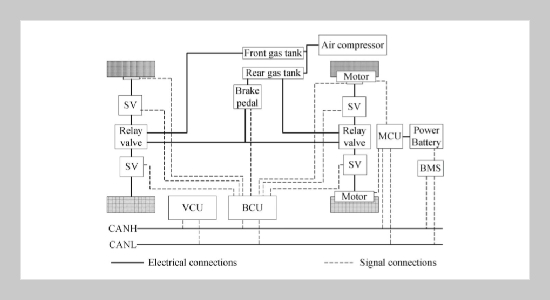
The scheme of pneumatic regulating module with SV for RBS.
Copyright The Author(s). This is an open access article distributed under the terms of the Creative Commons Attribution License (CC BY 4.0), which permits unrestricted use, distribution, and reproduction in any medium, provided the original author and source are cited.
Download Citation: BibTeX | http://dx.doi.org/10.6180/jase.201806_21(2).0010
The Regenerative Braking System (RBS), as an important energy-saving technology, can effectively improve the energy economy of the electric vehicle [1]. The introduction of the regenerative braking force requiring the pneumatic regulating module to control the friction braking force more precisely and quickly. Solenoid on/off valve (SV) is controlled discontinuously with long response time as well as frequent pressure fluctuation, so consider using proportional relay valve (PPV) instead of it. Atypical braking and Anti-lock Brake System (ABS) control Hardware-In-Loop (HIL) test was conducted with two kinds of pneumatic regulating modules. The test results shown that the PPV has more advantages in application of RBS.
Keywords: Electric Vehicle, Regenerative Braking Systems, Solenoid On/off Valve, Proportional Relay Valve, Hardware-In-Loop
- [1] Zhang, J., Kong, D., Chen, L. and Chen, X., “Optimization of Control Strategy for Regenerative Braking of an Electrified Bus Equipped with an Anti-lock Braking System,” Proceedings of the Institution of Mechanical Engineers Part D: Journal of Automobile Engineering, Vol. 226, Issue 4, pp. 494–506 (2012). doi: 10.1177/0954407011422463
- [2] Information on http://www.wabco-auto.com.
- [3] Lv, C., Zhang, J. and Li, Y., “Hardware-in-the-loop Simulation of Pressure-difference-limiting Modulation of the Hydraulic Brake for Regenerative Braking Control of Electric Vehicles,” Proceedings of the Institution of Mechanical Engineers, Part D: Journal of Automobile Engineering, Vol. 228, No. 6, pp. 649–658 (2014). doi: 10.1177/0954407013516942
- [4] Chiara, F. and Canova, M., “A Review of Energy Consumption, Management, and Recovery in Automotive Systems, with Considerations of Future Trends,” Proceedings of the Institution of Mechanical Engineers, Part D: Journal of Automobile Engineering, Vol. 227, No. 6, pp. 914–936 (2013). doi: 10.1177/0954407012471294
- [5] Crolla, D. A. and Cao, D., “The Impact of Hybrid and Electric Powertrains on Vehicle Dynamics, Control Systems and Energy Regeneration,” Vehicle System Dynamics, Vol. 50, No. 1, pp. 95–109 (2012). doi: 10.1080/00423114.2012.676651
- [6] Ko, J. W., Ko, S. Y. and Kim, I. S., “Co-operative Control for Regenerative Braking and Friction Braking to Increase Energy Recovery without Wheel Lock,” International Journal of Automotive Technology, Vol. 15, No. 2, pp. 253–262 (2014). doi: 10.1007/s12239-014-0026-6
- [7] Information on http://www.bosch-presse.de/pressportal/de/index.html.
- [8] Zhang, J., Chen, X. and Zhang, P., “Integrated Control of Braking Energy Regeneration and Pneumatic Anti-lock Braking,” Proceedings of the Institution of Mechanical Engineers, Part D: Journal of Automobile Engineering, Vol. 224, No. 5, pp. 587–610 (2010). doi: 10.1243/09544070JAUTO1307
- [9] Chiara, F. and Canova, M., “Review of Energy Consumption, Management, and Recovery in Automotive Systems, with Considerations of Future Trends,” Proceedings of the Institution of Mechanical Engineers, Part D: Journal of Automobile Engineering, Vol. 227, No. 6, pp. 914–936 286 (2013). doi: 10.1177/0954407012471294
- [10] Bayar, K., Wang, J. and Rizzoni, G., “Development of a Vehicle Stability Control Strategy for a Hybrid Electric Vehicle Equipped with Axle Motors,” Proceedings of the Institution of Mechanical Engineers, Part D: Automobile Engineering, Vol. 226, No. 6, pp. 795–814 (2012). doi: 10.1177/0954407011433396
- [11] Peng, D., Zhang, Y., Yin, C. and Zhang, J., “Combined Control of a Regenerative Braking and Antilock Braking System for Hybrid Electric Vehicles,” International Journal of Automotive Technology, Vol. 9, Issue 6, pp. 749–757 (2008). doi: 10.1007/s12239-008-0089-3
- [12] Peng, J., He, H. and Liu, W., “Hierarchical Control Strategy for the Cooperative Braking System of Electric Vehicle,” The Scientific World Journal, Vol. 2015, Art. ID 584075 (2015). doi: 10.1155/2015/584075