





Fuh-Min Fang1, Yi-Chao Li2 and Cheng-Yang Chung3
1Department of Civil Engineering, National Chung Hsing University, Taichung, Taiwan 402, R.O.C.
2Wind Engineering Research Center, Tamkang University, Tamsui, Taiwan 251, R.O.C.
3Architecture and Building Research Institute, Ministry of Interior, NewTaipei City, Taiwan 231, R.O.C.
Received: January 06, 2016
Accepted: July 04, 2016
Publication Date: August 02, 2026
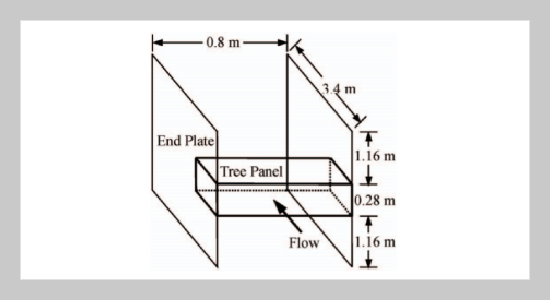
Sketch of experimental set-up.
Copyright The Author(s). This is an open access article distributed under the terms of the Creative Commons Attribution License (CC BY 4.0), which permits unrestricted use, distribution, and reproduction in any medium, provided the original author and source are cited.
Download Citation: BibTeX | http://dx.doi.org/10.6180/jase.2016.19.4.06
A numerical model was established to predict flow past discrete broad-leaf trees so as to provide a handy tool for pedestrian wind analysis during the preliminary design stage for local wind environments. In the study, a tree factor was proposed to reflect the effect due to the existence of the trees. Besides the applications of numerical computations in flow analysis, wind tunnel measurements were also performed to guide and confirm the numerical simulations. Results showed that the calibrated tree factor generally increased with increases of the volume ratio and horizontal thickness of the tree body. Based on the calibrated relationship of the tree factor, finally, additional numerical computations were performed to simulate flow past an isolated tree and dual trees in a tandem and a side-by-side arrangement. The predicted downstream wind velocity profiles appeared in good agreements with the measurement results.
Keywords: Large Eddy Simulation, Wind Tunnel Test, Bluff-body Flow, Porous Body
- [1] Finnigan, J., “Turbulence in Plant Canopies,” Annual Review of Fluid Mechanics, Vol. 32, pp. 519–571 (2000). doi: 10.1146/annurev.fluid.32.1.519
- [2] Raupach, M. R., Antonia, R. A. and Rajagopalan, S., “Rough-Wall Turbulent Boundary Layers,” Applied Mechanics Reviews, Vol. 44, pp. 1–25 (1991). doi: 10.1115/1.3119492
- [3] Raupach, M. R., Coppin, P. A. and Legg, B. J., “Experiments on Scalar Dispersion within a Model Plant Canopy. Part I: the Turbulence Structure,” Boundary-Layer Meteorology, Vol. 35, pp. 21–52 (1986). doi: 10.1007/BF00117300
- [4] Mihailovic, D. T., Lalic, B., Rajkovic, B. and Arsenic, I., “A Roughness Sublayer Wind Profile above Non-Uniform Surface,” Boundary-Layer Meteorology, Vol. 93, pp. 425–451 (1999). doi: 10.1023/A:1002063405979
- [5] Massman, W., “A Comparative Study of some Mathematical Models of the Mean Wind Structure and Aerodynamic Drag of Plant Canopies,” Boundary-Layer Meteorology, Vol. 40, pp. 179–197 (1987). doi: 10.1007/BF00140075
- [6] Novak, M. D., Warland, J. S., Orchansky, A. L., Ketler, R. and Green, R., “Wind Tunnel and Field Measurements of Turbulent Flow in Forests, Part I: Uniformly Thinned Stands,” Boundary-Layer Meteorology, Vol. 95, pp. 457–495 (2000). doi: 10.1023/A:1002693625637
- [7] Boldes, U., Colman, J. and Maranon, D. L. J., “Field Study of the Flow Behind Single and Double Row Herbaceous Windbreaks,” Journal of Wind Engineering and Industrial Aerodynamics, Vol. 89, pp. 665–687 (2001). doi: 10.1016/S0167-6105(01)00065-4
- [8] Flesch, T. K. and Wilson, J. D., “Wind and Remnant Tree Sway in Forest Cutblocks. I. Measured Winds in Experimental Cutblocks,” Agricultural Forest Meteorology, Vol. 93, pp. 229–242 (1999). doi: 10.1016/S0168-1923(98)00112-9
- [9] Flesch, T. K. and Wilson, J. D., “Wind and Remnant Tree Sway in Forest Cutblocks. II. Relating Measured Tree Sway to Wind Statistics,” Agricultural Forest Meteorology, Vol. 93, pp. 243–258 (1999). doi: 10.1016/S0168-1923(98)00113-0
- [10] Shaw, R. H. and Schumann, U., “Large-eddy Simulation of Turbulent Flow above and within a Forest,” Boundary-Layer Meteorology, Vol. 61, pp. 47–64 (1992). doi: 10.1007/BF02033994
- [11] Wilson, J. D. and Flesch, T. K., “Wind and Remnant Tree Sway in Forest Cutblocks. III. A Windflow Model to Diagnose Spatial Variation,” Agricultural Forest Meteorology, Vol. 93, pp. 259–282 (1999). doi: 10.1016/S0168-1923(98)00121-X
- [12] Su, H. B., Shaw, R. H., Pawu, K. T., Moeng, C. H. and Sullivan, P. P., “Turbulent Statistics of Neutrally Stratified Flow Within and above a Sparse Forest from Large-Eddy Simulation and Field Observations,” Boundary-Layer Meteorology, Vol. 88, pp. 363–397 (1998). doi: 10.1023/A:1001108411184
- [13] Patton, E. G. and Davis, K. J., “Decaying Scalars Emitted by a Forest Canopy: a Numerical Study,” Boundary-Layer Meteorology, Vol. 100, pp. 91–129 (2001). doi: 10.1023/A:1019223515444
- [14] Watanabe, T., “Large Eddy Simulation of Coherent Turbulence Structures Associated with Scalar Ramps over Plant Canopies,” Boundary-Layer Meteorology, Vol. 112, pp. 307–341 (2004). doi: 10.1023/B:BOUN.0000027912.84492.54
- [15] Sládek, I., Bodnar, T. and Kozel, K., “On a Numerical Study of Atmospheric 2D and 3D-Flows over a Complex Topography with Forest Including Pollution Dispersion,” Journal of Wind Engineering and Industrial Aerodynamics, Vol. 95, pp. 1424–1444 (2007). doi: 10.1016/j.jweia.2007.02.024
- [16] Song, C. C. S. and Yuan, M., “A Weakly Compressible Flow Model and Rapid Convergence Methods,” ASME Journal of Fluids Engineering, Vol. 110, pp. 441–455 (1988). doi: 10.1115/1.3243575
- [17] Smagorinsky, J., “General Circulation Experiments with Primitive Equations,” Monthly Weather Review, Vol. 91, pp. 99–164 (1963). doi: 10.1175/1520-0493(1963)091<0099:GCEWTP>2.3.CO;2