




School of Foreign Languages, Zhengzhou University of Science and Technology, Zhengzhou, 450064, China
Received: January 18, 2025
Accepted: March 13, 2025
Publication Date: April 6, 2026
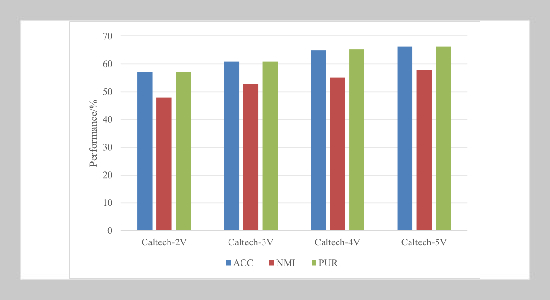
Multi-view fusion clustering performance on the Caltech-5V with multiple views.
Copyright The Author(s). This is an open access article distributed under the terms of the Creative Commons Attribution License (CC BY 4.0), which permits unrestricted use, distribution, and reproduction in any medium, provided the original author and source are cited.
Download Citation: BibTeX | http://dx.doi.org/10.6180/jase.202511_28(11).0019
Multi-view clustering-based multilingual data pattern mining has received significant attention in recent years due to its ability to fully leverage the complementary and consistent information from multiple languages. Although existing methods achieve encouraging performance, they often jointly optimize representation learning and pattern mining within a single feature space, which may degrade the effectiveness of multilingual data pattern mining. To address this issue, this paper proposes a multi-granularity contrastive learning-based deep multilingual data pattern mining method (MCL), which consists of three view-invariant learning modules: structure learning, semantics learning, and partitioning learning. MCL integrates these three levels of view-invariant learning into an end-to-end framework, comprehensively exploiting the consistency and complementarity of multi-view data, thereby significantly improving the accuracy and robustness of multilingual data pattern mining. Finally, through extensive experiments on five datasets, MCL shows to establish a new benchmark for ACC, NMI, and PUR, proving its superiority and effectiveness.
Keywords: Multi-granularity Contrastive Learning; tri-invariant alignment; multilingual data mining
- [1] X. Yan, H. Huang, Y. Jin, L. Chen, Z. Liang, and Z. Hao, (2023) “Neural architecture search via multihashing embedding and graph tensor networks for multilingual text classification” IEEE Transactions on Emerging Topics in Computational Intelligence 8(1): 350–363. DOI: 10.1109/TETCI.2023.3301774.
- [2] A. Ekbal et al., (2024) “Atmosphere kamaal ka tha (was wonderful): A multilingual joint learning framework for aspect category detection and sentiment classification” IEEE Transactions on Computational Social Systems: DOI: 10.1109/TCSS.2024.3374450.
- [3] J. Gao, P. Li, A. A. Laghari, G. Srivastava, T. R. Gadekallu, S. Abbas, and J. Zhang, (2024) “Incomplete multiview clustering via semidiscrete optimal transport for multimedia data mining in IoT” ACM Transactions on Multimedia Computing, Communications and Applications 20(6): 1–20. DOI: 10.1145/3625548.
- [4] J. Xu, H. Tang, Y. Ren, L. Peng, X. Zhu, and L. He. “Multi-level feature learning for contrastive multiview clustering”. In: Proceedings of the IEEE/CVF conference on computer vision and pattern recognition. 2022, 16051–16060.
- [5] S. Xiao, S. Du, Z. Chen, Y. Zhang, and S. Wang, (2023) “Dual fusion-propagation graph neural network for multiview clustering” IEEE Transactions on Multimedia 25: 9203–9215. DOI: DOI:10.1109/TMM.2023.3248173.
- [6] L. Fu, S. Huang, L. Zhang, J. Yang, Z. Zheng, C. Zhang, and C. Chen, (2024) “Subspace-contrastive multi-view clustering” ACM Transactions on Knowledge Discovery from Data 18(9): 1–35. DOI: 10.1145/367483.
- [7] Y. Sun, Y. Qin, Y. Li, D. Peng, X. Peng, and P. Hu, (2024) “Robust multi-view clustering with noisy correspondence” IEEE Transactions on Knowledge and Data Engineering: DOI: 10.1109/TKDE.2024.3423307.
- [8] J. Gao, M. Liu, P. Li, A. A. Laghari, A. R. Javed, N. Victor, and T. R. Gadekallu, (2023) “Deep incomplete multiview clustering via information bottleneck for pattern mining of data in extreme-environment IoT” IEEE Internet of Things Journal: DOI: 10.1109/JIOT.2023.3325272.
- [9] S. Shi, F. Nie, R. Wang, and X. Li, (2021) “Multi-view clustering via nonnegative and orthogonal graph reconstruction” IEEE transactions on neural networks and learning systems 34(1): 201–214. DOI: 10.1109/TNNLS.2021.3093297.
- [10] P. Zhang, S. Wang, L. Li, C. Zhang, X. Liu, E. Zhu, Z. Liu, L. Zhou, and L. Luo. “Let the data choose: Flexible and diverse anchor graph fusion for scalable multi view clustering”. In: Proceedings of the AAAI Conference on Artificial Intelligence. 37. 9. 2023, 11262–11269. DOI: 10.1609/aaai.v37i9.26333.
- [11] Y. Ren, J. Pu, C. Cui, Y. Zheng, X. Chen, X. Pu, and L. He. “Dynamic weighted graph fusion for deep multiview clustering”. In: Proceedings of the 33rd International Joint Conference on Artificial Intelligence. 2024, 4842–4850.
- [12] W. Yan, Y. Zhang, C. Lv, C. Tang, G. Yue, L. Liao, and W. Lin. “Gcfagg: Global and cross-view feature aggregation for multi-view clustering”. In: Proceedings of the IEEE/CVF Conference on Computer Vision and Pattern Recognition. 2023, 19863–19872.
- [13] R. Zhang, S. Hang, Z. Sun, F. Nie, R. Wang, and X. Li, (2025) “Anchor-based fast spectral ensemble clustering” Information Fusion 113: 102587. DOI: 10.1016/j.inffus.2024.102587.
- [14] Y. Lin, Y. Gou, X. Liu, J. Bai, J. Lv, and X. Peng, (2022) “Dual contrastive prediction for incomplete multi-view representation learning” IEEE Transactions on Pattern Analysis and Machine Intelligence 45(4): 4447–4461. DOI: 10.1109/TPAMI.2022.3197238.
- [15] J. Pu, C. Cui, X. Chen, Y. Ren, X. Pu, Z. Hao, S. Y. Philip, and L. He. “Adaptive Feature Imputation with Latent Graph for Deep Incomplete Multi-View Clustering”. In: Proceedings of the AAAI Conference on Artificial Intelligence. 38. 13. 2024, 14633–14641. DOI: 10.1609/aaai.v38i13.29380.
- [16] S. Wang, X. Liu, S. Liu, W. Tu, and E. Zhu, (2024) “Scalable and structural multi-view graph clustering with adaptive anchor fusion” IEEE Transactions on Image Processing: DOI: 10.1109/TIP.2024.3444320.
- [17] P. Li, A. A. Laghari, M. Rashid, J. Gao, T. R. Gadekallu, A. R. Javed, and S. Yin, (2022) “A deep multimodal adversarial cycle-consistent network for smart enterprise system” IEEE Transactions on Industrial Informatics 19(1): 693–702. DOI: 10.1109/TII.2022.3197201.
- [18] J. Gao, M. Liu, P. Li, J. Zhang, and Z. Chen, (2024) “Deep Multiview Adaptive Clustering With Semantic Invariance” IEEE Transactions on Neural Networks and Learning Systems 35(9): 12965–12978. DOI: 10.1109/TNNLS.2023.3265699.
- [19] H. Kanayama, Y. Zhao, R. Iwamoto, and T. Ohko. “Incorporating syntax and lexical knowledge to multilingual sentiment classification on large language models”. In: Findings of the Association for Computational Linguistics ACL 2024. 2024, 4810–4817.
- [20] C. Wang and M. Banko. “Practical transformer-based multilingual text classification”. In: Proceedings of the 2021 Conference of the North American Chapter of the Association for Computational Linguistics: Human Language Technologies: Industry Papers. 2021, 121–129.