




Ganjikunta Ganesh Kumar1, Sibghatullah Inyatullah Khan1, G Prasad Acharya1, and Shravan Kumar S M2
1Department of Electronics and Communication Engineering, Sreenidhi Institute of Science and Technology, Hyderabad, India
2Department of Civil Engineering, Sreenidhi Institute of Science and Technology, Hyderabad, India
Received: June 6, 2024
Accepted: December 7, 2024
Publication Date: April 6, 2026
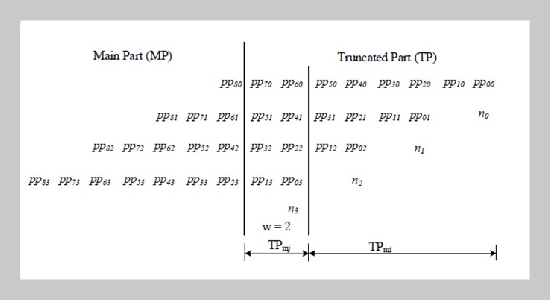
Partial Products based on w=2
Copyright The Author(s). This is an open access article distributed under the terms of the Creative Commons Attribution License (CC BY 4.0), which permits unrestricted use, distribution, and reproduction in any medium, provided the original author and source are cited.
Download Citation: BibTeX | http://dx.doi.org/10.6180/jase.202510_28(10).0008
This paper introduces an innovative solution for increasing precision of fixed-width radix-4 Booth multipliers through variable error compensation functions that leverage Approximation of Carry Function (ACF). Error compensation mechanisms typically comprise two carries-ideal and base carry functions–strategically chosen to minimize mean error. We present three distinct methods-ACF-1, ACF-2, and ACF-3—each employing fixed base values with varying column information (w) and bit lengths (N). Comparative analyses against recent studies demonstrate that our proposed fixed-width Booth multiplier using ACF-1 stands out in terms of accuracy and efficiency tradeoffs.
Keywords: Error-compensation function; Fixed-width multiplier; Ideal and base carry functions
- [1] C. R. Baugh and B. A. Wooley, (1973) “A two’s complement parallel array multiplication algorithm” IEEE Transactions on computers 100(12): 1045–1047. DOI: 10.1109/T-C.1973.223648.
- [2] J.-H. Tu and L.-D. Van, (2009) “Power-efficient pipelined reconfigurable fixed-width Baugh-Wooley multipliers” IEEE transactions on computers 58(10): 1346–1355. DOI: 10.1109/TC.2009.89.
- [3] A. Badawi, A. Alqarni, A. Aljuffri, M. S. BenSaleh, A. M. Obeid, and S. M. Qasim. “FPGA realization and performance evaluation of fixed-width modified Baugh-Wooley multiplier”. In: 2015 Third International Conference on Technological Advances in Electrical, Electronics and Computer Engineering (TAEECE). IEEE. 2015, 155–158. DOI: 10.1109/TAEECE.2015.7113618.
- [4] R. Keote and P. Karule, (2018) “Performance Analysis of Fixed Width Multiplier using Baugh Wooley Algorithm” International Organization of Scientific Research Journal of Very Large-Scale Integration and Signal Processing 8(3): 31–38. DOI: 10.9790/4200-0803013138.
- [5] A. D. Booth, (1951) “A signed binary multiplication technique” The Quarterly Journal of Mechanics and Applied Mathematics 4(2): 236–240. DOI: 10.1093/qjmam/4.2.236.
- [6] L.-D. Van, S.-S. Wang, and W.-S. Feng, (2000) “Design of the lower error fixed-width multiplier and its application” IEEE Transactions on Circuits and Systems II: Analog and Digital Signal Processing 47(10): 1112–1118. DOI: 10.1109/82.877155.
- [7] S.-J. Jou, M.-H. Tsai, and Y.-L. Tsao, (2003) “Low-error reduced-width Booth multipliers for DSP applications” IEEE Transactions on Circuits and Systems I: Fundamental Theory and Applications 50(11): 1470–1474. DOI: 10.1109/TCSI.2003.817779.
- [8] K.-J. Cho, K.-C. Lee, J.-G. Chung, and K. K. Parhi, (2004) “Design of low-error fixed-width modified booth multiplier” IEEE Transactions on Very Large Scale Integration (VLSI) Systems 12(5): 522–531. DOI: 10.1109/TVLSI.2004.825853.
- [9] J.-P. Wang, S.-R. Kuang, and S.-C. Liang, (2009) “Highaccuracy fixed-width modified booth multipliers for lossy applications” IEEE transactions on very large scale integration (VLSI) systems 19(1): 52–60. DOI: 10.1109/TVLSI.2009.2032289.
- [10] C.-Y. Li, Y.-H. Chen, T.-Y. Chang, and J.-N. Chen, (2011) “A probabilistic estimation bias circuit for fixedwidth Booth multiplier and its DCT applications” IEEE
Transactions on Circuits and Systems II: Express Briefs 58(4): 215–219. DOI: 10.1109/TCSII.2011.2111610. - [11] Y.-H. Chen, (2014) “An accuracy-adjustment fixed-width booth multiplier based on multilevel conditional probability” IEEE transactions on very large scale integration (VLSI) systems 23(1): 203–207. DOI: 10.1109/TVLSI.2014.2302447.
- [12] W.-Q. He, Y.-H. Chen, and S.-J. Jou, (2015) “Highaccuracy fixed-width booth multipliers based on probability and simulation” IEEE Transactions on Circuits and Systems I: Regular Papers 62(8): 2052–2061. DOI: 10.1109/TCSI.2015.2440731.
- [13] G. G. Kumar and S. K. Sahoo. “Power-delay product minimization in high-performance fixed-width multiplier”. In: TENCON 2015-2015 IEEE Region 10 Conference. IEEE. 2015, 1–4. DOI: 10.1109/TENCON.2015.7372864.
- [14] Z. Zhang and Y. He, (2017) “A low-error energy-efficient fixed-width booth multiplier with sign-digit-based conditional probability estimation” IEEE Transactions on Circuits and Systems II: Express Briefs 65(2): 236–240. DOI: 10.1109/TCSII.2017.2709801.
- [15] Y. He, X. Yi, Z. Zhang, B. Ma, and Q. Li, (2020) “A probabilistic prediction-based fixed-width booth multiplier for approximate computing” IEEE Transactions on Circuits and Systems I: Regular Papers 67(12): 4794–4803. DOI: 10.1109/TCSI.2020.3001654.
- [16] Z. Aizaz and K. Khare, (2021) “Area and power efficient truncated booth multipliers using approximate carrybased error compensation” IEEE Transactions on Circuits and Systems II: Express Briefs 69(2): 579–583. DOI: 10.1109/TCSII.2021.3094910.
- [17] R. Marimuthu, Y. E. Rezinold, and P. S. Mallick, (2016) “Design and analysis of multiplier using approximate 15-4 compressor” IEEE Access 5: 1027–1036. DOI: 10.1109/ACCESS.2016.2636128.
- [18] M. H. Haider and S.-B. Ko, (2023) “Booth encodingbased energy efficient multipliers for deep learning systems” IEEE Transactions on Circuits and Systems II: Express Briefs 70(6): 2241–2245. DOI: 10.1109/TCSII.2022.3233923.
- [19] R. Marimuthu, D. Bansal, S. Balamurugan, and P. Mallick, (2013) “Design of 8-4 and 9-4 compressors forhigh speed multiplication” American Journal of Applied Sciences 10(8): 893. DOI: 10.3844/ajassp.2013.893.900.
- [20] R. Marimuthu and P. Mallick, (2017) “Design of Efficient Signed Multiplier Using Compressors for FFT Architecture.” Journal of Engineering Science & Technology Review 10(2): DOI: 10.25103/jestr.102.13.
- [21] E. Zacharelos, I. Nunziata, G. Saggese, A. G. Strollo, and E. Napoli, (2022) “Approximate recursive multipliers using low power building blocks” IEEE Transactions on Emerging Topics in Computing 10(3): 1315–1330. DOI: 10.1109/TETC.2022.3186240.
- [22] R. Marimuthu, S. Balamurugan, and P. S. Mallick, (2018) “Design of 5-3 multicolumn compressor for high performance multiplier” International Journal of Computer Aided Engineering and Technology 10(5): 568–575. DOI: 10.1504/IJCAET.2018.094334.
- [23] W. Liu, T. Cao, P. Yin, Y. Zhu, C. Wang, E. E. Swartzlander, and F. Lombardi, (2018) “Design and analysis of approximate redundant binary multipliers” IEEE Transactions on computers 68(6): 804–819. DOI: 10.1109/TC.2018.2890222.