




Ziqi Ren1,2,3,4, Yaping Zhao1,3, Baoxiu Li1,2,3, and Zixuan Zhang1,3
1Department of Materials and Construction Engineering, Hebei Institute of Mechanical and Electrical Technology, Xingtai City, Hebei Province, 054000, China
2Hebei Science Popularization Base for Additive Manufacturing, Xingtai City, Hebei Province, 054000, China
3Hebei Technology Innovation Centre for New Energy Vehicle Integrated Die Casting, Xingtai City, Hebei Province, 054000, China
4Xingtai Green Digital Precision Casting Technology Innovation Center, Xingtai City, Hebei Province, 054000, China
Received: June 22, 2026
Accepted: September 20, 2026
Publication Date: October 26, 2026
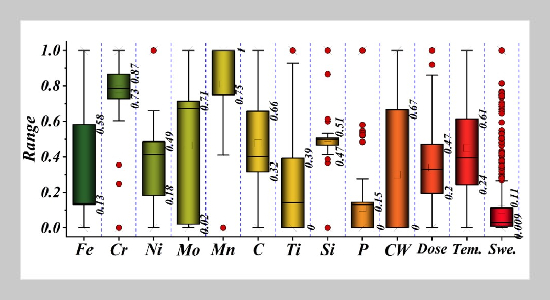
Introduced input parameters’ box plot to estimate Swe
Copyright The Author(s). This is an open access article distributed under the terms of the Creative Commons Attribution License (CC BY 4.0), which permits unrestricted use, distribution, and reproduction in any medium, provided the original author and source are cited.
Download Citation: BibTeX | http://dx.doi.org/10.6180/jase.202701_36.046
Radiation-induced swelling (swe) of structural steels under fast neutron irradiation is a critical degradation phenomenon that limits the service lifetime and safety of nuclear reactor components. Conventional experimental approaches for evaluating swelling behavior are costly, time-consuming, and difficult to apply under high-dose irradiation conditions. This study develops an optimized machine learning framework for predicting the swelling behavior of austenitic steels exposed to fast neutron irradiation. A dataset containing 444 experimental samples collected from published literature was established, including twelve input variables related to chemical composition (Fe, Cr, Ni, Mo, Mn, C, Ti, Si, and P), cold work degree, irradiation dose, and temperature. Two ensemble regression models, Adaptive Boosting Regression (ABR) and Extra Tree Regression (ETR), were optimized using the Tyrannosaurus Rex Optimization (TRO) algorithm to improve hyperparameter selection and prediction performance. The dataset was randomly divided into 75% training data (333 samples) and 25% testing data (111 samples), with preprocessing methods including normalization, randomization, interquartile range (IQR)-based outlier treatment, and four-fold cross-validation applied to enhance model reliability. The optimized Extra Tree Regression model (ExtraT-T) achieved superior predictive performance, obtaining coefficients of determination (R2) of 0.9908 and 0.9563 for the training and testing datasets, respectively, compared with 0.9679 and 0.8991 for the optimized ABR model (AdaB-T). Feature analysis revealed that irradiation dose and cold work degree were the dominant factors affecting swelling behavior[cite: 80]. The proposed optimized machine learning framework provides an efficient approach for predicting radiation-induced swelling, reducing dependence on irradiation experiments, and supporting the design of radiation-resistant nuclear materials.
Keywords: SWE; Neutrons; Irradiation; Austenitic steel; ML; Boosting algorithms
- [1] Y. V. Konobeev, A. M. Dvoriashin, S. I. Porollo, and F. A. Garner, (2006) “Swelling and microstructure of pure Fe and Fe-Cr alloys after neutron irradiation to 26 dpa at 400 C” Journal of Nuclear Materials 355: 124-130. DOI: 10.1016/j.jnucmat.2006.04.011.
- [2] F. A. Garner. “Void swelling and irradiation creep in light water reactor (LWR) environments”. In: Understanding and Mitigating Ageing of Nuclear Power Plants. Elsevier, 2010, 308-356. DOI: 10.1533/9781845699956.2.308.
- [3] R. Bullough, B. L. Eyre, and K. Krishan, (1975) “Cascade damage effects on the swelling of irradiated materials” Proceedings of the Royal Society of London. A. Mathematical and Physical Sciences 346: 81-102. DOI: 10.1098/rspa.1975.0167.
- [4] G. A. Cottrell, (2003) “Void migration, coalescence and swelling in fusion materials” Fusion Engineering and Design 66: 253-257. DOI: 10.1016/S0920-3796(03)00299-0.
- [5] M. P. Surh, J. B. Sturgeon, and W. G. Wolfer, (2005) “Radiation swelling behavior and its dependence on temperature, dose rate, and dislocation structure evolution” Journal of Nuclear Materials 336: 217-224. DOI: 10.1016/j.jnucmat.2004.09.016.
- [6] A. A. Kohnert, B. D. Wirth, and L. Capolungo, (2018) “Modeling microstructural evolution in irradiated materials with cluster dynamics methods: A review” Computational Materials Science 149: 442-459. DOI: 10.1016/j.commatsci.2018.02.049.
- [7] S. I. Golubov, A. M. Ovcharenko, A. V. Barashev, and B. N. Singh, (2001) “Grouping method for the approximate solution of a kinetic equation describing the evolution of point-defect clusters” Philosophical Magazine A 81: 643-658. DOI: 10.1080/01418610108212164.
- [8] M. A. Golsefidi, M. Esmaeili-Falak, and H. Sarbaz, (2026) “An interpretable AI framework using XGB-POA for micropile compressive stiffness prediction” Scientific Reports: DOI: 10.1038/s41598-026-60145-1.
- [9] R. S. Benemaran, E. Khajavi, and A. R. T. Khanghah, (2026) “Construction of multi-parameter intelligent comprehensive estimation algorithms for soil compression modulus” Scientific Reports: DOI: 10.1038/s41598-026-43812-1.
- [10] B. Razzaghzadeh, (2025) “Data-Driven Forecasting of Plastic Viscosity in Stressed Fresh Concrete Using Metaheuristic Boosted XGBoost Models” Novel Approaches in Civil and Geotechnical Engineering 1: 69-84.
- [11] M. Esmaeili-Falak, (2026) “Optimized Gradient Boosting Model for Estimating Unconfined Compressive Strength of Pozzolanic Geopolymer-stabilized Granular Materials Using Pufferfish Algorithm” Transportation Infrastructure Geotechnology 13: 106. DOI: 10.1007/s40515-026-00834-6.
- [12] M. S. Borchelooei and M. Esmaeili-Falak, (2026) “Predicting Water Absorption in Hardened Concrete Using Machine Learning: A Comparative Analysis of XGBoost Optimization Methods” International Journal of Pavement Research and Technology: DOI: 10.1007/s42947-026-00707-8.
- [13] H. S. Milani and R. S. Benemaran, (2026) “Estimation of bond strength of steel-concrete composites subjected to high temperature using tuned tree-based algorithms” Multiscale and Multidisciplinary Modeling, Experiments and Design 9: 81. DOI: 10.1007/s41939-026-01177-y.
- [14] M. Esmaeili-Falak and B. Sojoudi, (2026) “Enhancing dimensional stability in cement pastes: a machine learning approach with metaheuristic-optimized categorical boosting” Multiscale and Multidisciplinary Modeling, Experiments and Design 9: 94. DOI: 10.1007/s41939-026-01183-0.
- [15] H. Kou, J. Quan, S. Guo, and E. Hassankhani, (2024) “Light and normal weight concretes shear strength estimation using tree-based tunned frameworks” Construction and Building Materials 452: 138955. DOI: 10.1016/j.conbuildmat.2024.138955.
- [16] M. Esmaeili-Falak and A. Letafat, (2025) “Prediction of Unconfined Compressive Strength in Pozzolanic Geopolymer-Stabilized Granular Materials Using Tree-Based Models” Transportation Infrastructure Geotechnology 12: 247. DOI: 10.1007/s40515-025-00701-w.
- [17] X. Sun, X. Dong, W. Teng, L. Wang, and E. Hassankhani, (2024) “Creation of regression analysis for estimation of carbon fiber reinforced polymer-steel bond strength” Steel and Composite Structures 51: 509-527. DOI: 10.12989/scs.2024.51.5.509.
- [18] N. K. Oghli and E. F. Mahzad, (2025) “Predicting Liquefaction Triggering Potential Using Metaheuristic GMDH Approaches” Geotechnical and Geological Engineering 43: 1-24. DOI: 10.1007/s10706-025-03275-z.
- [19] R. S. Benemaran and H. S. Milani, (2026) “Post peak flexural strength assessment of concrete reinforced with steel fiber employing categorical boosting frameworks” Innovative Infrastructure Solutions 11: DOI: 10.1007/s41062-026-02645-7.
- [20] H. Zheng, (2025) “Predicting Splitting Tensile Strength of Basalt Fiber-Reinforced Concrete Using Hybrid Decision Tree Algorithms Optimized by Metaheuristic Techniques” Novel Approaches in Civil and Geotechnical Engineering 1: 52-70.
- [21] K. Zhang, Y. Zhang, and B. Razzaghzadeh, (2024) “Application of the optimal fuzzy-based system on bearing capacity of concrete pile” Steel and Composite Structures 51: 25-41. DOI: 10.12989/scs.2024.51.1.025.
- [22] M. Jin, P. Cao, and M. P. Short, (2019) “Predicting the onset of void swelling in irradiated metals with machine learning” Journal of Nuclear Materials 523: 189-197. DOI: 10.1016/j.jnucmat.2019.05.054.
- [23] H. R. Brager and F. A. Garner, (1983) “Microstructural and Microchemical Comparisons of AISI 316 Irradiated in HFIR and EBR-II” Journal of Nuclear Materials 117: 159-176. DOI: 10.1016/0022-3115(83)90022-3.
- [24] D. S. Gelles, (1984) “Swelling in several commercial alloys irradiated to very high neutron fluence” Journal of Nuclear Materials 122: 207-213. DOI: 10.1016/0022-3115(84)90597-X.
- [25] A. V. Kozlov and I. A. Portnykh, (2009) “Dependence of steady-state radiation swelling rate of 0.1C-16Cr-15Ni-2Mo-2Mn-Ti-Si austenitic steel on dpa rate and irradiation temperature” Journal of Nuclear Materials 386-388: 147-151. DOI: 10.1016/j.jnucmat.2008.12.072.
- [26] E. N. Shcherbakov, A. V. Kozlov, P. I. Yagovitin, M. V. Evseev, E. A. Kinev, V. L. Panchenko, I. Isobe, M. Sagisaka, T. Okita, and N. Sekimura, (2009) “Influence of damage rate on physical and mechanical properties and swelling of 18Cr-9Ni austenitic steel in the range of $3 \times 10^{-9}$ to $4 \times 10^{-8}$ dpa/s” Journal of Nuclear Materials 386-388: 152-156. DOI: 10.1016/j.jnucmat.2008.12.080.
- [27] S. I. Porollo, Y. V. Konobeev, and F. A. Garner, (2009) “Swelling and microstructure of austenitic stainless steel ChS-68 CW after high dose neutron irradiation” Journal of Nuclear Materials 393: 61-66. DOI: 10.1016/j.jnucmat.2009.05.005.
- [28] F. A. Garner, M. B. Toloczko, and B. H. Sencer, (2000) “Comparison of swelling and irradiation creep behavior of fcc-austenitic and bcc-ferritic/martensitic alloys at high neutron exposure” Journal of Nuclear Materials 276: 123-142. DOI: 10.1016/S0022-3115(99)00225-1.
- [29] T. R. Allen, J. I. Cole, C. L. Trybus, D. L. Porter, H. Tsai, F. Garner, E. A. Kenik, T. Yoshitake, and J. Ohta, (2006) “The effect of dose rate on the response of austenitic stainless steels to neutron radiation” Journal of Nuclear Materials 348: 148-164. DOI: 10.1016/j.jnucmat.2005.09.011.
- [30] I. A. Portnykh, A. V. Kozlov, V. L. Panchenko, and N. M. Mitrofanova, (2012) “Characteristics of radiation porosity formed upon irradiation in a BN-600 reactor in the fuel-element cans of cold-deformed steel EK-164 (06Kh16N20M2G2BTFR)-ID cd” Physics of Metals and Metallography 113: 520-531.
- [31] I. A. Portnykh and V. L. Panchenko, (2016) “Characteristics of radiation porosity and structural phase state of reactor austenitic 07C-16Cr-19Ni-2Mo-2Mn-Ti-Si-V-P-B steel after neutron irradiation at a temperature of 440-600 C to damaging doses of 36-94 dpa” Physics of Metals and Metallography 117: 611-623. DOI: 10.1134/S0031918X16060090.
- [32] F. A. Garner and H. R. Brager, (1985) “The role of phosphorus in the swelling and creep of irradiated austenitic alloys” Journal of Nuclear Materials 133-134: 511-514. DOI: 10.1016/0022-3115(85)90200-4.
- [33] F. A. Garner, H. R. Brager, and R. J. Puigh, (1985) “Swelling behavior of titanium-modified alloys in EBR-II” Journal of Nuclear Materials 133-134: 535-539. DOI: 10.1016/0022-3115(85)90205-3.
- [34] P. Dubuisson, A. Maillard, C. Delalande, D. Gilbon, and J.-L. Seran. The effect of phosphorus on the radiation induced microstructure of stabilized austenitic stainless steels. Tech. rep. Gif-sur-Yvette, France: CEA Centre d’Etudes Nucleaires de Saclay, 1990.
- [35] F. A. Garner and A. S. Kumar. “The influence of both major and minor element composition on void swelling in austenitic steels”. In: ASTM STP 955. 1987, 289-314. DOI: 10.1520/STP33826S.
- [36] F. A. Garner and H. R. Brager, (1988) “The influence of Mo, Si, P, C, Ti, Cr, Zr and various trace elements on the neutron-induced swelling of AISI 316 stainless steel” Journal of Nuclear Materials 155-157: 833-837. DOI: 10.1016/0022-3115(88)90425-4.
- [37] F. A. Garner and M. A. Mitchell, (1992) “The complex role of phosphorus in the neutron-induced swelling of titanium-modified austenitic stainless steels” Journal of Nuclear Materials 187: 223-229. DOI: 10.1016/0022-3115(92)90501-B.
- [38] K. L. Murty and I. Charit, (2008) “Structural materials for Gen-IV nuclear reactors: Challenges and opportunities” Journal of Nuclear Materials 383: 189-195. DOI: 10.1016/j.jnucmat.2008.08.044.
- [39] G. M. Bond, B. H. Sencer, F. A. Garner, M. L. Hamilton, T. R. Allen, and D. L. Porter. “Void swelling of annealed 304 stainless steel at 370-385 C and PWR-relevant displacement rates”. In: Proceedings of the Ninth International Symposium on Environmental Degradation of Materials in Nuclear Power Systems-Water Reactors. Wiley, 1999, 1045-1050. DOI: 10.1002/9781118787618.ch109.
- [40] J. Benesty, J. Chen, Y. Huang, and I. Cohen. “Pearson Correlation Coefficient”. In: Noise Reduction in Speech Processing. Springer, 2009, 1-4. DOI: 10.1007/978-3-642-00296-0_5.
- [41] P. Geurts, D. Ernst, and L. Wehenkel, (2006) “Extremely randomized trees” Machine Learning 63: 3-42. DOI: 10.1007/s10994-006-6226-1.
- [42] V. John, Z. Liu, C. Guo, S. Mita, and K. Kidono. “Real-time lane estimation using deep features and extra trees regression”. In: Image and Video Technology: 7th Pacific-Rim Symposium, PSIVT 2015. Springer, 2016, 721-733. DOI: 10.1007/978-3-319-29451-3_57.
- [43] V. S. D. M. Sahu, P. Samal, and C. K. Panigrahi, (2023) “Tyrannosaurus optimization algorithm: a new nature-inspired meta-heuristic algorithm for solving optimal control problems” e-Prime – Advances in Electrical Engineering, Electronics and Energy 5: 100243. DOI: 10.1016/j.prime.2023.100243.
- [44] R. E. Schapire, (1990) “The strength of weak learnability” Machine Learning 5: 197-227. DOI: 10.1007/BF00116037.
- [45] R. E. Schapire. “Explaining adaboost”. In: Empirical Inference: Festschrift in Honor of Vladimir N. Vapnik. Springer, 2013, 37-52. DOI: 10.1007/978-3-642-41136-6_5.
- [46] P. Korotaev and A. Yanilkin, (2025) “Neural networks for prediction of swelling in austenitic steels irradiated by fast neutrons” Computational Materials Science 246: 113408. DOI: 10.1016/j.commatsci.2024.113408.
- [47] S. M. Lundberg, G. Erion, H. Chen, A. DeGrave, J. M. Prutkin, B. Nair, R. Katz, J. Himmelfarb, N. Bansal, and S.-I. Lee, (2020) “From local explanations to global understanding with explainable AI for trees” Nature Machine Intelligence 2: 56-67. DOI: 10.1038/s42256-019-0138-9.