





1School of Artificial Intelligence and Information Technology, Henan Polytechnic, Zhengzhou 450046, Henan, China
2Henan Engineering Research Center of Fault-Tolerant Server, Zhengzhou 450046, Henan, China
3Changchun Humanities and Sciences College, Changchun 130117, Jilin, China
Received: December 30, 2025
Accepted: August 03, 2026
Publication Date: October 26, 2026
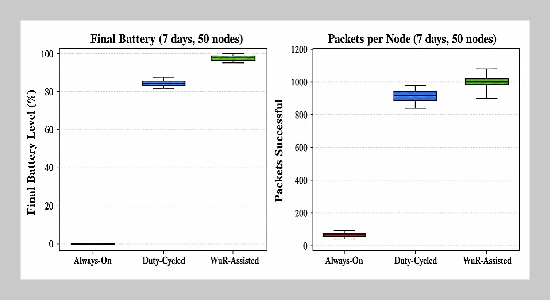
Baseline network lifetime and throughput distributions
Copyright The Author(s). This is an open access article distributed under the terms of the Creative Commons Attribution License (CC BY 4.0), which permits unrestricted use, distribution, and reproduction in any medium, provided the original author and source are cited.
Download Citation: BibTeX | http://dx.doi.org/10.6180/jase.202701_36.045
The deployment of long-term autonomous Internet of Things (IoT) sensor networks is constrained by the finite energy budget of battery-powered nodes. Although Synchronous Duty Cycling (SDC) is widely used to reduce idle-listening energy, its scalability is limited by synchronization overhead and packet collisions. This study quantitatively compares Wake-up Radio (WuR)-assisted communication with SDC and Always-On baselines using a discrete-event simulation framework. The model incorporates long-term battery depletion, stochastic packet generation, collision-induced packet loss, and channel loss over a 365-day horizon. Results from a simulated 50-node network show that, although SDC extends network lifetime to approximately 45 days, its packet loss increases superlinearly and reaches approximately 16% under high-density conditions because of contention within synchronized active windows. In contrast, the WuR-assisted approach maintains packet loss below 1.2% across load levels and retains 34.6% of battery capacity after one year, corresponding to a projected lifetime of more than 1.5 years[cite: 68]. With an energy cost of 30.6 mJ per successful packet, WuR achieves a 13.5-fold improvement over SDC. These results indicate that WuR-assisted communication is a more suitable architecture for scalable, latency-sensitive, and ultra-long-lived IoT deployments.
Keywords: Wake-up Radio; Internet of Things; Energy Efficiency; Network Lifetime; Simulation
- [1] A. Uzoka, E. Cadet, and P. U. Ojukwu, (2024) “The role of telecommunications in enabling Internet of Things (IoT) connectivity and applications” Comprehensive Research and Reviews in Science and Technology 2: 55-73. DOI: 10.57219/crrst.2024.2.2.0037.
- [2] S. L. Ullo and G. R. Sinha, (2020) “Advances in smart environment monitoring systems using iot and sensors” Sensors 20: 3113. DOI: 10.3390/s20113113.
- [3] G. S. Kuaban, E. Gelenbe, T. Czachórski, P. Czekalski, and J. K. Tangka, (2023) “Modelling of the energy depletion process and battery depletion attacks for battery-powered internet of things (iot) devices” Sensors 23: 6183. DOI: 10.3390/s23136183.
- [4] J.-H. Park, Y.-J. Suh, D. Kim, H. Lee, H. Ahn, and Y. D. Park, (2025) “MILD: Minimizing idle listening energy consumption via down-clocking for energy-efficient WI-fi communications” Sensors 25: 1155. DOI: 10.3390/s25041155.
- [5] S. M. Vali, (2024) “Enhancing coverage and efficiency in wireless sensor networks: A review of optimization techniques” Advances in Engineering and Intelligence Systems 3: 39-52. DOI: 10.22034/aeis.2024.472891.1212.
- [6] F. Amin, R. Abbasi, S. Khan, and M. A. Abid, (2022) “An overview of medium access control and radio duty cycling protocols for internet of things” Electronics 11: 3873. DOI: 10.3390/electronics11233873.
- [7] B. Rana and Y. Singh. “Duty-cycling techniques in IoT: Energy-efficiency perspective”. In: Springer, 2022, 505-512. DOI: 10.1007/978-981-16-8248-3_42.
- [8] S. Chen, X. Yu, and X. Huang, (2025) “Wake-up receivers: A review of architectures analysis, design techniques, theories and frontiers” Journal of Low Power Electronics and Applications 15: 55. DOI: 10.3390/jlpea15040055.
- [9] R. Sanchez-Vital, C. Gomez, and E. Garcia-Villegas, (2024) “Exploring the boundaries of energy-efficient Wireless Mesh Networks with IEEE 802.11 ba” Internet of Things 28: 101366. DOI: 10.1016/j.iot.2024.101366.
- [10] S. L. Shah, Z. H. Abbas, G. Abbas, and N. H. Mahmood, (2025) “Energy-efficient and reliable data collection in receiver-initiated wake-up radio enabled IoT networks” Computer Networks: 111548. DOI: 10.1016/j.comnet.2025.111548.
- [11] D. Liu, Z. Cao, H. Jiang, S. Zhou, Z. Xiao, and F. Zeng, (2022) “Concurrent low-power listening: a new design paradigm for duty-cycling communication” ACM Transactions on Sensor Networks 19: 1-24. DOI: 10.1145/3517013.
- [12] M. A. Spohn, C. M. Ranieri, A. R. da Silva, and J. Ueyama, (2025) “A systematic review on wake-up radios applied to wireless sensor networks” Journal of Computer Science 21: 566-583. DOI: 10.3844/jcssp.2025.566.583.
- [13] S. Wang, T. J. Odelberg, P. W. Crary, M. P. Obery, and D. D. Wentzloff, (2025) “Low-power wake-up receivers for resilient cellular Internet of Things” Information 16: 43. DOI: 10.3390/info16010043.
- [14] L. Schulthess, S. Cortesi, and M. Magno. “WakeMod: A 6.9 µW Wake-Up Radio Module with-72.6 dBm Sensitivity for On-Demand IoT”. In: 2025 10th International Workshop on Advances in Sensors and Interfaces (IWASI). IEEE, 2025, 1-6. DOI: 10.1109/IWASI66786.2025.11122000.
- [15] R. Ding and W. Tatinian, (2025) “Hierarchical scalable models of semi-active wake-up radio for wireless sensor network simulations”: DOI: 10.36227/techrxiv.174495475.51279417/v1.
- [16] S. M. S. Panga and S. S. Borkotoky. “Leveraging wake-up radios in UAV-Aided LoRa networks: Some preliminary results on a random-access scheme”. In: 2023 17th International Conference on Telecommunications (ConTEL). IEEE, 2023, 1-7. DOI: 10.1109/ConTEL58387.2023.10199009.
- [17] S. L. Shah, Z. H. Abbas, G. Abbas, F. Muhammad, A. Hussien, and T. Baker, (2023) “An innovative clustering hierarchical protocol for data collection from remote wireless sensor networks based internet of things applications” Sensors 23: 5728. DOI: 10.3390/s23125728.
- [18] S. Mosavat, J. Göpfert, B.-C. Renner, P. J. Marrón, and M. Zella, (2025) “Cato: Wake-up receiver-based communication for batteryless devices” Sensors 25: 6813. DOI: 10.3390/s25226813.
- [19] G. Leenders, G. Callebaut, G. Ottoy, L. V. der Perre, and L. D. Strycker, (2023) “An energy-efficient LoRa multi-hop protocol through preamble sampling for remote sensing” Sensors 23: 4994. DOI: 10.3390/s23114994.
- [20] S. Hong, F. Yao, F. Zhang, Y. Ding, and S.-H. Yang, (2023) “LPWC: Long preamble wake-up communication protocol for a LoRa network” Internet of Things 22: 100787. DOI: 10.1016/j.iot.2023.100787.
- [21] A. A. Deshpande, F. Chiariotti, and A. Zanella. “Energy-efficient internet of things monitoring with content-based wake-up radio”. In: 2024 IEEE 35th International Symposium on Personal, Indoor and Mobile Radio Communications (PIMRC). IEEE, 2024, 1-6. DOI: 10.1109/PIMRC59610.2024.10817209.
- [22] C. Rup and E. Bajic, (2024) “Green and sustainable Industrial Internet of Things systems leveraging wake-up radio to enable on-demand IoT communication” Sustainability 16: 1160. DOI: 10.3390/su16031160.
- [23] M. Ghribi and A. Meddeb. “Performance evaluation of collision avoidance techniques using wake-up radio in WSNs”. In: 2020 International Conference on Software, Telecommunications and Computer Networks (SoftCOM). IEEE, 2020, 1-6. DOI: 10.23919/SoftCOM50211.2020.9238258.
- [24] Y. Luo and L. Pu, (2021) “WUR-TS: Semi-passive wake-up radio receiver based time synchronization method for energy harvesting wireless networks” IEEE Transactions on Mobile Computing 21: 4172-4186. DOI: 10.1109/TMC.2021.3064374.