




Huifang Xiong1,2 and Zhiming Huang3
1School of Information Engineering, Jiangxi Vocational and Technical College of Communications, Nanchang 330013, Jiangxi, China
2Key Laboratory of Traffic Incident Intelligent Monitoring of Jiangxi Education Institutes, Nanchang 330013, Jiangxi, China
3School of Design and Art, Jiangxi University of Finance and Economics, Nanchang 330013, Jiangxi, China
Received: August 24, 2026
Accepted: September 26, 2026
Publication Date: October 26, 2026
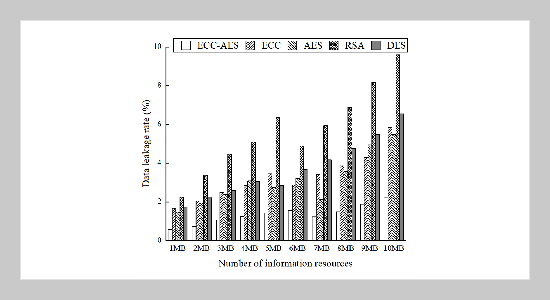
Comparison of data leakage rates for information resource management using different encryption algorithms
Copyright The Author(s). This is an open access article distributed under the terms of the Creative Commons Attribution License (CC BY 4.0), which permits unrestricted use, distribution, and reproduction in any medium, provided the original author and source are cited.
Download Citation: BibTeX | http://dx.doi.org/10.6180/jase.202701_36.042
Research on management of information resources in network conditions reveals important issues. One of the main problems is the risk of possible data leakage or alteration during transmission. Besides, basic authentication methods offer low protection. To eliminate the above difficulties, the author suggests a secure enhanced management system and suggests that ECC-AES hybrid encryption technology be adopted. In the ECC-AES encryption strategy, Elliptic Curve Cryptography is utilized to obtain public keys for quick key generation with ECC while Advanced Encryption Standard is used for high-speed symmetric encryption and thus ensures data safety both during transmission and storage. Experimental results demonstrate that, when encrypting 10 MB of data, this algorithm achieves a data leakage rate of 2.24% with an encryption time of 176 ms. This mechanism effectively mitigates common network threats and provides a reliable security safeguard for information resource management.
Keywords: Computer Network Environment, Information Resource Management, Security Mechanism, Elliptic Curve Cryptography, Advanced Encryption Standard, Hybrid Encryption
- [1] M. Ghobaei-Arani, A. Souri, and A. A. Rahmanian, (2019) “Resource Management Approaches in Fog Computing: A Comprehensive Review” Journal of Grid Computing 18(1): 1-42. DOI: 10.1007/s10723-019-09491-1.
- [2] P. Zhang, C. Wang, C. Jiang, N. Kumar, and Q. Lu, (2022) “Resource Management and Security Scheme of ICPSs and loT Based on VNE Algorithm” IEEE Internet of Things Journal 9(22): 22071-22080. DOI: 10.1109/JIOT.2021.3068158.
- [3] S. Hashemi and M. Zarei, (2020) “Internet of Things Backdoors: Resource Management Issues, Security Challenges, and Detection Methods” Transactions on Emerging Telecommunications Technologies 32(2): e4142. DOI: 10.1002/ett.4142.
- [4] L. Chen, (2022) “Research on Data Encryption Technology in Computer Network Information Security” Engineering Science Research and Application 3(4): 97-99. DOI: 10.37155/2717-5316-0304-35.
- [5] G. Yu, (2020) “Research on Computer Network Information Security Based on Improved Machine Learning” Journal of Intelligent & Fuzzy Systems 40(4): 6889-6900. DOI: 10.3233/JIFS-189520.
- [6] M. Du, (2020) “Application of Information Communication Network Security Management and Control Based on Big Data Technology” International Journal of Communication Systems 35(5): e4643. DOI: 10.1002/dac.4643.
- [7] I. De et al., (2024) “Implementing Multi-Factor Authentication (MFA) for Robust Network Access Security” Journal of Discrete Mathematical Sciences and Cryptography 27(2-B): 821-832. DOI: 10.47974/JDMSC-1958.