

Received: August 30, 2026
Accepted: October 10, 2026
Publication Date: October 26, 2026
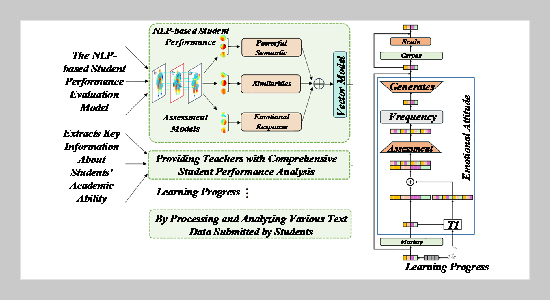
Student performance assessment and feedback diagram based on NLP
Copyright The Author(s). This is an open access article distributed under the terms of the Creative Commons Attribution License (CC BY 4.0), which permits unrestricted use, distribution, and reproduction in any medium, provided the original author and source are cited.
Download Citation: BibTeX | http://dx.doi.org/10.6180/jase.202701_36.037
Traditional teaching feedback and student assessment methods often struggle to provide timely, personalized, and comprehensive evaluations in large-scale digital learning environments. To address this core challenge, this study proposes an intelligent teaching feedback and student performance assessment framework based on natural language processing (NLP) and multimodal learning analytics. The framework integrates textual assignments, online discussions, behavioral records, and emotional information to construct a comprehensive learner model. By combining semantic analysis, sentiment analysis, and multimodal data fusion, the proposed approach enables automated performance evaluation and personalized feedback generation. Experimental results from a 16-week controlled trial with 346 students demonstrate that the proposed framework improves student engagement by 88.65%, increases knowledge retention by 65.9%, and achieves a personalized feedback satisfaction rate of 91.3%. In addition, multimodal data fusion lifts comprehensive assessment accuracy from 72% (single-modal text analysis) to 89%, and students’ final exam scores improve by 15% compared with the pre-intervention baseline. These findings demonstrate the effectiveness of the proposed framework in supporting intelligent educational assessment, personalized learning, and data-driven instructional decision-making.
Keywords: Natural Language Processing; Multimodal Learning Analytics; Automated Feedback; Student Performance Assessment; Personalized Learning
- [1] A. Abdi, G. Sedrakyan, B. Veldkamp, J. van Hillegersberg, and S. M. van den Berg, (2023) “Students feedback analysis model using deep learning-based method and linguistic knowledge for intelligent educational systems” Soft Computing 27(19): 14073-14094. DOI: 10.1007/s00500-023-07926-2.
- [2] M. Altamirano, P. Uribe, D. Schlotterbeck, A. Jimenez, R. Araya, J. Van der Molen Moris, and D. Caballero, (2022) “Unsupervised characterization of lessons according to temporal patterns of teacher talk via topic modeling” Neurocomputing 484: 211-222. DOI: https://api.semanticscholar.org/CorpusID:243789194.
- [3] O. Bonaventure, Q. De Coninck, F. Duchêne, A. Gego, M. Jadin, F. Michel, M. Piraux, C. Poncin, and O. Tilmans, (2020) “Open educational resources for computer networking” ACM SIGCOMM Computer Communication Review 50(3): 38-45. DOI: https://dl.acm.org/doi/10.1145/3411740.3411746.
- [4] K. Brassinne, M. Reynders, K. Coninx, and W. Guedens, (2020) “Developing and implementing GAPC, a gamification project in chemistry, toward a remote active student-centered chemistry course bridging the gap between precollege and undergraduate education” Journal of Chemical Education 97(8): 2147-2152. DOI: 10.1021/acs.jchemed.9600986.
- [5] L. Brkić, I. Mekterović, M. Fertalj, and D. Mekterović, (2024) “Peer assessment methodology of open-ended assignments: Insights from a two-year case study within a university course using novel open source system” Computers & education 213: 105001. DOI: 10.1016/j.compedu.2024.105001.
- [6] B. P. Cipriano, N. Fachada, and P. Alves, (2022) “Drop Project: An automatic assessment tool for programming assignments” SoftwareX 18: 101079. DOI: 10.1016/j.softx.2022.101079.
- [7] Y. Copur-Gencturk, J. Li, A. S. Cohen, and C. H. Orrill, (2024) “The impact of an interactive, personalized computer-based teacher professional development program on student performance: A randomized controlled trial” Computers & education 210: 104963. DOI: 10.1016/j.compedu.2023.104963.
- [8] P. M. Davies, R. J. Passonneau, S. Muresan, and Y. Gao, (2021) “Analytical techniques for developing argumentative writing in STEM: A pilot study” IEEE Transactions on Education 65(3): 373-383. DOI: 10.1109/TE.2021.3116202.
- [9] G. Deeva, D. Bogdanova, E. Serral, M. Snoeck, and J. De Weerdt, (2021) “A review of automated feedback systems for learners: Classification framework, challenges and opportunities” Computers & Education 162: 104094. DOI: 10.1016/j.compedu.2020.104094.
- [10] A. J. Dood, F. M. Watts, M. C. Connor, and G. V. Shultz, (2024) “Automated text analysis of organic chemistry students’ written hypotheses” Journal of Chemical Education 101(3): 807-818. DOI: 10.1021/acs.jchemed.3c00757.
- [11] C. Eitemüller, F. Trauten, M. Striewe, and M. Walpuski, (2023) “Digitalization of multistep chemistry exercises with automated formative feedback” Journal of Science Education and Technology 32(3): 453-467. DOI: 10.1007/s10956-023-10043-2.
- [12] R. Ferreira, M. Canesche, P. Jamieson, O. P. V. Neto, and J. A. Nacif, (2024) “Examples and tutorials on using Google Colab and Gradio to create online interactive student-learning modules” Computer Applications in Engineering Education 32(4): e22729. DOI: 10.1002/cae.22729.
- [13] M. Giannakos, R. Azevedo, P. Brusilovsky, M. Cukurova, Y. Dimitriadis, D. Hernandez-Leo, S. Järvelä, M. Mavrikis, and B. Rienties, (2025) “The promise and challenges of generative AI in education” Behaviour & Information Technology 44(11): 2518-2544. DOI: 10.1080/0144929X.2024.2394886.
- [14] D. M. Hall, I. Čustović, R. Sriram, and Q. Chen, (2022) “Teaching generative construction scheduling: Proposed curriculum design and analysis of student learning for the Tri-Constraint Method” Advanced Engineering Informatics 51: 101455. DOI: 10.1016/j.aei.2021.101455.
- [15] H. Khalid and M. Aslam, (2024) “Automating the evaluation of urdu handwriting for novice writers with localized feedback” IEEE Access 12: 70357-70376. DOI: 10.1109/ACCESS.2024.3389748.
- [16] G. A. Bannor, S. K. Boadu, and Y. D. Arthur, (2023) “Effects of teaching quality, teaching competence, and mathematics connection on mathematics achievement motivation among senior high school students in Ghana” Matrix Science Mathematic 7(2): 46-51. DOI: 10.26480/msmk.02.2023.63.68.
- [17] R. Lankau, (2024) “Algorithmus und Avatar im Klassenzimmer” Monatsschrift Kinderheilkunde 172(10): 865-871. DOI: 10.1007/s00112-024-02005-8.
- [18] J. J. Lopez-Jimenez, J. A. Garcia-Berna, A. Toval, J. L. Fernandez-Aleman, and A. Idri, (2023) “Automated intelligent feedback based learning in a software development project management course” Int J Eng Educ 39(4): 949-960.
- [19] K. Masood, M. A. Khan, U. Saeed, M. A. Al Ghamdi, M. Asif, and M. Arfan, (2022) “Semantic analysis to identify students’ feedback” The Computer Journal 65(4): 918-925. DOI: 10.1093/comjnl/bxaa130.
- [20] R. Nakamoto, B. Flanagan, Y. Dai, T. Yamauchi, K. Takami, and H. Ogata, (2023) “Enhancing self-explanation learning through a real-time feedback system: An empirical evaluation study” Sustainability 15(21): 15577. DOI: 10.3390/su152115577.
- [21] R. Nawaz, Q. Sun, M. Shardlow, G. Kontonatsios, N. R. Aljohani, A. Visvizi, and S.-U. Hassan, (2022) “Leveraging AI and machine learning for national student survey: actionable insights from textual feedback to enhance quality of teaching and learning in UK’s higher education” Applied Sciences 12(1): 514. DOI: 10.3390/app12010514.
- [22] H. Park and Y. Kim, (2020) “Clik: Cloud-based linux kernel practice environment and judgment system” Computer Applications in Engineering Education 28(5): 1137-1153. DOI: 10.1002/cae.22289.
- [23] N. J. Patterson, (2020) “Machine learning driven interpretation of computational fluid dynamics simulations to develop student intuition” Computer Applications in Engineering Education 28(3): 490-496. DOI: 10.1002/cae.22216.
- [24] A. Radecki and T. Rybicki, (2024) “Comparison of sentiment analysis methods used to investigate the quality of teaching aids based on virtual simulators of embedded systems” Electronics 13(10): 1811. DOI: 10.3390/electronics13101811.
- [25] R. Ren, J. Zhang, and Y. Jiang, (2021) “New automated activity-on-node calculation grading method for construction management education innovation” Journal of Civil Engineering Education 147(3): 04021004. DOI: 10.1061/(ASCE)EI.2643-9115.0000043.
- [26] J. Ruiz, E. S. Asensio, and M. Snoeck, (2020) “Learning UI functional design principles through simulation with feedback” IEEE Transactions on Learning Technologies 13(4): 833-846. DOI: 10.1109/TLT.2020.3028596.